

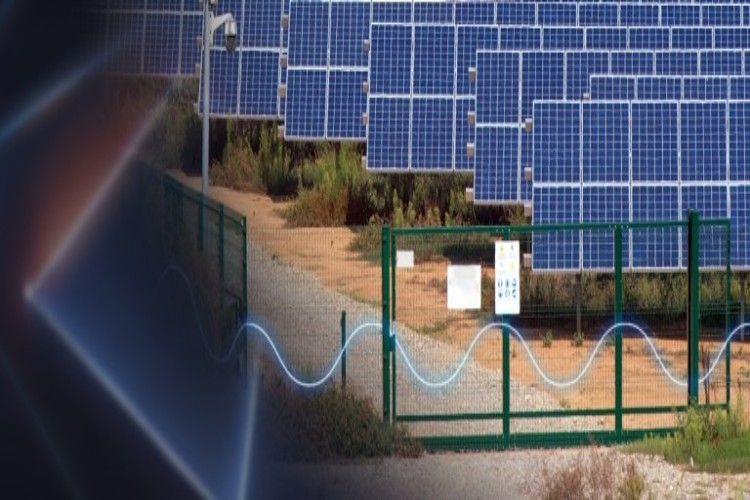
Providing perimeter security for very large and often remote solar farms has typically been both extremely challenging and very expensive. This blog looks at a new multi-layered protection model which uses fiber-cables to reduce the infrastructure burden, improve accuracy and save costs.
A solar farm (also known as a solar park or photovoltaic power station) is a large-scale deployment of solar panels designed to generate electricity for the grid. Unlike residential solar setups, solar farms span vast areas of open land — a 100 MW installation alone can cover up to 400 acres — housing thousands of solar panels, inverters, and extensive copper cabling networks. These facilities are among the most valuable assets in the energy sector, yet they are often located in remote areas, unattended after dark, with no lighting and no on-site staff.
Theft, vandalism, and unauthorized access are real and growing risks. Across Europe, an estimated 5,000 major solar thefts occur annually. In the UK alone, at least 70 theft incidents were recorded against solar farms in just the first eight months of 2024, with more than 20% of incidents involving the theft of over 20 kilometers of copper cable. The environment itself — remote, dark, full of wildlife, exposed to harsh weather — makes effective solar farm perimeter security exceptionally difficult.
Why do traditional security systems fail at solar farms?
The most common approach to solar park security systems includes infrared beams, electric fences, and dense cameras along the fence line. On paper, this covers the basics. In practice, however, each technology brings specific weaknesses that represent common solar farm security mistakes.
For example, infrared beams and electric fences may provide zone-based detection, but the coverage tends to be discontinuous. Corners, terrain dips, and gate transitions create gaps that a determined intruder will find. They also generate frequent false alarms from high winds and wildlife, and cannot distinguish a fox from a person.
When false alarms occur, many security cameras used in solar farm security installations may theoretically be able to address the visual verification problem, but in practice, this typically comes at enormous infrastructure cost. Every camera along the fence line, after all, needs a pole, a power connection, and a network feed. Just a 500-meter perimeter typically needs 8 to 10 cameras to achieve visual coverage. And besides, at night, without supplemental lighting, most cameras still struggle to provide actionable footage.
The result is high deployment cost, persistent false alarm noise, and coverage gaps. This, in turn, drains patrol resources while leaving real incidents under-responded.
How to secure a solar farm perimeter?
Because of issues such as these, solar farm perimeter security solutions are evolving. It is now widely recognized that deploying a single static system and hoping it covers everything is not sufficient and, as a result, we are seeing a shift toward a multi-layered, active protection model, with optical fiber acting as the primary sensor along the fence line and cameras functioning as the verifier.
The innovative approach effectively creates two different, yet complimentary, layers of protection:
- First layer (detection): Fiber-optic sensing covers every meter of the perimeter continuously
- Second layer (verification): Cameras activate only when and where the fiber reports a disturbance
So, should someone climb, cut, or cross the fence, the cable detects the vibration and pinpoints the location to within the nearest 5 meters. It does this in complete darkness, in the rain, in the wind, and at any time of day or night. Because the fiber runs continuously along the entire fence line, there are no gaps, no ‘dark’ zones, and no blind spots.
With cameras acting as the second layer, there is no need to saturate the perimeter with a camera every 50 meters. A smaller number of PTZ or thermal cameras automatically pivot to investigate disturbances reported by the fiber system. This approach focuses on verifying alerts from the detection layer, eliminating the inefficiency of trying to watch everything at once.
How does fiber-optic sensing reduce false alarms?
Detecting a vibration on the fence is only useful if the system can tell whether it matters. This is where most basic vibration sensors fall short—they detect everything and filter nothing. To truly improve solar farm security, the technology must be smarter. Hikvision’s fiber-optic vibration sensing system addresses this. The fiber processor uses Distributed Acoustic Sensing (HIK-DAS) acoustic recognition and AI algorithms to analyze vibration patterns at the sensing level, rejecting false alarms from the environment, such as wind, rain, snow, and small animals.
Simultaneously, a linked PTZ camera slews automatically to the precise alarm location. It captures images and live video, and an AI-powered NVR analyzes the video to confirm. If the event is verified as a genuine intrusion, a network speaker near that point issues an immediate voice warning, which is often enough to deter opportunistic intruders on its own. The control room receives an alert with live camera feed and precise location already attached.
The practical effect of this multi-layered protection model is that operators stop receiving dozens of nightly alerts for irrelevant events and start receiving a smaller number of qualified alerts that rightly demand their attention. Response, therefore, becomes faster and significantly more decisive.
How much can this reduce deployment costs?
These security improvements bring considerable cost savings, thanks to an infrastructure that requires fewer cameras and a detection layer which requires no independent power supply.
In a camera-first setup, cameras serve as the detection layer, requiring enough units to cover the entire perimeter with overlapping fields of view. This drives up pole count, power infrastructure, and network cabling. When fiber-optic sensing perimeter security products handle detection instead, cameras shift to verification. This means that far fewer PTZ or thermal cameras are needed. Each eliminated camera removes a pole, power feed, network connection, and ongoing maintenance that is inevitably required.
The fiber itself is entirely passive. This means that no power or network infrastructure is needed along the fence. For a perimeter measured in kilometers, this not only means simple installation, but also translates into meaningfully lower energy consumption and carbon emissions over the system’s lifetime. It’s also fire-resistant, electrically insulated, and free from electromagnetic interference, ensuring the detection stability even in remote environments.
On the operational side, the passive front-end cable has no active components to fail or maintain. And fewer false alarms mean less time spent on unnecessary responses and lower alarm handling costs. Taken together, the total cost of a fiber-plus-camera approach is substantially lower than a camera-grid setup—without any reduction in coverage or detection quality.
What Hikvision equipment is used to create a multi-layered solar farm perimeter security solution?
- Fiber-optic processors handle detection along the fence line, available in 1 km, 2 km, and 5 km configurations with meter-level positioning accuracy.
- PTZ cameras provide visual verification at the point of alert—with 40x optical zoom and strong low-light performance, or thermal imaging for complete all-weather, day-and-night capability.
- DeepinMind NVR provides the AI-powered video analysis layer that handles the second stage of false alarm filtering.
- HikCentral Professional brings everything together in one management platform—fiber-optic sensing, cameras, speakers, NVR, alarms, and access control—with real-time alerts, live view, and remote access.
Is this approach right for other energy sites too?
Solar parks are the clearest example of this security challenge, but they’re not the only one. Substations, wind farms, and oil and gas facilities share many of the same characteristics: high asset value, remote locations, extended perimeters, and environments that make conventional security difficult.
The same fiber-first approach applies wherever dense camera deployment is cost-prohibitive, wildlife false alarms are persistent, and reliable night-time, all-weather performance is essential. Solar farm security fences enhanced with fiber sensing deliver consistent protection across these demanding environments.