

Urja Daily
No Result
View All Result
  • News
  • Renewable
    • Solar
    • Rooftop
    • Floating Solar
    • Module
    • Wind
    • Hydrogen
    • Biomass
    • Tenders
    • Sustainibility
  • Storage
  • E-Mobility
  • Battery
  • Smart City
  • Power
    • Smart Grid
    • Microgrid
    • Off-Grid
  • Editor’s Pick
    • Articles
    • In Talks
    • E-MAG
    • Market Research
  • On-demand Webinars
  • More
    • Events
    • Contact Us
    • Subscribe
  • News
  • Renewable
    • Solar
    • Rooftop
    • Floating Solar
    • Module
    • Wind
    • Hydrogen
    • Biomass
    • Tenders
    • Sustainibility
  • Storage
  • E-Mobility
  • Battery
  • Smart City
  • Power
    • Smart Grid
    • Microgrid
    • Off-Grid
  • Editor’s Pick
    • Articles
    • In Talks
    • E-MAG
    • Market Research
  • On-demand Webinars
  • More
    • Events
    • Contact Us
    • Subscribe
No Result
View All Result
Urja Daily
No Result
View All Result
Home Editor's Pick Articles

STPOWER Studio: 3 new topologies for accurate electro-thermal simulation on STPOWER devices

Urja Daily by Urja Daily
October 15, 2024
in Articles
Reading Time: 4 mins read
0
STPOWER Studio
Share on FacebookShare on TwitterShare on Linkedin

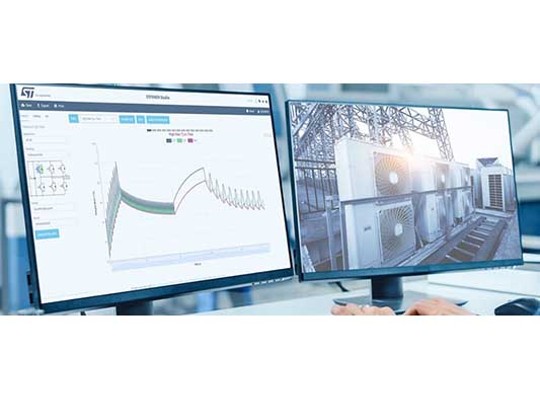
STPOWER Studio 4.0 just became available and now supports three new topologies (1-phase full bridge, 1-phase half-bridge, and 3-phase 3-level T-NPC) to cover significantly more applications. Previously, the online simulation tool only offered a 3-phase 2-level topology for motor drivers and photovoltaic inverters, which are some of the most popular use cases. Thanks to the robustness of the underlying architecture that ST recently updated and brought to the web, we are now able to build on top of the existing platform to make STPOWER Studio more versatile and assist more engineers in designing a more comprehensive range of power stages.
What is STPOWER Studio?

RELATED POSTS

The next phase of EV evolution in India

How the Digital Twin in Energy Market Leverages IIoT for Real Time Efficiency and Emission Controls?

A unique simulator –

STPOWER Studio, a component of eDesignSuite, specializes in thermo-electrical simulations. As  eDesignSuite transitioned to HTML5 to enhance its user interface , STPOWER Studio benefited from the same underlying architecture, enabling more powerful simulations. It stands out in the industry as one of the few simulators capable of adjusting power losses according to the junction temperature at the moment of the simulation, providing a more accurate representation of real-world usage. Some competitors traditionally use a fixed value for the junction temperature, leading to over- or underestimated losses. Thanks to our dynamic junction temperature, users get more accurate results.
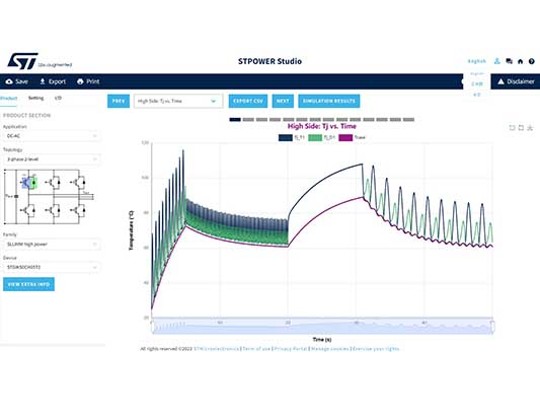
STPOWER Studio can simulate up to hundreds of seconds per step with Steady State off, which gives engineers enough time to see how their power stage would ramp up and stabilize. They can also run simulations with or without heat sinks, which will help them anticipate form factor and heat dissipation requirements. Users simply select the ST family of devices (ACEPACK or SLLIMM) and the component they will use in their design. Under Setting, designers can tweak the gate resistor values and some thermal properties. Finally, under I/O, users can adjust their mission profile by defining various steps with values such as the output power or the current level, among other things.

A design assistant – Let’s take the example of an engineer designing a large motor driver for industrial applications, an inverter for a photovoltaic converter, or an HVAC system. In our example, the motor would use a DC Link voltage of 650 V and an RMS Phase Current of 10 A. For a quick simulation, users can use Steady State ON to analyze performances after reaching a thermal steady state. Then, by choosing Steady State OFF, users can set the duration of the simulation step for a more detailed analysis. Obviously, it will require more computing power on the server and take longer to generate. However, ST reduced rendering times by a factor of 10 over the last releases of STPOWER Studio.

What’s new in STPOWER Studio 4.0?

1-phase full bridge – The new version of STPOWER Studio features three new topologies. The 1-phase full bridge will fit single-phase photovoltaic converters or uninterruptible power supplies. As more residential homes and buildings increasingly rely on renewable energy, the ability to store solar energy in batteries is increasingly in demand. Hence, we wanted to ensure that engineers could more rapidly test their designs and reduce their time to market. Similarly, engineers working on an uninterruptible power supply can very quickly anticipate what their design will look like if they adopt an STPOWER device.

1 phase half bridge – Since STPOWER Studio supports a one-phase full bridge topology, it made sense to offer a one-phase half-bridge. This structure is common in DC-AC conversion for smaller solar inverters or motor drivers. Engineers also combine single-phase half-bridge topologies when designing a one-phase to three-phase converter. In fact, while the current version of the simulator focuses solely on DC-AC systems, we are evaluating the addition of DC-DC applications and will update this blog post with more information as they become available.

3-phase 3-level T-NPC – Finally, the 3-phase 3-level T-NPC (T-type Neutral Point Clamped) is increasingly popular because it improves overall efficiency by reducing switching losses thanks to a mechanism that clamps the input voltage at its halfway point. Consequently, only half of the input voltage is applied to each switch, which reduces switching losses. This creative approach greatly benefits high-power systems, such as photovoltaic inverters, power factor inverters, or motor drivers, while ensuring the overall design remains relatively small.


Tags: eDesignSuiteInvertersPowereSTMicroelectronicsSTPOWER Studio
ShareTweetShare
Urja Daily

Urja Daily

Related Posts

Nagesh Basvanhalli

The next phase of EV evolution in India

by Palak
June 29, 2026
0

India has largely answered one important question: can electric vehicles scale in a price-sensitive and highly competitive mobility market? The...

Digital twin

How the Digital Twin in Energy Market Leverages IIoT for Real Time Efficiency and Emission Controls?

by Palak
June 26, 2026
0

Digital twins—highfidelity virtual replicas of physical assets and processes—are reshaping energy operations by enabling realtime simulation, predictive control and emissionsaware...

GOLDBECK SOLAR

Sustainable Solar Infrastructure: Designing for Longevity and Circularity

by Palak
June 17, 2026
0

As of March 2026, India's installed solar capacity stands at over 150 GW — a number that places this country...

Overcoming Transmission Bottlenecks The Role of the Dynamic Line Rating IoT Market in Wind Energy Grid Integration

Overcoming Transmission Bottlenecks: The Role of the Dynamic Line Rating IoT Market in Wind Energy Grid Integration

by Palak
June 15, 2026
0

As India and other markets accelerate wind capacity additions, transmission bottlenecks increasingly limit how much renewable energy reaches demand centres....

EV Charging

Accelerating India’s E-Mobility Infrastructure through the Solar Powered EV Charger Market Evolution

by Palak
June 15, 2026
0

IntroductionIndia’s emobility transition depends as much on charging infrastructure as on vehicle adoption. Solarpowered EV chargers—combining photovoltaic (PV) generation, battery...

Next Post
Metis Engineering

Metis Engineering Unveils Advanced Hydrogen Leak Detection Sensor for Enhanced Safety in Energy Storage Systems

Rapido Auto

Rapido Pioneers Sustainable Mobility with Bangalore's Largest EV Auto Fleet

Leave a Reply Cancel reply

Your email address will not be published. Required fields are marked *

RECOMMENDED

Automation Expo 2026 Invite

WIKA India to Showcase Intelligent Instrumentation and IIoT Solutions at Automation Expo 2026 Mumbai, Maharashtra

July 14, 2026
POWERGRID

POWERGRID secures LoI for ISTS augmentation project under TBCB

July 14, 2026

MOST VIEWED

  • Solar

    When the Sun Began Paying the Electricity Bills: The Story of PM Surya Ghar Muft Bijli Yojana

    0 shares
    Share 0 Tweet 0
  • India’s Emerging Polysilicon Manufacturing Ecosystem: Opportunities and Challenges

    0 shares
    Share 0 Tweet 0
  • KP Group & PP Savani University Launches Urjanoor Scholarship

    0 shares
    Share 0 Tweet 0
  • StarlinePS Enterprises Invests ₹160 Crore in Celloraa Energy

    0 shares
    Share 0 Tweet 0
  • Xpeng Selects u‑blox F9 Centimeter-level Multi-Band GNSS Technology for P7 Smart EV

    0 shares
    Share 0 Tweet 0

WIKA India to Showcase Intelligent Instrumentation and IIoT Solutions at Automation Expo 2026 Mumbai, Maharashtra

POWERGRID secures LoI for ISTS augmentation project under TBCB

JSW Energy arm bags Rs 4.4 billion BESS order from Bondada Engineering

KP Green Engineering Limited Secures ₹2.39 Billion Orders Across Multiple Business Segments

SAEL bags solar module supply order from NTPC REL

Thailand Approves $1.99 Billion Investment in AI, Data Centres and Clean Energy

Latest Magazine

© 2016 – 2025 TechZone Print Media | All Rights Reserved

  • About Us
  • Contact Us
No Result
View All Result
  • News
  • Renewable
    • Solar
    • Rooftop
    • Floating Solar
    • Module
    • Wind
    • Hydrogen
    • Biomass
    • Tenders
    • Sustainibility
  • Storage
  • E-Mobility
  • Battery
  • Smart City
  • Power
    • Smart Grid
    • Microgrid
    • Off-Grid
  • Editor’s Pick
    • Articles
    • In Talks
    • E-MAG
    • Market Research
  • On-demand Webinars
  • More
    • Events
    • Contact Us
    • Subscribe

© 2016 - 2025 TechZone Print Media | All Rights Reserved