



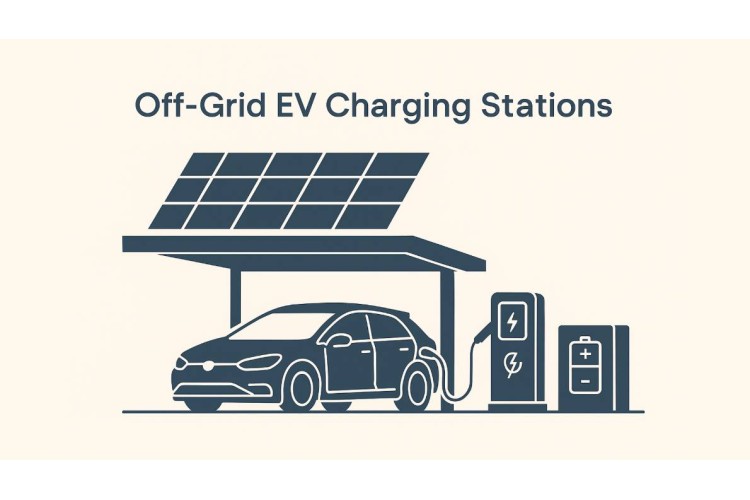
As electric vehicle ownership climbs and climate-driven power outages become more common, a quieter but fast-growing corner of the clean-energy industry is gaining attention: off-grid EV solar charging. Unlike conventional home chargers that draw electricity from the utility grid, off-grid solar EV chargers generate power directly from photovoltaic panels, store it in on-site batteries, and deliver it to a vehicle without ever touching a utility line. For rural homeowners, remote cabins, farms, overlanders, and regions with unreliable grid infrastructure, this technology is turning “charge anywhere the sun shines” from a novelty into a practical reality.
What Is an Off-Grid EV Solar Charger?
An off-grid EV solar charger is a self-contained energy system built around three core components: solar panels (typically monocrystalline for their higher energy density), a battery energy storage system to bank power for use after dark or on cloudy days, and a charge controller or inverter that manages power flow and delivers it to the vehicle at the correct voltage. Because the system operates independently of the utility grid, it requires enough generation and storage capacity to smooth out the natural variability of sunlight — a key engineering challenge that distinguishes off-grid systems from their grid-tied cousins.
These setups range from small, portable folding-panel kits designed to trickle-charge an EV during a camping trip, to substantial fixed installations capable of delivering a meaningful daily charge to a household vehicle. Some newer residential-scale units on the market pack in dual maximum-power-point-tracking (MPPT) controllers, remote monitoring over WiFi or cellular, and safety protections against overvoltage, short circuits, and overheating — features once reserved for utility-scale solar equipment.
Market Summary:
According to Research Intelo, the Global Off-Grid EV Solar Charger market size was valued at $1.2 billion in 2024 and is projected to reach $8.7 billion by 2033, expanding at a robust CAGR of 24.5% during the forecast period of 2025–2033. The principal driver fueling this substantial growth is the surging demand for sustainable and independent electric vehicle (EV) charging solutions, particularly in regions with unreliable grid infrastructure or remote locations.
Market Momentum and Growth Drivers
The broader solar charging landscape is expanding rapidly, and off-grid EV charging is riding that wave. Market research firms tracking the adjacent portable and stationary solar-charging categories point to strong double-digit annual growth, driven by a mix of consumer and infrastructure demand. Several forces are converging to push adoption higher:
Rising electricity costs and time-of-use pricing. As utilities in many markets expand time-of-use rate structures that charge more during peak demand hours, homeowners have a growing financial incentive to decouple vehicle charging from the grid altogether, rather than simply shifting it to off-peak hours.
Falling battery and solar hardware costs. Lithium-ion battery pack prices have continued their multi-year decline, dropping into roughly the $100-per-kWh range in recent reporting, while advances in cell efficiency — including passivated emitter and rear contact (PERC) architectures — have pushed panel conversion rates above 22% in consumer-grade products. Cheaper storage and more efficient panels directly lower the cost of building a capable off-grid system.
Grid resilience and energy independence. Wildfires, storms, and aging transmission infrastructure have made planned and unplanned outages a recurring concern in many regions. An off-grid solar charger offers EV owners a way to keep their vehicle charged even when the surrounding grid goes dark.
Expansion of off-grid and rural EV adoption. As EV ownership spreads beyond dense urban centers into rural and semi-rural areas where grid connections can be expensive or unreliable to extend, off-grid charging becomes less of a lifestyle choice and more of a practical necessity.
Outdoor recreation and overlanding culture. Campers, van-lifers, and overlanders represent one of the fastest-growing demand segments for portable solar charging equipment, and as EV pickups and adventure vehicles enter the market, that demand is extending into higher-wattage off-grid EV charging gear.
Supportive policy and certification frameworks. Regulatory pushes such as the EU’s renewable energy mandates are accelerating retailer demand for certified solar charging products across major European markets, a trend that is likely to ripple into North American and Asia-Pacific certification standards over time.
Market Segmentation
The off-grid EV solar charger market is generally understood along a few key dimensions:
- By capacity: Small-scale portable units (a few hundred watts) aimed at emergency and recreational use, versus larger fixed residential or commercial systems (multiple kilowatts) capable of meaningfully charging a daily-driver EV.
- By technology: Monocrystalline panels dominate for their efficiency-to-space ratio, while thin-film and flexible panels serve niche, weight-sensitive applications like rooftop tents or backpacking kits.
- By application: Residential off-grid properties, commercial and agricultural sites, emergency/disaster-response deployments, and recreational or overlanding use.
- By region: North America and Europe currently lead adoption, propelled by EV penetration and outdoor recreation culture, while Asia-Pacific is emerging as both a major manufacturing hub and a fast-growing demand center, particularly in areas with limited rural grid infrastructure.
Key Challenges
Despite the momentum, the category faces real hurdles. Charging speed remains dependent on sunlight availability and battery capacity, meaning off-grid systems generally can’t match the near-instant top-ups possible with high-power grid-tied DC fast chargers. Upfront costs — often running from a couple thousand dollars for a basic setup to well beyond that for larger dual-MPPT systems with significant battery storage — can be a barrier for cost-sensitive buyers, even as payback periods shrink alongside falling hardware costs. Component supply is also a factor: a significant share of global polysilicon and solar cell production is concentrated in a small number of countries, creating potential exposure to trade policy shifts and supply disruptions. Finally, consistent output during extended cloudy periods or winter months in high-latitude regions continues to be an engineering and user-experience challenge that manufacturers are addressing through smarter battery management and hybrid grid-solar modes.
Where the Market Is Headed
Looking ahead, a few trends stand out. Manufacturers are increasingly blurring the line between “off-grid” and “grid-tied” by offering hybrid modes that default to solar power but can draw from the grid when battery reserves run low — giving buyers flexibility without sacrificing the option of full energy independence. Bidirectional charging and vehicle-to-home (V2H) capability are also starting to intersect with off-grid solar setups, letting an EV’s battery serve as backup storage for the home itself. And as battery and panel costs continue their downward trajectory, the economics of off-grid EV charging are likely to become competitive with grid-tied home charging in an expanding range of markets, not just in remote or high-outage-risk areas.
Conclusion
Off-grid EV solar charging sits at the intersection of two powerful trends — the growth of electric vehicles and the maturing economics of residential solar and battery storage. What began as a niche solution for remote properties and outdoor enthusiasts is evolving into a credible mainstream option for energy independence, resilience against outages, and long-term charging cost savings. As hardware costs keep falling and battery technology keeps improving, the off-grid EV solar charger market is well positioned to become a meaningful and lasting segment of the broader clean-energy transition.
Source: https://researchintelo.com/report/off-grid-ev-solar-charger-market