


As of 2026, the transition toward sustainable mobility has moved beyond initial adoption into a phase of massive infrastructure scaling. The Electric Vehicle (EV) Charging Infrastructure Market is no longer a niche sector but a critical pillar of global energy and transportation systems. With global EV sales having surpassed 10 million units annually as early as 2022—representing 14% of all new car sales—the demand for a robust and reliable charging network has become the primary bottleneck for continued growth (Singh et al., 2022).
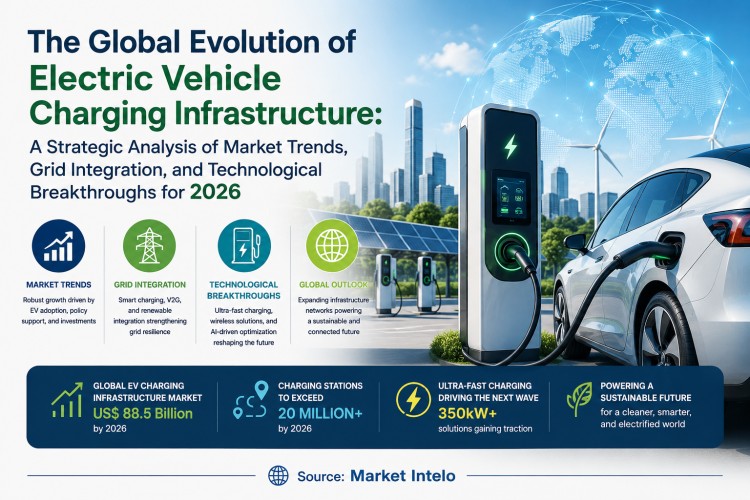
According to MarketIntelo, the Global Electric Vehicle Charging Infrastructure market size was valued at $22.5 billion in 2024, and is forecasted to hit $155.8 billion by 2033, growing at a robust CAGR of 23.7% during the forecast period
This article explores the current market dynamics, technological shifts, and regional leadership defining the landscape in 2026.
Market Drivers: Policy, Demand, and Decarbonization
The rapid expansion of the charging market is fueled by a convergence of government mandates and shifting consumer behavior. Nations like Norway have reached a milestone where over 80% of their market share is electric, supported by zero-emission zones and comprehensive nationwide charging systems (Singh et al., 2022). In the United States, federal programs have catalyzed the development of charging “corridors” to eliminate range anxiety on interstate highways.
Furthermore, the demand for EV batteries is projected to increase nearly sevenfold by 2035, a trajectory that necessitates a parallel increase in the density and power output of charging points (Singh et al., 2022). This growth is categorized into two primary streams: the expansion of public networks and the optimization of private residential systems.
Technological Transitions: Speed and Intelligence
In 2026, the industry is witnessing a shift from basic power delivery to “smart” energy management. The infrastructure is categorized into three levels:
- Level 1 and Level 2: Primarily used for residential and workplace settings, providing predictable charging over longer dwell times (Singh et al., 2022).
- DC Fast Charging (Level 3): These high-power stations (ranging from 50 kW to 350 kW) are essential for transit and highway use, where shorter connection durations are required (Ruttala et al., 2026).
Smart Charging and V2G Integration
One of the most significant trends in 2026 is the integration of Vehicle-to-Grid (V2G) technology. V2G allows for a bidirectional exchange of energy, transforming EVs into flexible storage resources. This enables vehicles to support the power grid by discharging energy during peak demand periods, thereby reducing the need for expensive “peak” power plants and supporting the integration of intermittent renewable energy sources like wind and solar (Ruttala et al., 2026).
To manage this complexity, operators are increasingly utilizing Artificial Intelligence (AI) and Machine Learning. These technologies optimize charging schedules based on real-time grid constraints and user behavior, ensuring that energy use is balanced and thermal management systems are maintained to prevent battery degradation (Ruttala et al., 2026).
Regional Market Landscapes
The global distribution of charging infrastructure remains uneven, with specific regions emerging as dominant leaders:
| Region | Market Characteristics | Primary Focus |
| China | Global Leader | Massive deployment of DC Fast Charging stations to support aggressive adoption targets (Ruttala et al., 2026). |
| Europe | Innovation Hub | Focus on cross-border interoperability and the implementation of IEC 61000 standards (Ruttala et al., 2026). |
| North America | Growing Network | Rapid expansion in states like New Hampshire, where EVs are projected to reach 20% of all vehicles by 2033 (Ruttala et al., 2026). |
While developed regions lead in volume, developing nations are beginning to explore hybrid and electric options to reduce rising fuel costs and urban pollution. However, these markets face unique challenges, including grid instability and a lack of initial policy support (Singh et al., 2022).
The Challenge of Thermal Management and Grid Load
As charging power increases—reaching megawatt levels for heavy-duty trucks—thermal management has become a critical engineering focus. High-power charging sessions generate significant heat, which can degrade battery performance and reduce the reliability of the charging station hardware. In 2026, sustainable station designs are incorporating active cooling systems and robust thermal monitoring to mitigate these risks (Ruttala et al., 2026).
Furthermore, the sudden spike in electricity demand from large fleets can strain local distribution grids. Orchestrated demand flexibility is being implemented to reduce these infrastructure costs; for instance, smart grid management could save billions in distribution investment by 2040 (Ruttala et al., 2026).
Future Outlook: 2027-2035
The roadmap for the next decade suggests a transition toward “Amenity Hubs.” Charging stations are evolving from simple plug-in points into integrated service centers that provide retail, Wi-Fi, and lounge facilities. This shift acknowledges that while DC fast charging is quick, it still requires a 15-to-20-minute dwell time.
By 2030, the global EV stock is estimated to reach 140 million units (Ruttala et al., 2026). To support this, the market must address current “soft costs,” such as permitting delays and the high capital expenditure required for ultra-fast charger installation. The integration of solid-state battery technology and autonomous “robotic” charging arms are also expected to enter the commercial pilot stage by the late 2020s.
In conclusion, the Electric Vehicle Charging Infrastructure Market is currently in its most critical growth phase. The successful integration of AI-driven smart charging, V2G capabilities, and ultra-fast hardware will determine the pace at which the global transportation sector can fully decarbonize.