

Urja Daily
No Result
View All Result
  • News
  • Renewable
    • Solar
    • Rooftop
    • Floating Solar
    • Module
    • Wind
    • Hydrogen
    • Biomass
    • Tenders
    • Sustainibility
  • Storage
  • E-Mobility
  • Battery
  • Smart City
  • Power
    • Smart Grid
    • Microgrid
    • Off-Grid
  • Editor’s Pick
    • Articles
    • In Talks
    • E-MAG
    • Market Research
  • On-demand Webinars
  • More
    • Events
    • Contact Us
    • Subscribe
  • News
  • Renewable
    • Solar
    • Rooftop
    • Floating Solar
    • Module
    • Wind
    • Hydrogen
    • Biomass
    • Tenders
    • Sustainibility
  • Storage
  • E-Mobility
  • Battery
  • Smart City
  • Power
    • Smart Grid
    • Microgrid
    • Off-Grid
  • Editor’s Pick
    • Articles
    • In Talks
    • E-MAG
    • Market Research
  • On-demand Webinars
  • More
    • Events
    • Contact Us
    • Subscribe
No Result
View All Result
Urja Daily
No Result
View All Result
Home Editor's Pick Articles

Solar in Space: The exciting endless possibilities

Urja Daily by Urja Daily
May 26, 2023
in Articles
Reading Time: 3 mins read
0
Solar in Space
Share on FacebookShare on TwitterShare on Linkedin

Solar space farms?

One of the most fascinating developments in the renewable energy sector has been the possibility of putting solar technology in space. NASA, in 1977, claimed that in the coming years space solar could completely replace fossil fuels. The study and investments were stopped citing a lack of understanding of the technology required and logistics required to pull it off.

When the world is hedging its bets on nuclear power or other terrestrial sources of energy, solar farms in space could be like a wild card and be crucial for a zero-carbon future. Such a concept, theoretically, can well last a million years. Sunlight is on average more than ten times as intense at the top of the atmosphere as it is down at the surface of the Earth.

RELATED POSTS

How the Digital Twin in Energy Market Leverages IIoT for Real Time Efficiency and Emission Controls?

Sustainable Solar Infrastructure: Designing for Longevity and Circularity

To capture this boundless energy, we can build structures that’ll orbit the sun- satellites with mirrors installed, that’ll receive the beam of sun rays, and send it to Earth. On the surface of earth, there would be antennas that’ll convert it into microwaves, and convert it into usable energy. Assembling them using automated robots would make the completion of the project swift. A solar array around the Earth’s orbit has the potential to receive more than 100 times the amount of energy every year than all of the energy that humanity will use in 2050.

 Did you know?

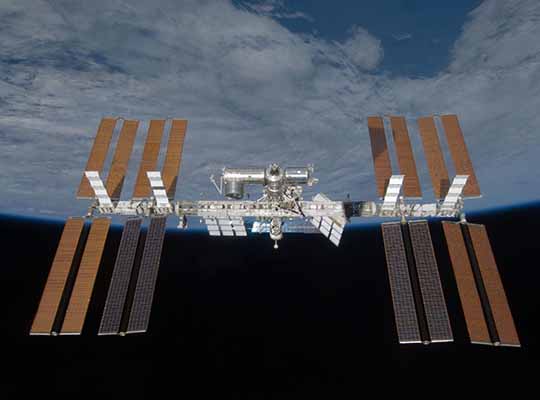
The International Space Station is run completely on solar energy. There are solar modules consisting of 262,400 solar cells spanning over 27,000 sq ft of area.

 Hindrances and possible issues

Some of the cynics of this wave of renewable energy across the world have said what makes solar extremely unreliable is the fact that the sun doesn’t always shine. 30% of the sunlight that shines on the

Earth gets reflected by the atmosphere. This limiting factor can be eliminated and negated by putting solar farms in space. But what is stopping us from embarking on this conceptualization?

The projects would be of high complexity and will require intricate planning and designing. High transport cost, damage risk because of space debris, enough research, investment, and persistence is required. Also, if there is a considerable loss in conversion, the project would not be financially viable.

These structures need to be built on a large scale to make the unit economics much more sensible, the fixed cost invested need to be recovered. We would have to build kilometres of solar arrays to cost-justify such a mammoth project.

The real question is would these projects be a private or a public undertaking. The likelihood of the government giving rights to private companies in such sensitive sectors is highly unlikely. Even the aerospace industry in India was opened for private players only a few years back.

From the conceptual stage to reality

But the upside is so promising- satellite-based solar panels can capture and transmit much more energy than their terrestrial counterparts. Typical communications satellite solar panels have a mass per kilowatt of about 20 kilograms, so with these current launch costs, it would amount to $10,000 per kilogram. Only developed countries can allot such huge sums of money to this side of energy exploration. SOLARIS, a three-year study issued by the UK government, has been formed with the goal of finding a source of clean and secure energy for citizens of Europe. Other countries are also following suit.

Before advancing into this endeavour, we need to do a thorough cost-benefit analysis. We need to ask ourselves, the benefits that we’ll reap, would it outweigh the costs that would be incurred. A perpetual source of undying energy has only been part of science fiction stories hitherto. If we actually make one, it would be a monumental feat, a remarkable milestone in human history.


About the Author :

Sharad Gupta, VP - Solar Design and Engineering at Oorjan Cleantech

Sharad Gupta

The Author is the Vice President – Solar Design and Engineering (VP – Solar Design and Engineering) of  Oorjan Cleantech (https://www.oorjan.com). Oorjan is one of India’s fastest-growing solar companies, co-founded by IITians and ex-bankers.


Tags: Renewable Energysolarsolar technology
ShareTweetShare
Urja Daily

Urja Daily

Related Posts

Digital twin

How the Digital Twin in Energy Market Leverages IIoT for Real Time Efficiency and Emission Controls?

by Palak
June 26, 2026
0

Digital twins—highfidelity virtual replicas of physical assets and processes—are reshaping energy operations by enabling realtime simulation, predictive control and emissionsaware...

GOLDBECK SOLAR

Sustainable Solar Infrastructure: Designing for Longevity and Circularity

by Palak
June 17, 2026
0

As of March 2026, India's installed solar capacity stands at over 150 GW — a number that places this country...

Overcoming Transmission Bottlenecks The Role of the Dynamic Line Rating IoT Market in Wind Energy Grid Integration

Overcoming Transmission Bottlenecks: The Role of the Dynamic Line Rating IoT Market in Wind Energy Grid Integration

by Palak
June 15, 2026
0

As India and other markets accelerate wind capacity additions, transmission bottlenecks increasingly limit how much renewable energy reaches demand centres....

EV Charging

Accelerating India’s E-Mobility Infrastructure through the Solar Powered EV Charger Market Evolution

by Palak
June 15, 2026
0

IntroductionIndia’s emobility transition depends as much on charging infrastructure as on vehicle adoption. Solarpowered EV chargers—combining photovoltaic (PV) generation, battery...

biogas upgrading system market

Navigating Evolving Grid Frameworks: Insights from the Global Biogas Upgrading System Market

by Palak
June 15, 2026
0

The global biogas upgrading system market is entering a more mature and strategic phase. What was once seen mainly as...

Next Post
JA Solar DEEP BLUE 4.0

JA Solar Releases its Next Generation Module DeepBlue 4.0 Pro

DELTA-2-Max

EcoFlow Launched Ultimate New Solar Generator

Leave a Reply Cancel reply

Your email address will not be published. Required fields are marked *

RECOMMENDED

Evaluating Circular Economy Potential A Global Bio-CNG Market Research

Evaluating Circular Economy Potential: A Global Bio-CNG Market Research Report 2033 Analysis

June 26, 2026
Digital twin

How the Digital Twin in Energy Market Leverages IIoT for Real Time Efficiency and Emission Controls?

June 26, 2026

MOST VIEWED

  • Solar

    When the Sun Began Paying the Electricity Bills: The Story of PM Surya Ghar Muft Bijli Yojana

    0 shares
    Share 0 Tweet 0
  • India’s Emerging Polysilicon Manufacturing Ecosystem: Opportunities and Challenges

    0 shares
    Share 0 Tweet 0
  • KP Group & PP Savani University Launches Urjanoor Scholarship

    0 shares
    Share 0 Tweet 0
  • Xpeng Selects u‑blox F9 Centimeter-level Multi-Band GNSS Technology for P7 Smart EV

    0 shares
    Share 0 Tweet 0
  • How proper refurbishment can extend life of pre-owned bikes in India?

    0 shares
    Share 0 Tweet 0

Evaluating Circular Economy Potential: A Global Bio-CNG Market Research Report 2033 Analysis

How the Digital Twin in Energy Market Leverages IIoT for Real Time Efficiency and Emission Controls?

IBM, Red Hat and Palo Alto Networks Expand Project Lightwell

European Battery Business Club [EBBC] Training Platform

CEAD and Comau Transform Manufacturing with Large-Format Additive Production

Fraunhofer TechFlash: FastDry Wall-Drying Technology & European Battery Business Training Platform

Latest Magazine

© 2016 – 2025 TechZone Print Media | All Rights Reserved

  • About Us
  • Contact Us
No Result
View All Result
  • News
  • Renewable
    • Solar
    • Rooftop
    • Floating Solar
    • Module
    • Wind
    • Hydrogen
    • Biomass
    • Tenders
    • Sustainibility
  • Storage
  • E-Mobility
  • Battery
  • Smart City
  • Power
    • Smart Grid
    • Microgrid
    • Off-Grid
  • Editor’s Pick
    • Articles
    • In Talks
    • E-MAG
    • Market Research
  • On-demand Webinars
  • More
    • Events
    • Contact Us
    • Subscribe

© 2016 - 2025 TechZone Print Media | All Rights Reserved