


The global sodium-ion battery market is charging toward a new era of affordable, sodium-abundant energy storage — and the numbers tell a compelling growth story.
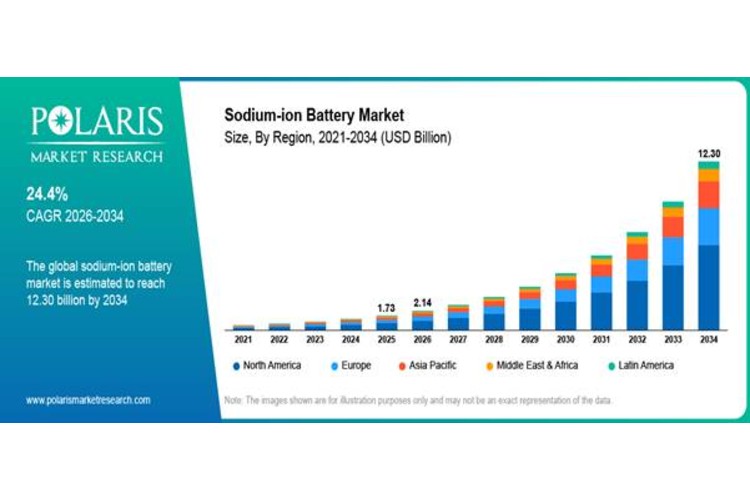
The world’s appetite for cheaper, more secure battery supply chains is fueling one of the fastest-growing corners of the energy storage industry. According to the Sodium-ion Battery Market report by Polaris Market Research, the global sodium-ion battery market was valued at USD 1.73 billion in 2025 and is projected to reach USD 12.30 billion by 2034, expanding at a robust CAGR of 24.4% between 2026 and 2034. The market is already estimated to touch USD 2.14 billion in 2026, underscoring the speed at which this technology is moving from lab curiosity to commercial mainstay.
Why Sodium Is Having Its Moment
For over a decade, lithium-ion chemistry has dominated the battery conversation. But lithium, cobalt, and nickel supply constraints, geopolitical sourcing risk, and rising raw material costs have pushed manufacturers and utilities to look for alternatives. Sodium, unlike lithium, is abundant, widely distributed, and inexpensive to extract — making sodium-ion batteries an increasingly attractive substitute for large-scale, cost-sensitive applications.
The technology works much like its lithium counterpart, relying on the movement of ions — in this case sodium ions — between the cathode and anode during charge and discharge cycles. While sodium-ion batteries generally trail lithium-ion in energy density, their cost advantage, thermal stability, and raw-material availability are proving decisive for stationary storage, grid infrastructure, and increasingly, entry-level electric mobility.
Asia Pacific Leads, North America Accelerates
Regionally, Asia Pacific commanded the largest share of the sodium-ion battery market in 2025, accounting for roughly 47.8% of global revenue. The region’s dominance stems from deep battery manufacturing capacity, aggressive clean-energy policy support, and heavy capital deployment into next-generation storage technologies. China alone manufactures the overwhelming majority of the world’s batteries and has built unmatched expertise in scaling production — advantages that carry directly into sodium-ion commercialization.
North America, meanwhile, is emerging as the fastest-growing region. Federal infrastructure investment aimed at modernizing electrical grids and transmission networks is creating fertile ground for new storage chemistries, while government-backed incentives for domestic battery manufacturing are drawing investment away from import-dependent supply chains. Europe is following a similar trajectory, with the EU’s continued large-scale spending on clean energy transition projects reinforcing demand for cost-effective storage solutions across Germany, France, and the UK.
Segment Breakdown: Where the Growth Is Concentrated
By type, sodium layered oxide batteries held the largest share in 2025, commanding roughly 52.4% of the market. Their commercial maturity, favorable cost profile, and suitability for large-scale energy storage projects have made them the go-to choice for early adopters. However, sodium polyanionic batteries are forecast to grow the fastest, driven by ongoing research into improved safety, longer battery life, and thermal stability — qualities that matter enormously as storage systems scale into gigawatt-hour territory.
By application, stationary energy storage is the undisputed leader, representing close to 58.6% of the market in 2025. This dominance tracks closely with the global buildout of renewable energy infrastructure and grid modernization efforts, both of which require dependable, cost-efficient storage to smooth out the intermittency of solar and wind power. Electric vehicles, while currently a smaller application segment, are projected to be the fastest-growing use case as automakers explore sodium chemistry for cost-sensitive vehicle segments.
By end user, utilities lead the pack with nearly 49.3% share, as grid operators lean on battery storage to strengthen reliability and integrate renewable generation. Automotive manufacturers are expected to post the fastest CAGR among end-user categories as EV makers push to lower battery costs without compromising safety.
Real-World Momentum Is Building Fast
This isn’t just a forecast built on spreadsheets — commercial milestones are already stacking up. In February 2026, CATL and CHANGAN jointly rolled out what is being described as the world’s first commercial sodium-ion passenger vehicle, a landmark step toward mainstream automotive adoption. Just months later, in June 2026, CATL launched what it calls the first commercially operational sodium-ion battery energy storage system, signaling that grid-scale deployment is no longer theoretical.
Elsewhere, Nuvve Japan announced a 2 MW/8 MWh grid-scale battery storage project in early 2026, expanding its footprint in AI-driven, grid-flexible energy management. On the manufacturing side, Changhong Sanjie New Energy’s roughly USD 1.3 billion battery plant investment in Malaysia — cleared in June 2026 — reflects growing confidence in scaling next-generation battery production capacity across Asia.
Headwinds Remain, But the Runway Is Long
The path forward isn’t without friction. Sodium-ion batteries still lag behind advanced lithium-ion cells in energy density, limiting their appeal in applications where weight and range are paramount. High capital costs for new manufacturing facilities, the need for continued R&D investment, certification hurdles, and competition from an entrenched, well-capitalized lithium-ion industry all pose real barriers to entry. Companies that can navigate these challenges through innovation, strategic partnerships, and manufacturing scale are best positioned to capture outsized value as the market matures.
Competitive Landscape
The market remains moderately competitive, with participation from established battery giants and specialized innovators alike. Key players named in the Polaris Market Research analysis include Altris AB, AMTE Power plc, Aquion Energy, CATL, Faradion Limited, HiNa Battery Technology Co., Ltd., Li-FUN Technology Corporation Limited, Natron Energy Inc., Northvolt AB, Peak Energy, TIAMAT SAS, and Zhejiang Natrium Energy Co., Ltd. Competitive differentiation continues to hinge on production capacity, battery performance, cost control, and the ability to forge partnerships across the supply chain — from raw material suppliers to system integrators.
The Bottom Line
Sodium-ion battery technology is transitioning from promising alternative to genuine commercial contender, propelled by renewable energy expansion, supply chain diversification, and a wave of manufacturing investment across Asia Pacific, North America, and Europe. With the market on pace to grow nearly sevenfold within a decade, stakeholders across utilities, automotive manufacturing, and industrial energy storage have strong incentive to track this space closely.
For a full breakdown of market sizing, segment-level forecasts, regional data, and competitive profiling through 2034, explore the complete Sodium-ion Battery Market report from Polaris Market Research — a comprehensive resource for investors, manufacturers, and energy strategists evaluating where the next wave of battery innovation is headed.