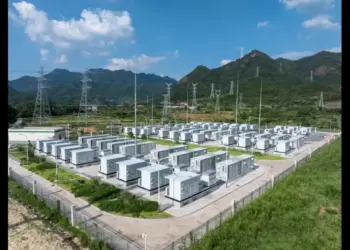




Arenko is pleased to announce the highly successful results of the Reserve from Storage trial which it pioneered throughout Summer 2020 with National Grid ESO.
Having originally proposed the service to National Grid ESO, Arenko designed it in collaboration with National Grid ESO, optimising 41MW of batteries in all three trials.
Highlights
- Batteries can effectively provide sustained Reserve allowing competition with other market participants to meet energy imbalances and driving cost efficiencies for the end consumer
- Providing Reserve from batteries will deliver increased operational resilience and support National Grid ESO’s wider ambitions of operating carbon free by 2025
- £0.7m saving to the consumer realised by using batteries participating in the trial versus the alternative solutions throughout the 20-day trial in Q3 2020. Using a linear scaling, which may not fully capture the true value for the consumer, a potential annual saving of £195m could be realised if current demand for Reserve was met using batteries
- Consumers made a 40% saving by using batteries to provide Reserve compared to business as usual
- Batteries were cost effective and represented value in 80% of all settlement periods (half hour periods) during the trial
- Over the course of the trial, steady value to the consumer was realised at all times throughout the day demonstrating value in a range of market and operational conditions
- National Grid ESO confirms ambition to procure Reserve from batteries going forward.
What is Reserve
Electricity demand and supply has to be kept in perfect balance on a second by second basis to ensure grid stability. While increasing renewable energy generation is essential for progressing towards net-zero, this makes power generation harder to forecast and match to demand, given the natural intermittency of wind and solar power. To deal with this, we need to hold ‘reserve’, akin to a substitutes bench to balance the grid when there is too much or too little power in the system.
Currently in the UK we get a lot of our ‘reserve’ from fossil fuelled plants. They have to be paid to switch on for 4-6 hours at a time, at part load, so that they can turn up or down rapidly to provide reserve as needed. If the UK is to transition to a net-zero future, this is unsustainable. It is the equivalent of leaving the engine running on your car all the time, just in case you need it. This is why Arenko proposed trialling the use of its battery technology to National Grid.
Rather than National Grid taking its ‘reserve’ from fossil fuelled plants, the trials have been running using ‘reserve’ from batteries instead. The great advantage is that batteries do not need to be generating power to provide reserve, unlike fossil fuelled plants, and so there is no need to switch off renewable generators such as wind farms to bring carbon emitting fossil fuel plants onto the system at part load. Throughout the trial, batteries charged up with large proportions of wind and solar power were able to provide ‘reserve’ cheaper than securing reserve from fossil fuelled plants.
Win-win-win
Arenko believes that procuring Reserve from batteries presents a unique win-win-win once the service is scaled for commercial use: The consumer benefits from c.£195m of annual savings on today’s business as usual; a pathway to mass deployment of renewables leading to a zero carbon electricity grid is made possible; battery owners can generate an attractive investment return in a major new market to support the required scale up of batteries.
This is an exportable, UK born solution to a global problem of how to transition to a low carbon future. It’s not a silver bullet but it’s part of a suite of services that are crucial to transitioning to economic, secure and sustainable energy systems across the globe.
A deep new market for storage
National Grid ESO’s System Operability Plan (“SOP”) indicated an ongoing requirement of up to 2GW of Reserve, which has historically been procured from traditional thermal power plants and CCGTs. If this requirement were to be satisfied from batteries, the evidence from this trial substantiates that consumers would benefit from annual savings of c.£195m if the savings announced following the trial are linearly scaled over the course of a year.
Demand for electricity dramatically dropped as a result of lockdown restrictions from COVID which substantially increased the proportion of renewables such as wind and solar on the system. Arenko’s analysis suggests this drove up the requirement for National Grid ESO to procure Reserve to c.5GW, representing a view of the future electricity grid’s needs in a high renewable penetration environment.
Over the next ten years, National Grid (Future Energy Scenarios) expects installed capacity of renewables to rise from 40GW today to between 70-104GW in 2030 (onshore and offshore wind component represents a 2.1-3.0x increase in capacity). At the same time, fossil fuels generation capacity will drop from 49GW today to 24-40GW. This is likely to drive the requirement for Reserve considerably higher than it is today.
Over the same timescale, National Grid forecasts batteries to grow from c.1GW today to up to 9GW, in order to balance the increasing intermittency of renewables. As evidenced by the trial each new MW installed can offer an annual saving to the consumer of £97.6k per annum (£11.14 per MW per hour) which represents a 40% saving versus alternative sources of reserve.
The challenges faced by National Grid ESO in balancing the system and having sufficient Reserve capacity to call on are faced by all international system operators and there is significant potential for this model to be exported to different markets.
Rupert Newland, Chief Executive, said:
“Arenko are delighted to have worked with National Grid to develop and deliver this important trial, whose results have huge global significance for the battery industry. The trial provides irrefutable evidence that new battery technologies, operated using intelligent software, can transform the management of the electricity grid to enable the mass deployment of renewable energy, a zero-carbon electricity system and the realisation of huge savings for the consumer.”