


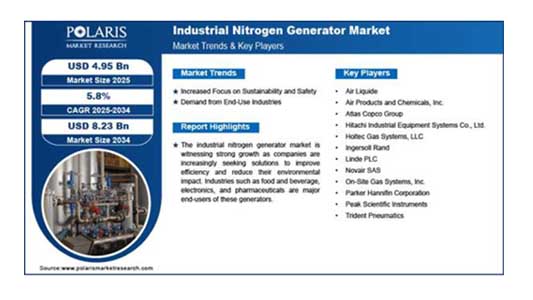
The Global Industrial Nitrogen Generator Market is poised for significant expansion over the coming decade, driven by rising industrial demand for on‑site nitrogen supply solutions that improve operational efficiency, reduce costs, and enhance safety in critical applications. According to a comprehensive market research study by Polaris Market Research, the market is projected to grow from an estimated USD 4.69 billion in 2024 to USD 8.23 billion by 2034, registering a compound annual growth rate (CAGR) of 5.8 % during the forecast period 2025–2034 — underscoring the increasing strategic importance of nitrogen generators across energy, power, utilities, and broader industrial ecosystems.
An industrial nitrogen generator is a specialized system that separates nitrogen from compressed air by removing oxygen and other gases, delivering a continuous, high‑purity nitrogen supply on‑site without reliance on external cylinders or deliveries. This capability has broad utility across sectors such as food & beverage processing, electronics manufacturing, pharmaceuticals, chemicals, and energy & utilities. On‑site generation models are particularly attractive for their safety benefits — eliminating risks associated with storing and handling high‑pressure gas cylinders — and for their ability to support sustainability goals by cutting transportation‑related emissions.
Market Drivers: Operational Efficiency & Sustainability
The shift toward on‑site nitrogen generation solutions is driven by a confluence of operational and environmental factors. Companies are increasingly prioritizing cost‑effective and energy‑efficient gas supply systems that reduce reliance on third‑party deliveries and bulky storage inventories. The rising need for continuous nitrogen supply — especially in processes like inerting, blanketing, and packaging — positions nitrogen generators as strategic capital equipment for modern industrial facilities seeking to enhance productivity.
Furthermore, sustainability imperatives are taking center stage. On‑site generation helps reduce carbon footprints by minimizing the logistical emissions associated with transporting gas cylinders and liquid nitrogen. This aligns with global trends toward cleaner, more resilient industrial operations, with companies increasingly committing to eco‑friendly practices that support broader energy and environmental targets.
Design & Technology Trends Shaping Market Growth
Plug‑and‑play nitrogen generator systems currently account for the largest share of the market due to their simplicity, ease of installation, and minimal technical requirements. These systems are particularly preferred by small and medium enterprises (SMEs) that seek compact, low‑maintenance solutions without extensive infrastructure dependencies.
From a technology standpoint, Pressure Swing Adsorption (PSA) remains the dominant segment as of 2024, thanks to its proven ability to produce high‑purity nitrogen at competitive operational costs — a crucial factor for industries like electronics, pharmaceuticals, and food processing where gas quality directly impacts product outcomes. Yet emerging technologies, including membrane‑based systems, are gaining traction for their compact designs and scalability, offering flexibility for tailored applications.
As industrial requirements evolve, cryogenic‑based nitrogen generation is also expected to grow, especially in scenarios demanding very high volumes or near‑maximum gas purity. Continued innovation in this space points to a broader trend of technology diversification, allowing businesses to match generation systems more closely with specific process needs.
End‑Use Industry Dynamics
The food & beverage sector holds the largest share of the industrial nitrogen generator market, owing to widespread use of nitrogen in modified atmosphere packaging (MAP). This technology displaces oxygen in packaging environments, significantly extending product shelf life, preserving quality, and reducing spoilage — key drivers in an era of heightened food safety standards and global demand for packaged goods.
Other major industrial end users include electronics manufacturing, where nitrogen is used to create inert atmospheres in soldering and component fabrication, and pharmaceutical production, which requires extremely clean and reliable gas environments for critical processes. Industries such as chemicals and energy power & utilities also employ nitrogen for inerting and purging applications, enhancing safety and process control in large‑scale operations.
View More Information @ https://www.polarismarketresearch.com/industry-analysis/industrial-nitrogen-generator-market/request-for-sample
Regional Outlook: North America Leads, Asia Pacific Expands Rapidly
Regionally, North America emerged as the largest market in 2024, benefiting from a mature industrial base, early adoption of advanced gas generation technology, and strong sustainability mandates across energy and manufacturing sectors. The United States, in particular, showcases robust nitrogen generator deployment across multiple industries seeking to optimize continuous production flows and regulatory compliance.
Simultaneously, the Asia Pacific region is projected to experience the fastest growth through 2034. Rapid industrialization, expanding manufacturing infrastructures, and rising demand for packaged products are key factors propelling market adoption in countries such as China and India. The rising emphasis on localized on‑site generation solutions reflects Asia Pacific industries’ increasing focus on cost‑efficiency and operational self‑sufficiency.
Competitive Landscape & Future Outlook
The industrial nitrogen generator market features a competitive landscape with several leading technology and service providers driving innovation and market penetration. Notable players include Air Products and Chemicals, Parker Hannifin, Atlas Copco, Linde PLC, Air Liquide, and other specialized gas systems manufacturers — all actively expanding product portfolios to meet growing demand across end‑use verticals.
Looking ahead, the confluence of technological innovation, industrial expansion, and sustainability mandates will continue to fuel market momentum. Energy power & utilities stakeholders, in particular, stand to benefit significantly from integrated nitrogen generation solutions that bolster operational reliability, enhance safety profiles, and support broader environmental strategies.
As organizations worldwide navigate the complexities of modern industrial gas requirements, the Industrial Nitrogen Generator Market is set not only for measurable growth but for strategic impact — reshaping how industries procure critical gas supplies and optimize core processes in the decade ahead.
Read More @ https://www.polarismarketresearch.com