


For much of the past decade, the automotive industry’s direction seemed straightforward: move from gasoline-powered vehicles toward fully electric cars. Automakers invested heavily in EV platforms, governments introduced electrification targets, and consumers became increasingly familiar with battery-powered driving.
Hybrid vehicles are gaining fresh attention as automakers respond to changing consumer demand, charging concerns, vehicle costs, and differences between regional markets. Rather than abandoning electrification, the industry is beginning to look at it through a wider lens one in which hybrids can play a meaningful role alongside fully electric vehicles.
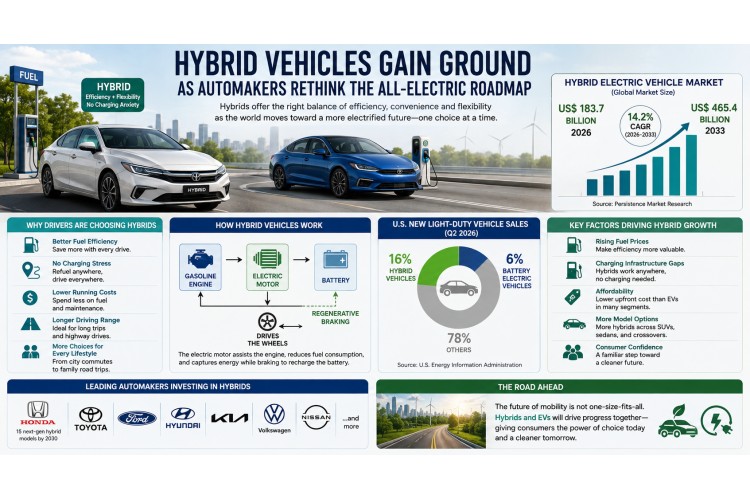
That shift is already visible in corporate strategy. Honda, for example, announced in 2026 that it would increase development and production resources for hybrids and plans to introduce 15 next-generation hybrid models globally by the end of its fiscal year 2030. The company is also reassessing its powertrain portfolio according to expected demand.
The message is clear: automakers are not necessarily moving away from electrification. They are becoming more flexible about how they get there.
Why Drivers Are Looking at Hybrids Again
For an everyday car buyer, the attraction of a hybrid is fairly simple.
A conventional hybrid combines a gasoline engine with an electric motor and battery. The electric system can assist the engine, particularly during acceleration and lower-speed driving, while regenerative braking can recover energy that would otherwise be lost.
The result can be improved fuel efficiency without requiring the driver to completely change how the vehicle is used.
That matters for consumers who want to reduce fuel consumption but may not have convenient access to a charging station. Someone living in an apartment, parking on the street, or regularly driving long distances may find a hybrid easier to manage than a fully electric vehicle.
Plug-in hybrids offer another option by allowing drivers to charge the battery externally and travel farther using electric power before relying on the engine.
In other words, consumers are no longer choosing simply between a gasoline car and an EV. They are increasingly choosing from a broader range of technologies designed for different lifestyles.
The Market Is Reflecting That Change
This growing variety is also showing up in market projections.
The global hybrid electric vehicle market is anticipated to reach US$183.7 billion in 2026 and is projected to grow to US$465.4 billion by 2033, representing a 14.2% CAGR between 2026 and 2033, according to Persistence Market Research.
The numbers point to something bigger than a short-term change in consumer preference. They suggest that hybrid technology could remain an important part of the global automotive industry as electrification develops at different speeds across countries and regions.
For consumers, this growth could mean more choices. More investment in hybrid technology can encourage manufacturers to introduce new models, improve efficiency, refine driving performance, and bring hybrid powertrains into vehicle segments where they were previously uncommon.
Automakers Are Learning That One Strategy May Not Fit Every Market
The global automotive industry is not moving at exactly the same pace everywhere.
Some countries have rapidly expanding charging networks and strong incentives for battery-electric vehicles. Other markets are still developing charging infrastructure or have consumers who place greater importance on purchase price, driving range, and easy refueling.
That creates a complicated environment for automakers.
A company that invests exclusively in one powertrain technology may struggle if consumer demand develops differently from its expectations. Hybrids provide manufacturers with another way to offer electrification while continuing to meet the needs of drivers who are not yet ready to go fully electric.
Recent U.S. data illustrates this changing balance. According to the U.S. Energy Information Administration, hybrid electric vehicles accounted for a record 16% of new light-duty vehicle sales in the second quarter of 2026, while battery-electric vehicles accounted for 6%.
That does not mean EVs are disappearing. Instead, it highlights how quickly the powertrain landscape can change when consumers are given more options.
The Practical Side of the Hybrid Argument
Technology is only part of the story. Convenience may be just as important.
For an EV owner, charging can become part of the daily routine. For some drivers, that is easy. They may have a home charger, a predictable commute, and access to public charging when needed.
For others, it can be more complicated.
A hybrid removes much of that concern for drivers who choose a conventional model. They can refuel at a traditional gas station while still benefiting from electric assistance and regenerative braking.
This flexibility becomes especially relevant during long journeys.
A family heading across several states or traveling between cities may value the ability to refuel within minutes rather than planning a trip around charging stops. For many consumers, that convenience can make the hybrid option feel like a lower-risk step toward electrification.
Hybrids Do Not Mean the EV Transition Is Over
It would be misleading to describe the rise of hybrids as the end of the EV story.
Battery technology continues to improve, charging networks are expanding, and automakers are still developing new electric models. At the same time, EV adoption is progressing rapidly in several markets.
The more interesting development is that the transition is becoming less predictable.
Automakers are increasingly balancing long-term electrification goals with what customers are actually willing and able to buy today. Honda’s 2026 strategy illustrates this approach: the company plans to continue developing EVs while also accelerating its next generation of hybrid vehicles.
That could become a defining feature of the next stage of automotive competition.
What Could Drive the Hybrid Market Forward?
Several factors could keep hybrids attractive in the coming years.
- Fuel efficiency remains a major consideration for drivers, particularly when fuel prices rise.
- Charging availability can influence whether consumers feel comfortable making the jump to a fully electric vehicle.
- Vehicle affordability also matters. Buyers may compare not only the purchase price but also fuel and operating costs over several years.
- Model availability is another important factor. As more automakers introduce hybrid SUVs, sedans, crossovers, and other vehicle types, consumers have more opportunities to find a model that fits their needs.
There is also the issue of familiarity. For some drivers, a hybrid represents a less dramatic change than moving directly from an internal-combustion vehicle to a fully electric one.
The Road Ahead May Be More Flexible Than Expected
The automotive industry is entering a period in which there may be no single winning powertrain for every driver or market. EVs will remain an important part of the industry’s future. But hybrids are demonstrating that consumers still value flexibility, convenience, efficiency, and choice. For automakers, that means the road toward electrification may require more than simply replacing every gasoline vehicle with an electric one. It may involve offering several technologies and allowing consumers to move toward electrified transportation at their own pace.
That is ultimately what makes the renewed interest in hybrids so significant. They are not simply a leftover technology from the period between gasoline cars and EVs. They are becoming part of a broader automotive strategy one that recognizes that the future of driving may be electric, but the journey there is unlikely to look the same for everyone.