


The global Bio-CNG market is emerging as one of the most promising renewable fuel segments in the transition toward a circular economy. Bio-CNG, also known as compressed biomethane, is produced by upgrading biogas generated from organic waste such as agricultural residue, food waste, cattle dung, sewage sludge, and municipal solid waste. By turning waste into fuel, the industry creates value from materials that would otherwise be discarded, underused, or released as emissions.
What makes Bio-CNG especially relevant today is its ability to solve multiple problems at once. It helps manage waste, reduces greenhouse gas emissions, supports energy security, and provides a substitute for fossil-based compressed natural gas. As governments, industries, and urban planners look for scalable low-carbon solutions, Bio-CNG is moving from a niche energy option to a practical infrastructure asset.
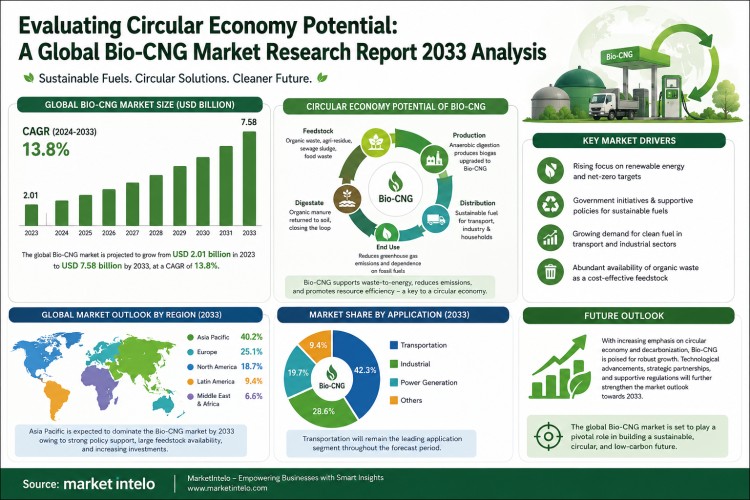
According to MarketIntelo, the Global Bio-CNG market size was valued at $3.1 billion in 2024, and is forecasted to hit $9.7 billion by 2033, growing at a robust CAGR of 13.6%.
Understanding Bio-CNG
Bio-CNG is produced when biogas is purified to remove carbon dioxide, hydrogen sulphide, moisture, and other impurities, leaving behind a high-methane fuel that can be compressed and used like conventional CNG. The process starts with anaerobic digestion, in which organic waste is broken down by microorganisms in the absence of oxygen. The resulting biogas is then upgraded and compressed for storage, transport, or direct use.
This makes Bio-CNG particularly attractive because it does not depend on extraction of new fossil resources. Instead, it uses existing waste streams as feedstock. In sectors like agriculture, food processing, livestock management, and municipal waste management, that creates a strong link between energy production and resource recovery. For this reason, Bio-CNG is often described as a clean fuel with a built-in circular economy model.
Circular Economy Value
The circular economy model is based on keeping materials in use for as long as possible, extracting maximum value from them, and then recovering and regenerating resources at the end of each cycle. Bio-CNG fits this concept very well. Organic waste that might otherwise be dumped or burned is transformed into fuel, while the digestate left behind can often be used as a soil conditioner or organic fertilizer.
This creates a chain of value that extends beyond fuel production. Farmers can benefit from better waste handling and nutrient recovery. Municipalities can reduce landfill pressure. Industries can lower disposal costs. Energy users gain access to a renewable fuel. In this way, Bio-CNG does more than replace fossil gas; it helps redesign waste into an economic input rather than a liability.
Market Growth Drivers
Several factors are driving the growth of the global Bio-CNG market. The first is the rising global demand for cleaner transport fuels. As fleets and commercial users face pressure to reduce emissions, Bio-CNG offers a practical alternative because it can often be used in existing CNG vehicles with limited modification.
The second driver is waste management. Rapid urbanization and industrial growth are increasing the amount of organic waste produced worldwide. Bio-CNG plants offer a decentralized solution that can convert this waste into energy close to where it is generated. This is especially useful in regions where landfill space is limited or where waste disposal is becoming more expensive.
A third major factor is policy support. Many governments are encouraging renewable fuel production through subsidies, blending mandates, waste-to-energy programs, and incentives for compressed biomethane projects. These measures improve project economics and make Bio-CNG more attractive to investors and operators.
Application Areas
Bio-CNG has a wide range of applications. In transportation, it is used for buses, trucks, taxis, and municipal fleets, especially where CNG infrastructure already exists. In agriculture, it can support farm-based energy systems and create local fuel loops. In industrial settings, Bio-CNG can serve as a process fuel or be injected into gas distribution networks where standards permit.
Municipal waste is another important application area. Cities that struggle with landfill overflow and organic waste management can use Bio-CNG plants as part of integrated solid waste systems. This not only improves waste handling efficiency but also creates a revenue-generating asset from material that previously had limited value.
Regional Opportunities
Different regions offer different growth conditions for Bio-CNG. Countries with large agricultural bases have abundant feedstock from crop residue, animal waste, and processing byproducts. Urban regions with high volumes of food and municipal waste also offer strong potential because of their concentrated waste streams.
In Asia, Bio-CNG is gaining momentum due to rising energy demand, large waste generation, and strong policy interest in clean fuel alternatives. In Europe, the market is supported by decarbonization targets and renewable gas policies. In North America, interest is growing in renewable natural gas, landfill gas recovery, and low-carbon transport solutions. Across all regions, the biggest opportunity lies in building systems that connect waste management with energy production more efficiently.
Challenges and Constraints
Despite its promise, the Bio-CNG market still faces important challenges. Feedstock collection and segregation can be difficult, especially in cities where organic waste is mixed with plastic and other contaminants. Without reliable input streams, plant efficiency can drop and operating costs can rise.
Another challenge is capital intensity. Bio-CNG projects require investment in digesters, upgrading systems, compression units, storage, and distribution infrastructure. For smaller developers, financing can be a major barrier. In addition, project success depends on stable policy support, long-term feedstock contracts, and access to gas or transport markets.
Operational complexity is another concern. Digesters require careful management, gas quality must be monitored continuously, and maintenance needs can be significant. These issues make technical expertise essential. A project may look attractive on paper, but if feedstock logistics or gas handling are weak, performance can suffer.
Forecast to 2033
Looking toward 2033, the global Bio-CNG market is expected to expand steadily as more countries adopt circular economy strategies and low-carbon fuel policies. Growth will likely come from a combination of transport demand, municipal waste initiatives, agricultural applications, and industrial decarbonization efforts. The market is also likely to benefit from improving upgrading technologies, stronger digestion efficiency, and better integration with waste collection systems.
Another important trend is localization. Rather than relying only on large centralized plants, many markets may move toward distributed Bio-CNG facilities that serve farms, towns, industrial estates, and city waste clusters. This approach can reduce transport costs, improve waste recovery, and make projects more resilient. Over time, Bio-CNG may become a key part of regional renewable fuel networks.
Strategic Importance
The strategic value of Bio-CNG goes beyond energy. It supports climate action, rural development, municipal sustainability, and industrial resource efficiency at the same time. That combination makes it more than a fuel market; it is a platform for circular infrastructure. In countries where waste disposal is costly and energy imports are a concern, Bio-CNG can create both environmental and economic benefits.
For policymakers, the key task is to create frameworks that support feedstock supply, project financing, and market access. For businesses, the priority is to build integrated systems that can convert organic waste into reliable, saleable fuel. For investors, the strongest opportunities are likely to be in projects with secure waste streams, clear offtake pathways, and supportive regulation.
Conclusion
The global Bio-CNG market has strong long-term potential because it sits at the intersection of clean energy, waste management, and circular economy development. Its ability to transform organic waste into usable fuel gives it an advantage over many other renewable options, especially in sectors where waste is abundant and transport decarbonization is urgent. As the market develops toward 2033, success will depend on how well stakeholders can scale feedstock collection, improve operating efficiency, and build policy environments that reward circular resource use.Bio-CNG is not just another alternative fuel. It is a practical example of how waste can become wealth, emissions can become energy, and sustainability can become a business model.