

The global transition toward clean and sustainable energy is creating significant opportunities for the wind power industry. Governments, energy companies, and private investors are increasingly focusing on renewable energy projects to reduce carbon emissions, strengthen energy security, and meet long-term sustainability targets. Wind turbines are becoming an essential part of this transformation, supported by technological advancements, expanding offshore wind installations, and growing electricity demand worldwide.
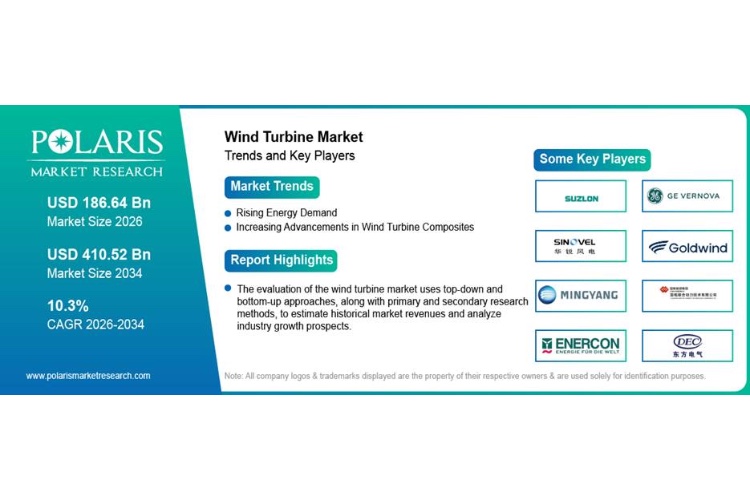
According to a recent study by Polaris Market Research, the global wind turbine market was valued at USD 169.29 billion in 2025 and is projected to reach USD 410.52 billion by 2034, registering a compound annual growth rate (CAGR) of 10.3% during 2026–2034. Increasing investments in renewable energy infrastructure, rising demand for electricity, and continuous improvements in turbine technology are among the major factors contributing to market expansion.
Rising Renewable Energy Demand Supports Market Growth
The growing need for reliable and low-carbon electricity is encouraging countries to accelerate wind energy development. Governments are introducing supportive renewable energy policies, investment incentives, and clean energy targets to increase the contribution of wind power to national electricity generation.
Wind turbines are widely adopted across utility-scale power projects because they provide a scalable solution for electricity generation. Increasing industrialization, urbanization, and electricity consumption are further strengthening demand for new wind installations. Additionally, declining wind power generation costs and growing corporate investments in renewable electricity procurement are creating favorable conditions for market development.
Offshore Wind Projects Create New Opportunities
Offshore wind energy is emerging as one of the most promising areas of the wind turbine industry. Offshore locations generally offer stronger and more consistent wind resources, allowing larger turbines to generate substantial electricity.
According to Polaris Market Research, the offshore segment is expected to register a CAGR of 16.20% during the forecast period. Increasing investments in large-scale offshore wind farms across Europe, Asia Pacific, and North America are supporting this growth.
The development of floating offshore wind technology is also expanding project opportunities in deeper waters where traditional fixed-bottom foundations are not practical. Improvements in offshore foundations, subsea cables, installation vessels, and turbine designs are expected to strengthen the commercial potential of offshore wind energy.
Technological Advancements Transform Wind Turbine Performance
Continuous innovation in turbine engineering and component manufacturing is improving energy generation efficiency and operational reliability. Manufacturers are developing larger rotor diameters, advanced blade designs, efficient generators, and improved drivetrain technologies to maximize electricity output.
Digital technologies are also transforming wind turbine operations. Artificial intelligence, Internet of Things (IoT) sensors, and predictive maintenance platforms are helping operators monitor equipment performance, identify potential faults, and reduce unexpected downtime. Digital twins and advanced control systems are further supporting operational optimization and lifecycle cost reduction.
The adoption of lightweight composite materials, including fiberglass and carbon fiber, is enabling manufacturers to develop longer and stronger turbine blades. These innovations are particularly important as the industry moves toward larger, higher-capacity wind turbines.
Asia Pacific Maintains a Leading Market Position
Regionally, Asia Pacific dominated the global wind turbine market with a 48.60% revenue share in 2025. Strong manufacturing capabilities, increasing electricity demand, and government initiatives promoting renewable energy adoption are supporting regional leadership. China, India, Japan, and South Korea continue to present important opportunities for wind energy development.
North America is expected to register a CAGR of 9.45% during the forecast period, supported by renewable energy investments, favorable policy frameworks, and expanding onshore and offshore wind projects. Europe also represents a significant market, benefiting from established wind energy infrastructure, sustainability commitments, and continued offshore wind investments.
Future Outlook and Industry Opportunities
Despite strong growth prospects, the wind turbine industry faces challenges such as high installation costs, supply chain disruptions, raw material price fluctuations, and grid connectivity limitations. Offshore projects, in particular, require substantial investments in specialized infrastructure, transportation, and maintenance.
However, ongoing improvements in turbine efficiency, floating offshore wind technology, recyclable materials, and digital monitoring solutions are expected to create new growth opportunities. The increasing integration of wind energy with battery storage and green hydrogen production could further strengthen its role in the global energy transition.
For businesses, investors, and industry stakeholders seeking detailed insights into emerging opportunities, Polaris Market Research provides comprehensive analysis of market size, growth forecasts, industry trends, competitive developments, and regional opportunities. These insights can help organizations understand changing market dynamics and make informed strategic decisions in the evolving global wind turbine industry.