


Urja Daily
No Result
View All Result
  • News
  • Renewable
    • Solar
    • Rooftop
    • Floating Solar
    • Module
    • Wind
    • Hydrogen
    • Biomass
    • Tenders
    • Sustainibility
  • Storage
  • E-Mobility
  • Battery
  • Smart City
  • Power
    • Smart Grid
    • Microgrid
    • Off-Grid
  • Editor’s Pick
    • Articles
    • In Talks
    • E-MAG
    • Market Research
  • On-demand Webinars
  • More
    • Events
    • Contact Us
    • Subscribe
No Result
View All Result
Urja Daily
No Result
View All Result
Home News

Shell Starship 2.0 Performance A reduction In Carbon Emissions

Urja Daily by Urja Daily
September 2, 2021
in News
Reading Time: 3 mins read
0
Shell Starship 2 0
Share on FacebookShare on TwitterShare on Linkedin

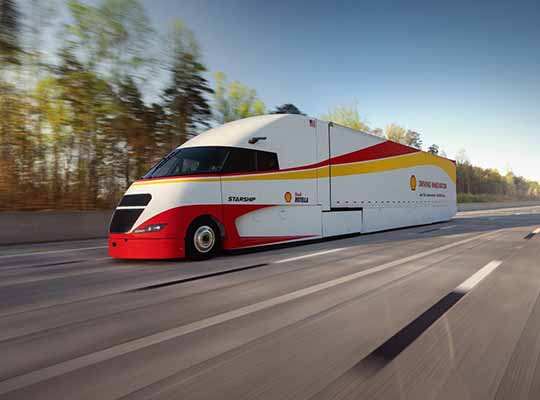
HOUSTON – The Shell Starship program exceeded its 2018 results in its second cross-country run using energy-efficient technologies to demonstrate what could be achieved driving a Class 8 truck in real-world conditions. The truck was designed to draw together these technologies in a single vehicle crafted to optimize performance and efficiency.

Following the initial program in 2018, the Shell Lubricants Solutions and Shell Technology teams worked together to pair the learnings from the first run with recent advancements in technology to develop the Shell Starship 2.0 truck. The new truck features a new chassis and drivetrain, along with new safety and fuel-efficient upgrades while maintaining the bespoke body from the original truck.

RELATED POSTS

BL Agro Goes Global; Aims To Invest ₹7,000 Crore in Tanzania Across Edible Oil, Dairy, Agriculture and Manufacturing

Transformerless Solar Central Inverter Market to Reach USD 8.4 Billion by 2034

Shell Starship 2.0 made a cross-country drive across the U.S. from San Diego to Jacksonville, following the same route as in 2018. A second, shorter 400-mile evaluation run was conducted to provide additional data about its freight ton efficiency and fuel economy benefits. Both trips were monitored and verified by the North American Council for Freight Efficiency.

For the cross-country drive, Shell Starship 2.0 achieved 254 ton-miles per gallon1 for freight ton efficiency – a 3.5 times improvement over the North America average freight ton efficiency2 for trucks which is 72 ton-miles per gallon.3 Freight ton efficiency is the most relevant statistic for judging the energy intensity associated with moving cargo from point A to point B since it combines the weight of cargo being moved with the amount of fuel consumed. Shell Starship 2.0 achieved an impressive 10.8 MPG on its cross-country run as compared to the 8.94 achieved by Starship 1.0 and the 6.4 MPG North American fleet average MPG. These numbers are made even more significant given Shell Starship 2.0 beat the 178 ton-miles per gallon for freight ton efficiency achieved in 2018 while carrying an 18% increase in payload, from 39,900 pounds of clean reef material in 2018 to 47,100-pounds this year.

“With increasing efforts to decarbonize road freight, we saw an opportunity to further demonstrate that the use of today’s efficient technologies can offer significant benefits to fleets,” said Jeff Priborsky, Global Marketing Manager for the On-Highway Fleet Sector, Shell Lubricant Solutions. “Understanding that not all fleets run fully loaded from coast-to-coast we felt it was important to conduct a variety of tests to provide additional data that can show how trucking efficiencies work in different conditions, in order to provide tangible benefits to the freight transport industry.”

The 400-mile short haul evaluation was completed in North Carolina with a cargo weight of 17.5 tons which was chosen to reflect more typical payload, commonly used by many fleets. The average fuel economy obtained was 12.0 mpg and the freight ton efficiency value was 210 ton-miles per U.S. gallon.4  While both values are direct consequences of the reduction in cargo mass, these are significant numbers when compared to the U.S. average of 6.4 mpg and 72 ton-miles per gallon. The fuel mileage is almost double the U.S. average and the ton-miles is more than triple.

“The efficiency testing with different payloads and miles driven demonstrate that efficient technologies have significant benefits for long-haul and shorter regional-haul applications,” said Robert Mainwaring, Technology Manager for Innovation, Shell Lubricants. “Fleets and owner-operators can evaluate which technologies are most beneficial for them and pursue them today to find significant fuel savings and carbon emissions reductions.”

The path to a low-carbon energy future will require a range of solutions and Shell Starship 2.0 demonstrates what is possible using efficient technologies and lubricants available today.

Tags: Class 8 truckefficientEnergyShellStarshipTechnologies
ShareTweetShare
Urja Daily

Urja Daily

Related Posts

BL Agro

BL Agro Goes Global; Aims To Invest ₹7,000 Crore in Tanzania Across Edible Oil, Dairy, Agriculture and Manufacturing

by Urja Daily
October 23, 2026
0

New Delhi/Bareilly : BL Agro announced its entry into the global market with a strategic investment of ₹7000 crore in...

Solar wind

Transformerless Solar Central Inverter Market to Reach USD 8.4 Billion by 2034

by Urja Daily
October 23, 2026
0

According to latest research by Growth Market Reports, the Transformerless Solar Central Inverter market size reached USD 4.1 billion in...

Yash Highvoltage

Yash Highvoltage® Delivers Robust H1 FY27 Growth with Revenue Up 95%, EBITDA Up 136% and PAT Up 165% YoY

by Urja Daily
October 22, 2026
0

Vadodara : Yash Highvoltage Limited a leading manufacturer of condenser-graded high voltage and high current transformer bushings, has announced its unaudited...

Comau

Comau Partners with NVIDIA to Advance Physical AI in Industrial Robotics

by Urja Daily
October 21, 2026
0

Comau is integrating NVIDIA Physical AI simulation libraries and accelerated computing into its products and system design processes to accelerate...

EcoCortec

EcoCortec® Lab Earns Prestigious ISO/IEC 17025 Accreditation, Solidifying Global Trust in VpCI® Quality

by Urja Daily
October 21, 2026
0

EcoCortec has been granted HRN EN ISO/IEC 17025:2017 accreditation. Effective October 5th for a five-year period, the EcoCortec® Testing Laboratory...

Next Post
Fuel Cell Truck Market

Fuel Cell Trucks Market Gains Momentum as Auto Industry

Yutong-Bus

Yutong Launched its Latest EV Battery Safety Technology

Leave a Reply Cancel reply

Your email address will not be published. Required fields are marked *

RECOMMENDED

Rahul Das, AVP

Why Should Large Industrial Entities Invest in BESS When They Have Already Invested in Solar?

October 23, 2026
Emmvee

Emmvee unveils India’s first Quarter-Cut Module with 4 Cut TOPCon Cell, delivering up to 30W higher power output 

October 23, 2026

MOST VIEWED

  • Solar

    When the Sun Began Paying the Electricity Bills: The Story of PM Surya Ghar Muft Bijli Yojana

    0 shares
    Share 0 Tweet 0
  • India’s Emerging Polysilicon Manufacturing Ecosystem: Opportunities and Challenges

    0 shares
    Share 0 Tweet 0
  • Xpeng Selects u‑blox F9 Centimeter-level Multi-Band GNSS Technology for P7 Smart EV

    0 shares
    Share 0 Tweet 0
  • KP Group’s Listed Renewable Businesses Post Strong Multi-Year Growth as Portfolio Expands Beyond 9.2 GW

    0 shares
    Share 0 Tweet 0
  • KP Group & PP Savani University Launches Urjanoor Scholarship

    0 shares
    Share 0 Tweet 0

Why Should Large Industrial Entities Invest in BESS When They Have Already Invested in Solar?

Emmvee unveils India’s first Quarter-Cut Module with 4 Cut TOPCon Cell, delivering up to 30W higher power output 

BL Agro Goes Global; Aims To Invest ₹7,000 Crore in Tanzania Across Edible Oil, Dairy, Agriculture and Manufacturing

Transformerless Solar Central Inverter Market to Reach USD 8.4 Billion by 2034

Fujiyama Power Systems Limited clarifying the potential impact of China’s proposed export restrictions on solar cell manufacturing technology and machinery

Yash Highvoltage® Delivers Robust H1 FY27 Growth with Revenue Up 95%, EBITDA Up 136% and PAT Up 165% YoY

Latest Magazine

© 2016 – 2025 TechZone Print Media | All Rights Reserved

  • About Us
  • Contact Us
No Result
View All Result
  • News
  • Renewable
    • Solar
    • Rooftop
    • Floating Solar
    • Module
    • Wind
    • Hydrogen
    • Biomass
    • Tenders
    • Sustainibility
  • Storage
  • E-Mobility
  • Battery
  • Smart City
  • Power
    • Smart Grid
    • Microgrid
    • Off-Grid
  • Editor’s Pick
    • Articles
    • In Talks
    • E-MAG
    • Market Research
  • On-demand Webinars
  • More
    • Events
    • Contact Us
    • Subscribe

© 2016 - 2025 TechZone Print Media | All Rights Reserved