

Urja Daily
No Result
View All Result
  • News
  • Renewable
    • Solar
    • Rooftop
    • Floating Solar
    • Module
    • Wind
    • Hydrogen
    • Biomass
    • Tenders
    • Sustainibility
  • Storage
  • E-Mobility
  • Battery
  • Smart City
  • Power
    • Smart Grid
    • Microgrid
    • Off-Grid
  • Editor’s Pick
    • Articles
    • In Talks
    • E-MAG
    • Market Research
  • On-demand Webinars
  • More
    • Events
    • Contact Us
    • Subscribe
  • News
  • Renewable
    • Solar
    • Rooftop
    • Floating Solar
    • Module
    • Wind
    • Hydrogen
    • Biomass
    • Tenders
    • Sustainibility
  • Storage
  • E-Mobility
  • Battery
  • Smart City
  • Power
    • Smart Grid
    • Microgrid
    • Off-Grid
  • Editor’s Pick
    • Articles
    • In Talks
    • E-MAG
    • Market Research
  • On-demand Webinars
  • More
    • Events
    • Contact Us
    • Subscribe
No Result
View All Result
Urja Daily
No Result
View All Result
Home E-Mobility

Research Finds Automakers are Struggling to Make EV More Sustainable

Urja Daily by Urja Daily
April 13, 2022
in E-Mobility
Reading Time: 3 mins read
0
Hexagon
Share on FacebookShare on TwitterShare on Linkedin

NEW DELHI – Independent research into electric vehicle (EV) development has found that most automotive companies are more focused on improving the electric car range and reducing costs than improving the vehicles’ carbon footprint, despite mounting scrutiny of their hidden environmental impacts. The research has been published by the Manufacturing Intelligence division of global technology company Hexagon, whose technology touches 95% of all cars produced every year.

While EVs eliminate tailpipe emissions, they also produce a ‘long tail-pipe’ of increased demand for fossil-fuel generated electricity, and reliance on energy-intensive materials and processes to construct vehicles and single-use batteries. A recent report by Volvo backs that up, announcing that EVs are far “dirtier” out of the factory gate, as the resource extraction for an electric drive train is so carbon-intensive, with EVs needing to clock up nearly twice as many miles compared to petrol cars to ‘break even’.

RELATED POSTS

Sharika Enterprises Limited Enters SCADA-ADMS Market with Uttarakhand Grid Modernization Project

Flip Chip Technology Market Witnesses Rising Demand from Consumer Electronics Sector

Despite this mounting scrutiny, only 38% of carmakers are currently increasing their investment in more sustainable design of EVs, which appears to be a much lower priority than the attributes that will appeal to consumers on the forecourt. Namely, the research also found:

  • 84% are increasing investment in improving EV range
  • 60% are increasing investment in design that will enable lower production and retail costs
  • 58% are increasing investment in improving EV performance

These factors all improve the environmental footprint of an EV compared to a petrol car, but the research found that companies are hitting other roadblocks in achieving the vehicles’ full green promise. When asked about their challenges in achieving greener EVs, the majority of carmakers (56%) identify a lack of alternatives to rare-earth metals for batteries as the major obstacle. Half (49%) are also concerned about the lack of recyclable battery materials, closely followed by the lack of recycling programmes and infrastructure (47%).

Ignazio Dentici, VP Global eMobility Industry for Hexagon’s Manufacturing Intelligence division, said: “Our research reflects a welcome recognition by the auto industry that sustainability involves more than merely reducing road emissions, revealing an understanding of the whole-lifecycle manufacturing and material impact of vehicles. However, it also shows that despite this knowledge, car makers are feeling more pressure to compete for consumer sales than to ensure EVs are able to fulfil their core purpose of reducing the environmental impact of road transport. The industry is having to move at unprecedented speed to innovate in pursuit of improvements in range, production costs and sustainability, within an increasingly competitive environment and while facing significant supply chain challenges. To fulfil the promise of a net zero automotive industry sooner while balancing consumer demands, intelligent data-driven manufacturing approaches must be embraced that support the development of sustainable solutions for every part, as well as creating recyclable cars. Only by designing for a circular economy – from factory, to consumer and beyond – can we reduce demand for energy and materials in the coming years.”

Surveyed adopters of smarter product development and manufacturing approaches report cutting time to market by 25%, with the methods producing lighter, more recyclable materials, and more autonomous manufacturing to help resolve the tension between consumer demand and impacts on the planet, progressively reducing costs and development timelines for greener designs. Furthermore, synchronising design, testing and engineering is shown to dramatically reduce physical testing and failed products, providing engineers with the opportunity to address efficiency and sustainability at drawing board stage.

Supply chain vulnerabilities, as exemplified by the ongoing chip shortages, are identified as one of the biggest obstacles to expanding the production of electric vehicles, with 73% citing challenges sourcing the required volumes of materials. The research highlights different ways these are being addressed by smart manufacturing proponents, including vertical integration of production and open digital ecosystems that enable end-to-end visibility and control over materials across their lifecycle.

The report, Recharging the Automotive Market, is produced by Hexagon and draws from on original research conducted with Wards Intelligence and Informa Tech Automotive Group (ITAG), with a comprehensive survey of 416 eMobility design and manufacturing decision-makers across the global automotive supply chain.

For more information, visit: https://emobility.hexagonmi.com/

Tags: automotive companieschip shortageselectric vehicleeMobility IndustryEVHexagonInforma Tech Automotive GroupITAG
ShareTweetShare
Urja Daily

Urja Daily

Related Posts

Sharika Enterprises Limited

Sharika Enterprises Limited Enters SCADA-ADMS Market with Uttarakhand Grid Modernization Project

by Palak
June 3, 2026
0

Noida : Sharika Enterprises Limited has secured a key subcontract for the deployment of an Advanced Distribution Management System (ADMS) under...

Flip Chip Technology

Flip Chip Technology Market Witnesses Rising Demand from Consumer Electronics Sector

by Palak
June 3, 2026
0

The semiconductor industry is experiencing a period of rapid transformation as consumer electronics continue to evolve toward higher performance, compact...

VinFast

VinFast is Tackling the EV Problems Many OEMs Ignore

by Palak
June 2, 2026
0

Gurugram, Haryana, India - For many Indian aftersales partners visiting Vietnam in May, the biggest takeaway from the VinFast Global...

India's E-Mobility Roadmap 2033 Automotive & Transportation Market Analysis of Infrastructure Expansion

India’s E-Mobility Roadmap 2033: Automotive & Transportation Market Analysis of Infrastructure Expansion

by Palak
May 22, 2026
0

India stands at the cusp of a transportation revolution, with its E-Mobility Roadmap to 2033 charting a bold path toward...

Electric Vehicles

The Benefits Making Electric Vehicles Increasingly Popular in India

by Palak
May 19, 2026
0

Gurugram, Haryana, India - For many Indian consumers, electric vehicles are increasingly becoming a practical solution that combines lower running...

Next Post
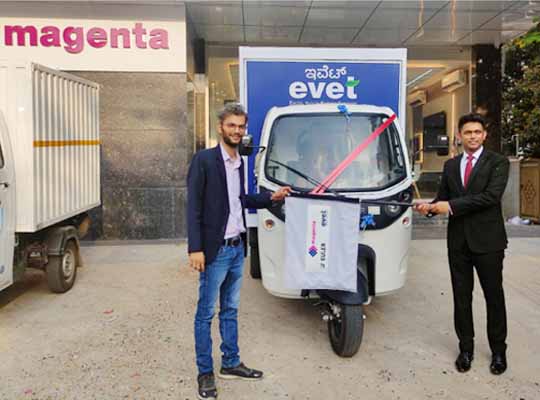
Magenta - Euler

Magenta, Euler Motors to Deploy over 1000 Electric Cargo Vehicles

Duke Energy

Duke Energy Offers Community Solar Program for Florida Customers

Leave a Reply Cancel reply

Your email address will not be published. Required fields are marked *

RECOMMENDED

Joint solar

Joint Solar sharpens focus on TOPCon and higher-efficiency solar modules

June 3, 2026
Shri V. Packirisamy

V. Packirisamy Appointed Director (Commercial) at Power Finance Corporation Limited

June 3, 2026

MOST VIEWED

  • Solar

    When the Sun Began Paying the Electricity Bills: The Story of PM Surya Ghar Muft Bijli Yojana

    0 shares
    Share 0 Tweet 0
  • India’s Emerging Polysilicon Manufacturing Ecosystem: Opportunities and Challenges

    0 shares
    Share 0 Tweet 0
  • KP Group & PP Savani University Launches Urjanoor Scholarship

    0 shares
    Share 0 Tweet 0
  • How proper refurbishment can extend life of pre-owned bikes in India?

    0 shares
    Share 0 Tweet 0
  • ACWA Power Signs Landmark $10 Billion Clean Energy Agreements

    0 shares
    Share 0 Tweet 0

Joint Solar sharpens focus on TOPCon and higher-efficiency solar modules

V. Packirisamy Appointed Director (Commercial) at Power Finance Corporation Limited

Sharika Enterprises Limited Enters SCADA-ADMS Market with Uttarakhand Grid Modernization Project

Cargill Launches Two-Year Livestock Development Initiative to Strengthen Maharashtra’s Dairy Sector

Flip Chip Technology Market Witnesses Rising Demand from Consumer Electronics Sector

Servotech Signs ₹400 Crore MoU for Haryana Manufacturing Expansion

Latest Magazine

© 2016 – 2025 TechZone Print Media | All Rights Reserved

  • About Us
  • Contact Us
No Result
View All Result
  • News
  • Renewable
    • Solar
    • Rooftop
    • Floating Solar
    • Module
    • Wind
    • Hydrogen
    • Biomass
    • Tenders
    • Sustainibility
  • Storage
  • E-Mobility
  • Battery
  • Smart City
  • Power
    • Smart Grid
    • Microgrid
    • Off-Grid
  • Editor’s Pick
    • Articles
    • In Talks
    • E-MAG
    • Market Research
  • On-demand Webinars
  • More
    • Events
    • Contact Us
    • Subscribe

© 2016 - 2025 TechZone Print Media | All Rights Reserved