

Urja Daily
No Result
View All Result
  • News
  • Renewable
    • Solar
    • Rooftop
    • Floating Solar
    • Module
    • Wind
    • Hydrogen
    • Biomass
    • Tenders
    • Sustainibility
  • Storage
  • E-Mobility
  • Battery
  • Smart City
  • Power
    • Smart Grid
    • Microgrid
    • Off-Grid
  • Editor’s Pick
    • Articles
    • In Talks
    • E-MAG
    • Market Research
  • On-demand Webinars
  • More
    • Events
    • Contact Us
    • Subscribe
  • News
  • Renewable
    • Solar
    • Rooftop
    • Floating Solar
    • Module
    • Wind
    • Hydrogen
    • Biomass
    • Tenders
    • Sustainibility
  • Storage
  • E-Mobility
  • Battery
  • Smart City
  • Power
    • Smart Grid
    • Microgrid
    • Off-Grid
  • Editor’s Pick
    • Articles
    • In Talks
    • E-MAG
    • Market Research
  • On-demand Webinars
  • More
    • Events
    • Contact Us
    • Subscribe
No Result
View All Result
Urja Daily
No Result
View All Result
Home News

NREL Scientists Explore How To Make PV Even Greener

Urja Daily by Urja Daily
July 4, 2022
in News, Solar
Reading Time: 3 mins read
0
NREL
Share on FacebookShare on TwitterShare on Linkedin

How do we reduce the carbon impact of an already green technology?

This is the question that NREL researchers Hope Wikoff, Samantha Reese, and Matthew Reese tackle in their new paper in Joule, “Embodied Energy and Carbon from the Manufacture of Cadmium Telluride and Silicon Photovoltaics.”

RELATED POSTS

FPT Enters The Top Three of Europe’s Certified High-Voltage Battery Producers With TÜV SÜD Recognition 

Gruner’s CBG Plant Sets Asia Record with 23.5 TPD Output, Achieves 120% of Design Capacity at Satna

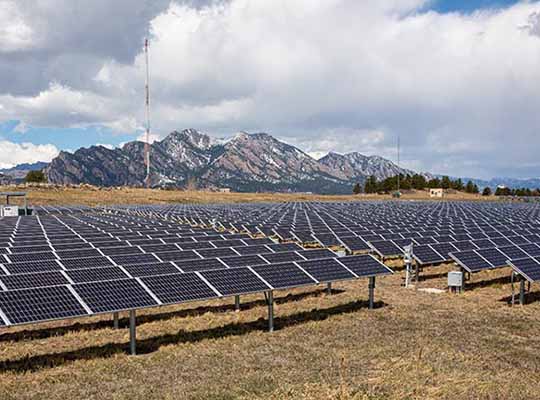
In the paper, the team focuses on the two dominant deployed photovoltaic (PV) technologies: silicon (Si) and cadmium telluride (CdTe) PV. These green technologies help reduce carbon emissions and meet global decarbonization goals—but their manufacturing processes can themselves result in greenhouse gas emissions.

“Green technologies are awesome, but as we are working to scale them up to an incredible magnitude, it makes sense to take a close look to see what can be done to minimize the impact,” said Samantha Reese, a senior engineer and analyst in NREL’s Strategic Energy Analysis Center.

To understand the overall impact of these green technologies on global decarbonization goals, the team looked beyond traditional metrics like cost, performance, and reliability. They evaluated “embodied” energy and carbon—the sunk energy and carbon emissions involved in manufacturing a PV module—as well as the energy payback time (the time it takes a PV system to generate the same amount of energy as was required to produce it).

“Most advances have been driven by cost and efficiency because those metrics are easy to evaluate,” said Matthew Reese, a physics researcher at NREL. “But if part of our goal is to decarbonize, then it makes sense to look at the bigger picture. There is certainly a benefit to trying to push efficiencies, but other factors are also influential when it comes to decarbonization efforts.”

“One of the unique things that was done in this paper is that the manufacturing and science perspectives were brought together,” Samantha Reese said. “We combined life-cycle analysis with materials science to explain the emission results for each technology and to examine effects of future advances. We want to use these results to identify areas where additional research is needed.”

The manufacturing location and the technology type both have a major impact on embodied carbon and represent two key knobs that can be turned to influence decarbonization. By looking at present-day grid mixes in countries that manufacture solar, the authors found that manufacturing with a cleaner energy mix—compared to using a coal-rich mix—can reduce emissions by a factor of two. Furthermore, although Si PV presently dominates the market, thin-film PV technologies like CdTe and perovskites provide another path to reducing carbon intensity by an additional factor of two.

This insight matters because of the limited carbon budget available to support the expected scale of PV manufacturing in the coming decades.

“If we want to hit the decarbonization goals set by the Intergovernmental Panel on Climate Change, as much as a sixth of the remaining carbon budget could be used to manufacture PV modules,” Matthew Reese said. “That’s the scale of the problem—it’s a massive amount of manufacturing that has to be done in order to replace the energy sources being used today.”

The authors’ hope is that by illustrating the magnitude of the problem, their paper will cause people to take another look at the potential use of thin-film PV technologies, such as CdTe, and manufacturing with clean grid mixes.

Ultimately, accelerating the incorporation of low-carbon energy sources into the electrical grid mix is paramount.

“One of the big strengths of PV is that it has this positive feedback loop,” said Nancy Haegel, center director of NREL’s Materials Science Center. “As we clean up the grid—in part by adding more PV to the grid—PV manufacturing will become cleaner, in turn making PV an even better product.”


Tags: EnergyGreen TechnologyNRELPhotovoltaicsPV technologies
ShareTweetShare
Urja Daily

Urja Daily

Related Posts

FPT TUVSUDV

FPT Enters The Top Three of Europe’s Certified High-Voltage Battery Producers With TÜV SÜD Recognition 

by Urja Daily
June 23, 2026
0

FPT, the Iveco Group brand dedicated to the design, production, and sale of low-environmental impact powertrains, has obtained certification in...

Utkarsh Gupta

Gruner’s CBG Plant Sets Asia Record with 23.5 TPD Output, Achieves 120% of Design Capacity at Satna

by Urja Daily
June 23, 2026
0

Satna, Madhya Pradesh: Gruner Renewable Energy, the flagship company of the Gruner Group and one of World's fastest-growing Technology + Engineering,...

VinFast India

VinFast India, Tata Capital Join Hands for Dealer Financing

by Palak
June 20, 2026
0

Gurugram, Haryana, India - VinFast Auto India, a subsidiary of the global EV brand VinFast, has signed a Memorandum of...

Mr. Vinod Sharma, Director, Joint Solar

Joint Solar backs India’s domestic solar manufacturing push with focus on quality and reliability

by Palak
June 19, 2026
0

New Delhi : India’s renewable energy sector is moving towards building a stronger domestic manufacturing ecosystem. In line with this shift,...

Kosol Energie

Kosol Energie Commissions 31 MW Solar Project at Junachay, Gujarat

by Palak
June 18, 2026
0

Kosol Energie Pvt. Ltd., a Grade-A Top Tier-1 Global Solar Manufacturer and a leading solar EPC and module manufacturing company...

Next Post
NREL floating pv

Untapped Potential Exists for Blending Hydropower, Floating PV

Energy Storage

IESA Academy’s 5th Masterclass on Advanced Energy Storage Manufacturing

Leave a Reply Cancel reply

Your email address will not be published. Required fields are marked *

RECOMMENDED

FPT TUVSUDV

FPT Enters The Top Three of Europe’s Certified High-Voltage Battery Producers With TÜV SÜD Recognition 

June 23, 2026
FPT

FPT And Green Power Systems Help Boost Algeria’s Powdered Milk Production

June 23, 2026

MOST VIEWED

  • Solar

    When the Sun Began Paying the Electricity Bills: The Story of PM Surya Ghar Muft Bijli Yojana

    0 shares
    Share 0 Tweet 0
  • India’s Emerging Polysilicon Manufacturing Ecosystem: Opportunities and Challenges

    0 shares
    Share 0 Tweet 0
  • KP Group & PP Savani University Launches Urjanoor Scholarship

    0 shares
    Share 0 Tweet 0
  • Xpeng Selects u‑blox F9 Centimeter-level Multi-Band GNSS Technology for P7 Smart EV

    0 shares
    Share 0 Tweet 0
  • How proper refurbishment can extend life of pre-owned bikes in India?

    0 shares
    Share 0 Tweet 0

FPT Enters The Top Three of Europe’s Certified High-Voltage Battery Producers With TÜV SÜD Recognition 

FPT And Green Power Systems Help Boost Algeria’s Powdered Milk Production

Gruner’s CBG Plant Sets Asia Record with 23.5 TPD Output, Achieves 120% of Design Capacity at Satna

Integrals Power Validates Sustainably Produced Iron Phosphate Precursor and LFP Cathode Material in Cell Level at University of St Andrews

Power Transmission is the Foundation of Economic Growth

VinFast India, Tata Capital Join Hands for Dealer Financing

Latest Magazine

© 2016 – 2025 TechZone Print Media | All Rights Reserved

  • About Us
  • Contact Us
No Result
View All Result
  • News
  • Renewable
    • Solar
    • Rooftop
    • Floating Solar
    • Module
    • Wind
    • Hydrogen
    • Biomass
    • Tenders
    • Sustainibility
  • Storage
  • E-Mobility
  • Battery
  • Smart City
  • Power
    • Smart Grid
    • Microgrid
    • Off-Grid
  • Editor’s Pick
    • Articles
    • In Talks
    • E-MAG
    • Market Research
  • On-demand Webinars
  • More
    • Events
    • Contact Us
    • Subscribe

© 2016 - 2025 TechZone Print Media | All Rights Reserved