

Urja Daily
No Result
View All Result
  • News
  • Renewable
    • Solar
    • Rooftop
    • Floating Solar
    • Module
    • Wind
    • Hydrogen
    • Biomass
    • Tenders
    • Sustainibility
  • Storage
  • E-Mobility
  • Battery
  • Smart City
  • Power
    • Smart Grid
    • Microgrid
    • Off-Grid
  • Editor’s Pick
    • Articles
    • In Talks
    • E-MAG
    • Market Research
  • On-demand Webinars
  • More
    • Events
    • Contact Us
    • Subscribe
  • News
  • Renewable
    • Solar
    • Rooftop
    • Floating Solar
    • Module
    • Wind
    • Hydrogen
    • Biomass
    • Tenders
    • Sustainibility
  • Storage
  • E-Mobility
  • Battery
  • Smart City
  • Power
    • Smart Grid
    • Microgrid
    • Off-Grid
  • Editor’s Pick
    • Articles
    • In Talks
    • E-MAG
    • Market Research
  • On-demand Webinars
  • More
    • Events
    • Contact Us
    • Subscribe
No Result
View All Result
Urja Daily
No Result
View All Result
Home News

Untapped Potential Exists for Blending Hydropower, Floating PV

Urja Daily by Urja Daily
July 4, 2022
in News, Solar
Reading Time: 3 mins read
0
NREL floating pv
Share on FacebookShare on TwitterShare on Linkedin

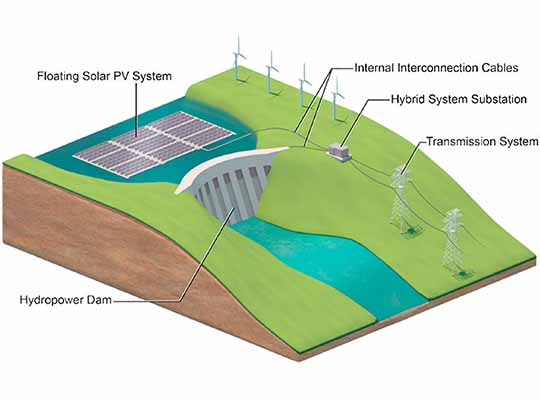
Hybrid systems of floating solar panels and hydropower plants may hold the technical potential to produce a significant portion of the electricity generated annually across the globe, according to an analysis by researchers at the U.S. Department of Energy’s National Renewable Energy Laboratory (NREL).

The researchers estimate that adding floating solar panels to bodies of water that are already home to hydropower stations could produce as much as 7.6 terawatts of potential power a year from the solar PV systems alone, or about 10,600 terawatt-hours of potential annual generation. Those figures do not include the amount generated from hydropower.

RELATED POSTS

Shweta Solar pushes for stronger storage and grid readiness as rooftop solar expands

VinFast India Partners with Federal Bank to Strengthen Dealer Financing Ecosystem

For comparison, global final electricity consumption was just over 22,300 terawatt-hours in 2018, the most recent year for which statistics are available, according to the International Energy Agency.

“This is really optimistic,” said Nathan Lee, a researcher with NREL’s Integrated Decision Support group and lead author of a new paper published in the journal Renewable Energy. “This does not represent what could be economically feasible or what the markets could actually support. Rather, it is an upper-bound estimate of feasible resources that considers waterbody constraints and generation system performance.”

The article, “Hybrid floating solar photovoltaics-hydropower systems: Benefits and global assessment of technical potential,” was co-authored by NREL colleagues Ursula Grunwald, Evan Rosenlieb, Heather Mirletz, Alexandra Aznar, Robert Spencer, and Sadie Cox.

Floating photovoltaics (PV) remain a nascent technology in the United States, but their use has caught on overseas where space for ground-mounted systems is less available. Previous NREL work estimated that installing floating solar panels on man-made U.S. reservoirs could generate about 10 percent of the nation’s annual electricity production.

So far, only a small hybrid floating solar/hydropower system has been installed, and that is in Portugal.

NREL estimates 379,068 freshwater hydropower reservoirs across the planet could host combined floating PV sites with existing hydropower facilities. Additional siting data is needed prior to any implementation because some reservoirs may be dry during parts of the year or may not be otherwise conducive to hosting floating PV.

Potential benefits exist by coupling floating PV with hydropower. For example, a hybrid system would reduce transmission costs by linking to a common substation. Additionally, the two technologies can balance each other. The greatest potential for solar power is during dry seasons, while for hydropower rainy seasons present the best opportunity. Under one scenario, that means operators of a hybrid system could use pumped storage hydropower to store excess solar generation.

Funding for the research came from NREL’s Laboratory Directed Research and Development Program.

NREL is the U.S. Department of Energy’s primary national laboratory for renewable energy and energy efficiency research and development. NREL is operated for the Energy Department by the Alliance for Sustainable Energy LLC.


Tags: ElectricityEnergyfloating solar panelshydropowerNRELRenewable Energy
ShareTweetShare
Urja Daily

Urja Daily

Related Posts

Shweta Solar

Shweta Solar pushes for stronger storage and grid readiness as rooftop solar expands

by Palak
August 22, 2026
0

New Delhi : The rooftop solar market in India has moved well beyond the early stage of convincing households to...

VinFast India

VinFast India Partners with Federal Bank to Strengthen Dealer Financing Ecosystem

by Palak
August 22, 2026
0

Gurugram, Haryana, India - VinFast India has signed a Memorandum of Understanding (MOU) with Federal Bank, one of India’s leading...

IGNITE

MC²+ Ignite Selects 30 Energy Deep-Tech Startups for Funding

by Palak
August 22, 2026
0

National : MC²+, an energy innovation platform led by the Ministry of Petroleum & Natural Gas (MoPNG) and backed by...

Servotech Renewable Power System Ltd.

Servotech Renewable Launches New TVC for Solar Lithium Batteries Featuring Sonu Sood

by Palak
August 20, 2026
0

New Delhi : Servotech Renewable Power System Ltd. has launched its latest TVC under its ongoing brand campaign featuring actor...

Palo Alto Networks

Palo Alto Networks Introduces Frontier AI Critical Defense Program

by Palak
August 20, 2026
0

Mumbai, India — Palo Alto Networks announced the Frontier AI Critical Defense Program, a first-of-its-kind initiative to protect critical infrastructure from...

Next Post
Energy Storage

IESA Academy’s 5th Masterclass on Advanced Energy Storage Manufacturing

BILITI Electronics

Biliti Electric Felicitated by Telangana Government at the T-Hub 2.0 Launch Program

Leave a Reply Cancel reply

Your email address will not be published. Required fields are marked *

RECOMMENDED

Beyond Installation: What Defines a Successful Industrial Solar Project?

August 22, 2026
Shweta Solar

Shweta Solar pushes for stronger storage and grid readiness as rooftop solar expands

August 22, 2026

MOST VIEWED

  • Solar

    When the Sun Began Paying the Electricity Bills: The Story of PM Surya Ghar Muft Bijli Yojana

    0 shares
    Share 0 Tweet 0
  • India’s Emerging Polysilicon Manufacturing Ecosystem: Opportunities and Challenges

    0 shares
    Share 0 Tweet 0
  • KP Group & PP Savani University Launches Urjanoor Scholarship

    0 shares
    Share 0 Tweet 0
  • StarlinePS Enterprises Invests ₹160 Crore in Celloraa Energy

    0 shares
    Share 0 Tweet 0
  • Business Delegation Signs 66 MoUs During Central Asia Visit to Boost Multi-Sector Collaboration

    0 shares
    Share 0 Tweet 0

Beyond Installation: What Defines a Successful Industrial Solar Project?

Shweta Solar pushes for stronger storage and grid readiness as rooftop solar expands

VinFast India Partners with Federal Bank to Strengthen Dealer Financing Ecosystem

MC²+ Ignite Selects 30 Energy Deep-Tech Startups for Funding

Servotech Renewable Launches New TVC for Solar Lithium Batteries Featuring Sonu Sood

Nuvoton Begins Production of 16-Cell Battery Monitoring ICs for AI Servers

Latest Magazine

© 2016 – 2025 TechZone Print Media | All Rights Reserved

  • About Us
  • Contact Us
No Result
View All Result
  • News
  • Renewable
    • Solar
    • Rooftop
    • Floating Solar
    • Module
    • Wind
    • Hydrogen
    • Biomass
    • Tenders
    • Sustainibility
  • Storage
  • E-Mobility
  • Battery
  • Smart City
  • Power
    • Smart Grid
    • Microgrid
    • Off-Grid
  • Editor’s Pick
    • Articles
    • In Talks
    • E-MAG
    • Market Research
  • On-demand Webinars
  • More
    • Events
    • Contact Us
    • Subscribe

© 2016 - 2025 TechZone Print Media | All Rights Reserved