



Urja Daily
No Result
View All Result
  • News
  • Renewable
    • Solar
    • Rooftop
    • Floating Solar
    • Module
    • Wind
    • Hydrogen
    • Biomass
    • Tenders
    • Sustainibility
  • Storage
  • E-Mobility
  • Battery
  • Smart City
  • Power
    • Smart Grid
    • Microgrid
    • Off-Grid
  • Editor’s Pick
    • Articles
    • In Talks
    • E-MAG
    • Market Research
  • On-demand Webinars
  • More
    • Events
    • Contact Us
    • Subscribe
No Result
View All Result
Urja Daily
No Result
View All Result
Home Editor's Pick Articles

Is Solar Power the answer to High Electricity Bills in India?

editor by editor
August 28, 2024
in Articles
Reading Time: 3 mins read
0
Mr. Ravi Kumar, Vice President at Oorjan Cleantech Private Limited
Share on FacebookShare on TwitterShare on Linkedin

India’s solar potential – There are about 25 crore households in India. These households have power-hungry electrical appliances like ACs, washing machines, fridges, televisions etc. India’s current residential sector demand for electricity is about 310 TWh.

And as our per capita income rises, our per capita electricity consumption will also escalate. Is adopting solar energy the solution to the exorbitantly high electricity bills?

RELATED POSTS

Fuel Shocks Make Farm Waste a Strategic Industrial Fuel for India, says Ankur Scientific as it Marks 40 Years of R&D

How India’s Next Solar Bottleneck May Not Be Land, Capital or Technology and Could be Skilled Manpower?

The actual technical potential is upwards of 600 to 700 GW of plant capacity. If you take account of the actual household electricity demand and eliminate the ones not having economic viability, we’ll still have a little over 100 GW potential.

So far we have installed around 12 GW of rooftop capacity in our country. 60% of rooftop potential in seven states- Maharashtra, Uttar Pradesh, West Bengal, Odisha, Rajasthan, Andhra Pradesh and Tamil Nadu.

For more than 80% of residential households in India electricity bills fall in the lowest slab, hence adopting solar is not economically feasible for them. This is termed as a lack of economic viability.

Net metering is the process of connecting the solar system to the grid. Net-metering allows the import of energy from the grid in case of a shortage and export and sell the extra power produced in case of a surplus.
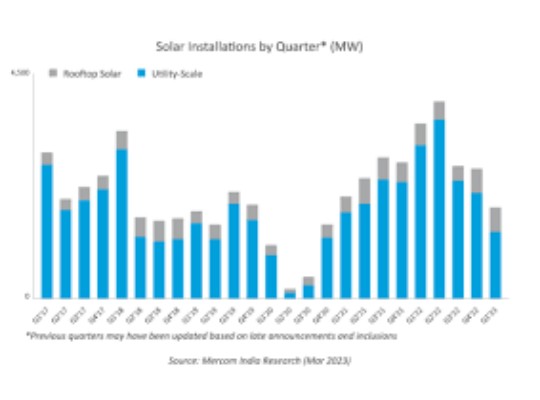
Mercom India Reasearch

Solar- Upsides – Rooftop solar is not only environmentally-friendly, but also affordable. The usual payback period is 2 to 5 years. Solar energy is renewable, inexhaustible and abundant. Solar panels require minimal maintenance, with a monthly visit sufficing in most of the cases.
Solar can also be seen as an investment. Having a solarified household increases the property value. According to NREL, solar can increase the property value by 4%. Most of the renowned solar EPCs also offer zero-cost EMIs.

In the interim budget of 2024, the Pradhan Mantri Suryodaya Yojana was announced. PMSY is a government initiative to install solar rooftop systems for 1 crore households. Furthermore 300 units of free electricity every month will be provided.

In emerging fields like renewable energy, education is the best marketing. More the awareness, more the demand. But the ground reality is that less than 50% of Indians know about solar and what are the potential benefits.

Solar- Downsides – Moreover, we need innovative financing models like zero-cost EMI to reduce the financial burden on potential customers if any. Some of the deterrents to quicker adoption of solar are the high upfront cost, the lack of familiarity with technology, and the not-so-smooth net-metering procedure.

EV- A shining example – In emerging markets like renewable energy, education is the best marketing. More the awareness, more the demand. The ground reality today is that less than 50% of Indians are cognizant of solar and its potential benefits.

EVs are a great guidebook on how to approach such a novel, high-concept, accessible, and part of day-to-day conversions. Once the demand reaches a magnitude, the scale of economies helps in achieving price parity with the existing alternatives. Aggressive and persistent marketing for years has finally created a sizable appetite for EVs.

In conclusion, under the National Solar Mission, we were to install 100 GW by 2022, and 40 GW were to come from the rooftop segment, yet we have done only 12 GW. We are lagging quite a bit in our targets. However, the recent momentum indicates we are on our path to forging a record number of solar installations in the years ahead. In the past few decades, we have made significant improvements as an industry in making solar accessible and affordable. We expect to double the already existing capacity in the next 5 years.


Tags: ElectricityEVRooftop SolarSolar Power
ShareTweetShare
editor

editor

Related Posts

Ankur Jain

Fuel Shocks Make Farm Waste a Strategic Industrial Fuel for India, says Ankur Scientific as it Marks 40 Years of R&D

by Urja Daily
October 21, 2026
0

Vadodara : Wars and geopolitical conflicts in recent years have exposed the vulnerabilities of global energy supply chains, with disruptions increasingly...

Tanmoy Duari

How India’s Next Solar Bottleneck May Not Be Land, Capital or Technology and Could be Skilled Manpower?

by Urja Daily
October 21, 2026
0

As installations surge and manufacturing scales up, a shortage of skilled manpower is emerging as a critical bottleneck in the...

Mr. Madhvendra Singh

Embedded Technology: The Intelligence Behind Electronics and the Careers of Tomorrow

by Urja Daily
October 14, 2026
0

Much of the technology we rely on every day is powered by computing systems that most users never see. A...

Ravi Kumar

Managing Peak Power Demand: How BESS Can Help Commercial Establishments Optimise Energy Consumption

by Urja Daily
September 24, 2026
0

There is one line on every high-tension electricity bill in Maharashtra that businesses often treat as fixed: the demand charge. Unlike...

Dushyant Kumar, PV Quality Manager

The “Solar Shelf-Life” Problem and how today’s Best Module Become Obsolete Before Its 25-Year Warranty Ends?

by Urja Daily
September 23, 2026
0

India’s solar sector is confronting an unexpected shift: while photovoltaic modules are lasting longer than ever, they may be losing...

Next Post
Servotech Power

Servotech Power Drives Solar with Subsidized Solutions under PM Surya Ghar Yojana

GreenPioneer

GreenPioneer Mobility India Launches ‘NonStop’: Revolutionizing Retail for Rehabilitation and Mobility Solutions

Leave a Reply Cancel reply

Your email address will not be published. Required fields are marked *

RECOMMENDED

Rahul Das, AVP

Why Should Large Industrial Entities Invest in BESS When They Have Already Invested in Solar?

October 23, 2026
Emmvee

Emmvee unveils India’s first Quarter-Cut Module with 4 Cut TOPCon Cell, delivering up to 30W higher power output 

October 23, 2026

MOST VIEWED

  • Solar

    When the Sun Began Paying the Electricity Bills: The Story of PM Surya Ghar Muft Bijli Yojana

    0 shares
    Share 0 Tweet 0
  • India’s Emerging Polysilicon Manufacturing Ecosystem: Opportunities and Challenges

    0 shares
    Share 0 Tweet 0
  • Xpeng Selects u‑blox F9 Centimeter-level Multi-Band GNSS Technology for P7 Smart EV

    0 shares
    Share 0 Tweet 0
  • KP Group’s Listed Renewable Businesses Post Strong Multi-Year Growth as Portfolio Expands Beyond 9.2 GW

    0 shares
    Share 0 Tweet 0
  • KP Group & PP Savani University Launches Urjanoor Scholarship

    0 shares
    Share 0 Tweet 0

Why Should Large Industrial Entities Invest in BESS When They Have Already Invested in Solar?

Emmvee unveils India’s first Quarter-Cut Module with 4 Cut TOPCon Cell, delivering up to 30W higher power output 

BL Agro Goes Global; Aims To Invest ₹7,000 Crore in Tanzania Across Edible Oil, Dairy, Agriculture and Manufacturing

Transformerless Solar Central Inverter Market to Reach USD 8.4 Billion by 2034

Fujiyama Power Systems Limited clarifying the potential impact of China’s proposed export restrictions on solar cell manufacturing technology and machinery

Yash Highvoltage® Delivers Robust H1 FY27 Growth with Revenue Up 95%, EBITDA Up 136% and PAT Up 165% YoY

Latest Magazine

© 2016 – 2025 TechZone Print Media | All Rights Reserved

  • About Us
  • Contact Us
No Result
View All Result
  • News
  • Renewable
    • Solar
    • Rooftop
    • Floating Solar
    • Module
    • Wind
    • Hydrogen
    • Biomass
    • Tenders
    • Sustainibility
  • Storage
  • E-Mobility
  • Battery
  • Smart City
  • Power
    • Smart Grid
    • Microgrid
    • Off-Grid
  • Editor’s Pick
    • Articles
    • In Talks
    • E-MAG
    • Market Research
  • On-demand Webinars
  • More
    • Events
    • Contact Us
    • Subscribe

© 2016 - 2025 TechZone Print Media | All Rights Reserved