



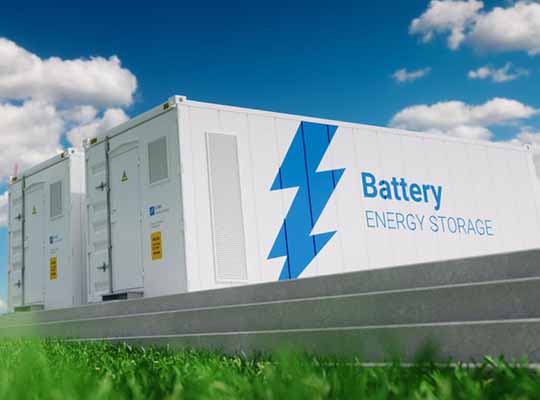
DES PLAINES – Honeywell announced a new flow battery technology that works with renewable generation sources such as wind and solar to meet the demand for sustainable energy storage. The new flow battery uses a safe, non-flammable electrolyte that converts chemical energy to electricity to store energy for later use while meeting the environmental, longevity and safety objectives of utilities.
Honeywell’s new technology delivers greater flexibility and extended duration for utilities. The battery stores energy that can be used when wind and solar are absent, in the event of power outages and when power grids are at capacity. It can store and discharge electricity for up to 12 hours, exceeding the duration of lithium-ion batteries, which can only discharge up to 4 hours. The battery is designed with recyclable components and does not degrade over time. It maintains system performance, providing a reliable and cost-efficient system for 20 years.
The flow battery technology will be tested by Duke Energy at its Emerging Technology and Innovation Center in Mount Holly, N.C. The company has more than a decade of experience testing various battery chemistries and has deployed numerous large-scale energy storage projects across the country.
Honeywell will deliver a 400-kilowatt-hour (kWh) unit to Duke Energy’s facility in Mount Holly in 2022. If the battery is deployed at scale, it will reduce the use of Duke Energy’s fossil-fuel power plants by utilizing solar and wind. These renewable generation sources are increasingly cost competitive versus traditional fossil fuels and represent over 70% of new power generation. Honeywell aims to deploy a utility-scale pilot project of 60-megawatt-hours starting in 2023.
“With this flow battery, Honeywell has developed an innovative energy storage technology to answer upcoming energy storage needs beyond the current technologies available on the market,” said Ben Owens, vice president and general manager, Honeywell Sustainable Technology Solutions. “As utilities and corporations seek cost-effective alternatives to coal-fired plants with long-duration energy storage solutions, they are switching to renewable energy targets that work around the clock to reduce carbon emissions. By partnering with Duke, we can implement this innovate energy storage technology at scale and bring to market a revolutionary flow battery to meet growing energy storage demands while assisting companies in meeting their carbon neutral goals.”
Duke Energy is executing an aggressive clean energy strategy, with goals of a 50 percent reduction of carbon emissions versus 2005 levels by 2030 and net-zero carbon emissions by 2050.
“Duke Energy has followed flow battery technology for a number of years and is interested in the advancements Honeywell is pursuing,” said Tom Fenimore, director, Smart Grid Emerging Technology and Operations. “Our Emerging Technology and Innovation Center is an ideal proving ground to study this technology. Over the next five years, Duke Energy plans to install almost 400 megawatts of battery storage capacity in our service territory. We have a keen interest in breakthrough technologies.”
Industry data states that the long duration energy storage market will grow to $13.7B by 2030 and require 115 gigawatts (GW) of energy storage to support the implementation of wind and solar capacity.
The Honeywell flow battery can also be combined with Honeywell’s unified system for process, business and asset management, Experion PKS, and its enterprise performance management solution, Honeywell Forge, for remote monitoring. The combination of technologies and renewable energy generation sources will provide a complete integrated energy storage solution for utilities and independent power producers to meet net-zero carbon goals. The overall system will also establish Honeywell as one of the first vertically integrated end-to-end energy storage solution providers from battery manufacturing to integration, controls, energy management systems and performance contracts.
Honeywell recently committed to achieve carbon neutrality in its operations and facilities by 2035. This commitment builds on the company’s track record of sharply reducing the greenhouse gas intensity of its operations and facilities as well as its decades-long history of innovation to help customers meet their environmental and social goals. About half of Honeywell’s new product introduction research and development investment is directed toward products that improve environmental and social outcomes for customers.
Duke Energy (NYSE: DUK), a Fortune 150 company headquartered in Charlotte, N.C., is one of America’s largest energy holding companies. Its electric utilities serve 7.9 million customers in North Carolina, South Carolina, Florida, Indiana, Ohio and Kentucky, and they collectively own 51,000 megawatts of energy capacity. Its natural gas unit serves 1.6 million customers in North Carolina, South Carolina, Tennessee, Ohio and Kentucky. The company employs 27,500 people.