


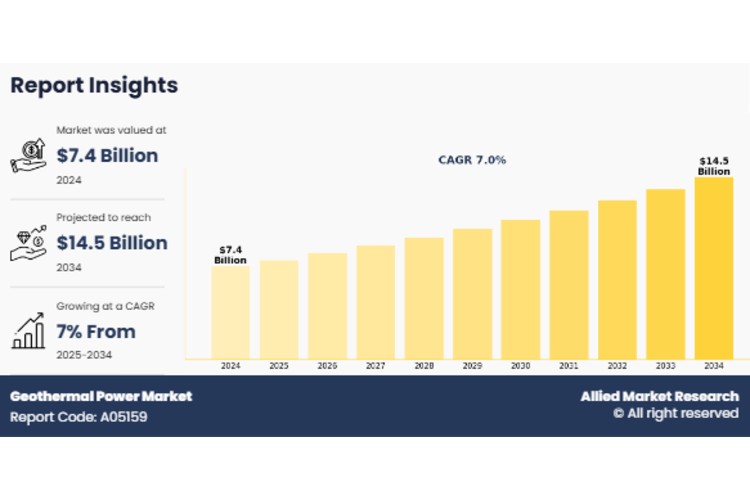
According to a new report published by Allied Market Research, the global geothermal power market size was valued at $7.4 billion in 2024 and is projected to reach $14.5 billion by 2034, growing at a CAGR of 7% from 2025 to 2034. Rising demand for reliable renewable energy, increasing investments in low-carbon infrastructure, and growing energy security concerns are key factors driving expansion of the geothermal power market.
Introduction
Geothermal power refers to electricity generation using the natural heat stored beneath the Earth’s surface. This heat originates from the planet’s core, where extremely high temperatures are produced by radioactive decay and residual heat from Earth’s formation.
To harness this energy, wells are drilled into underground geothermal reservoirs containing hot water or steam trapped in porous rocks. The steam or hot fluid is brought to the surface and used to spin turbines connected to generators, producing electricity with minimal greenhouse gas emissions.
The geothermal power market is gaining momentum as countries seek stable and sustainable alternatives to fossil fuels. Unlike solar and wind energy, geothermal power plants can operate continuously, making them ideal for baseload electricity supply.
Market Dynamics Driving Growth
The transition toward clean energy is the most significant factor fueling the geothermal power market. Governments, industries, and consumers worldwide are prioritizing low-carbon energy solutions to address climate change and rising energy demand.
Geothermal energy offers a unique advantage: it is both renewable and highly reliable. While solar and wind output fluctuates with weather conditions, geothermal systems provide consistent power generation around the clock.
Sustainability commitments and net-zero emission targets are accelerating investment in geothermal projects. Many countries have introduced renewable energy mandates, financial incentives, and policy support to encourage development of geothermal infrastructure.
Additionally, geothermal plants require relatively small land areas and can operate for decades, enhancing their long-term economic viability.
Energy Security and Resource Diversification
Growing concerns about energy security are further strengthening the geothermal power market. Nations heavily dependent on imported fossil fuels are exploring domestic renewable resources to reduce vulnerability to supply disruptions.
Regions with abundant geothermal potential—such as East Africa, Southeast Asia, parts of North America, and Europe—are leveraging this resource to stabilize energy supplies and support economic development.
Advancements in Enhanced Geothermal Systems (EGS) are expanding opportunities even in areas lacking traditional geothermal reservoirs. EGS technology creates artificial reservoirs by injecting water into hot rock formations, enabling power generation in previously unsuitable locations.
Challenges Hindering Market Expansion
Despite its advantages, the geothermal power market faces significant challenges. High initial capital investment remains the primary barrier. Exploration and drilling activities are expensive and involve considerable uncertainty.
Identifying viable geothermal reservoirs requires extensive geological surveys, seismic studies, and test drilling. Even after substantial investment, some wells may fail to produce sufficient energy, discouraging private investors.
Drilling costs can reach several million dollars per well, depending on depth and geological conditions. Building power plants and steam collection infrastructure further increases financial requirements.
Compared to solar and wind projects, which typically have lower upfront costs and shorter development timelines, geothermal projects often involve longer payback periods. These factors can limit investment, particularly in developing economies.
Emerging Opportunities
Rising investments in clean energy infrastructure are creating new opportunities within the geothermal power market. Governments, private companies, and international financial institutions are channeling funds into renewable projects to accelerate energy transition goals.
Innovative financing mechanisms such as green bonds, climate funds, and public–private partnerships are helping mitigate exploration risks and improve project viability.
Technological advancements in drilling techniques, reservoir management, and power plant efficiency are also reducing costs and expanding the feasibility of geothermal projects. These developments are expected to unlock new markets and drive long-term growth.
Segmentation by Power Station Type
The geothermal power market is segmented into three major power station types:
- Dry steam power stations
- Flash steam power stations
- Binary cycle power stations
Among these, flash steam power stations are projected to grow at the fastest rate, with a CAGR of 7.7% during the forecast period. This growth is driven by their ability to efficiently convert high-temperature geothermal fluids into electricity.
Flash steam technology is widely used because suitable high-temperature reservoirs are relatively common in geothermal-rich regions.
End-Use Analysis
Based on end-use, the geothermal power market is categorized into residential, commercial, industrial, and others.
The industrial segment is expected to witness significant growth, driven by increasing use of geothermal energy for process heating, district energy systems, and manufacturing operations. Industries are adopting geothermal power to reduce operating costs, improve energy efficiency, and meet sustainability targets.
The commercial segment is also projected to expand rapidly as businesses seek low-carbon energy solutions for offices, retail spaces, and large facilities.
Regional Outlook
Regionally, the geothermal power market spans North America, Europe, Asia-Pacific, and LAMEA (Latin America, Middle East, and Africa).
Asia-Pacific is expected to register the fastest growth, with a projected CAGR of 7.3% during the forecast period. Rapid industrialization, population growth, and increasing electricity demand are driving renewable energy investments across the region.
Countries such as Indonesia, the Philippines, Japan, and New Zealand possess significant geothermal resources and are expanding capacity to meet rising energy needs.
North America and Europe also maintain strong market positions due to established geothermal infrastructure and supportive regulatory frameworks.
Competitive Landscape
The global geothermal power market includes several major companies engaged in power generation, equipment manufacturing, and project development. Key players include Yokogawa Electric Corporation, Enel SpA, ABB Ltd., Toshiba Corporation, General Electric, Korea Electric Power Corporation, Siemens AG, Tata Power Company Limited, Mitsubishi Heavy Industries Ltd., and Ormat Technologies Inc..
These companies focus on technological innovation, strategic partnerships, and geographic expansion to strengthen their market presence.
Conclusion
In conclusion, the geothermal power market is poised for substantial growth as the global transition toward sustainable energy accelerates. With its ability to provide continuous, low-carbon electricity and enhance energy security, geothermal power represents a critical component of future energy systems.
Although high upfront costs and exploration risks pose challenges, technological advancements and increasing financial support are expected to improve project feasibility. As countries diversify energy portfolios and pursue net-zero targets, the geothermal power market will play a vital role in delivering reliable and environmentally friendly power for decades to come.