


There is a broad array of chemistries used for battery cells in electric vehicles, offering differing electrochemical profiles. NMC is commonly used in Europe and North America, offering high energy density for premium vehicles, while LFP is ubiquitous for mass-market vehicles in China due to lower costs. Meanwhile, LMFP provides a middle ground between the two and is expected to see deployment in the next few years.
Behind each cell chemistry is a distinct cell material demand profile, including cathode materials such as nickel, manganese, cobalt, iron and phosphate, and anode materials such as graphite and silicon. IDTechEx’s new market report “Materials for Electric Vehicle Battery Cells and Packs 2026-2036: Technologies, Markets, Forecasts” explores the materials that act as the foundation for the EV battery cell market and predicts that the overall cell material market for electric vehicles will reach US$154 billion by 2036.
Overview of cell chemistries
Li-ion cells is a term used to describe a broad array of chemistries, including LCO cells for consumer electronics and LTO cells for high-power commercial applications. However, for electric vehicles the dominant cell chemistries are nickel-based (including NMC and NCA) and LFP. LFP is the dominant chemistry in China and is also gaining market share in North America and Europe as automakers pivot towards mass-market electric vehicle solutions. This is due to lower cost per kWh. LFP’s energy density is on the low side, however optimization of pack and vehicle design can allow for “good-enough” vehicle range in spite of this.
Nickel-based chemistries, meanwhile, offer higher energy density at higher costs, making them well-suited to premium vehicle applications. NMC has been dominant in the North American and European markets previously, though it is losing market share to LFP more recently. There is a general trend towards higher nickel content in NMC cells, to enable even higher energy density and reduce reliance on cobalt. NMC 811 is currently standard, replacing NMC 532 from ten years ago as the primary premium vehicle solution.
Battery cell material price volatility
Critical battery materials include lithium, nickel and cobalt. These materials have a somewhat limited supply and generally long extraction times. As a result, prices are highly volatile due to the inflexibility of supply and varying demand. Lithium prices saw a spike in 2022/2023 as a result of higher than expected demand, reaching a peak of US$80,000 per tonne for lithium hydroxide, compared to US$13000 in 2025. Lithium prices have also been rising in 2026 due to high demand and shutdown of major Chinese mines. Cobalt prices are also volatile, having spiked in 2025 due to a temporary export ban from the DRC, the world’s primary cobalt supplier. Volatility in the raw materials market leads to volatility in cell costs. Sensitivity to lithium prices is especially high for Li-ion batteries.
Cell cost estimates for NMC 811 and LFP
IDTechEx utilizes raw material prices to estimate cell material costs for both NMC 811 and LFP. IDTechEx estimated that in 2025, both LFP and NMC 811 raw material costs were at an all time low, with LFP at US$34/kWh and NMC 811 at US$39/kWh. Previously LFP offered significant cost advantages on the materials side, however the gap seems to have narrowed, though it remains significant. It should be noted that this analysis does not include materials processing or cell assembly costs, which contribute significantly to the full cost of the cell.
Future materials trends from advanced Li-ion cells
There are several next-generation cell chemistries and designs that would change the material demand produced by Li-ion cells. Most of these chemistries are intended to increase cell energy density or potentially reduce costs for premium vehicle cells.
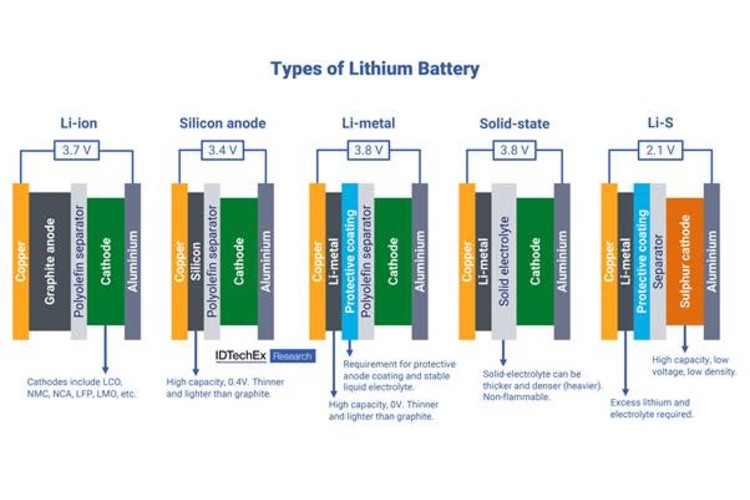
- Silicon anodes: silicon is already used as an additive in premium electric vehicle cells, e.g. in Tesla vehicles. However, higher percentage silicon anodes are being developed that would significantly improve cell energy density. IDTechEx predicts a shift towards silicon over graphite in premium vehicle anodes towards the end of the next decade.
- Solid-state: Batteries conventionally use liquid electrolytes, however there is significant development of semi-solid and solid-state electrolytes to replace these and enable use of higher energy density anode materials. This would require polymer, ceramic or oxide-based materials. This is expected to be limited, however, due to challenges with scaling manufacturing.
- Advanced cathodes: Development of LMFP, LMO and LNMO is approaching commercialization, shifting the cathode materials market away from cobalt and towards low-cost manganese.
- Lithium metal: Lithium anodes enable extremely high energy density, but increases battery degradation and reduces cycle life. A small proportion of the market may shift to lithium by the end of the next decade, reducing graphite demand, especially in an anode-less cell design.
- Lithium-sulfur: Lithium anodes can also be paired with low-cost sulfur cathodes to develop high gravimetric energy density cells. This would entail a reduction in other cathode material intensities, though market share is expected to be very limited in the EV sector.
The materials market for lithium-ion cells is diverse and growing, with material demand for electric vehicle cells set to exceed 17.9 million tonnes by 2036. For more information on both cell and pack materials trends, see the recent report “Materials for Electric Vehicle Battery Cells and Packs 2026-2036: Technologies, Markets, Forecasts”. For more information on this report, including downloadable sample pages, please visit www.IDTechEx.com/EVBattMat. The full portfolio of related research available from IDTechEx can be found at www.IDTechEx.com.