

The energy sector is under a lot of pressure. German distribution grid operators need to get their infrastructure ready for the energy transition and fast.
By 2030, some 80 percent of electricity is to be generated from renewable sources. A pilot project at naturenergie netze GmbH is demonstrating how transformer substations can be modernised more quickly. In collaboration with software suppliers Eplan and entegra, this southern German distribution grid operator is now working for the first time on a digital twin that will greatly speed up the planning and further development of transformer substations.
In the past, there was distribution. For decades, energy was simply distributed in one direction – from continuously operating coal and nuclear power stations to transformer substations, and from there (once the voltage had been stepped down several times) to end consumers. To use a road traffic analogy, this quiet “one-way street” has now become a busy city-centre road network. Nowadays, the energy mix changes hourly with the wind and weather, so there essentially isn’t a reliable base load any more. In addition, wind farm and solar system operators feed in energy decentrally at medium- and low-voltage levels, so power grids now work in two directions. Heat pumps and electric vehicle charging stations mean higher consumption, while the long-familiar load profiles that peak in the early evening are now a thing of the past. However, both the quality of the supply and the 50 Hz frequency must be guaranteed at all times.
Grid operators are facing a mammoth task – they need to make their grids fit for these complex requirements. For naturenergie netze, this involves new construction work as well as modernising a number of existing transformer substations. The plants need to be adapted to suit the increasing demand for electricity, but that isn’t the only challenge. A bigger challenge is that they need to be adapted to cope with a much higher level of flexibility in terms of energy sources and flows and the precise control of electricity.
A digital twin
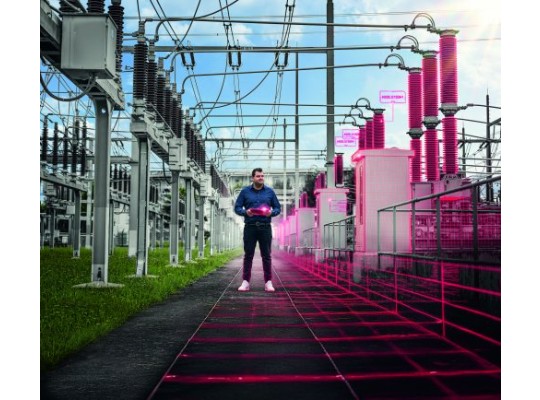
naturenergie netze (see text box) was quick to address these challenges and is currently working on a pilot project as it modernises one of its systems. The grid operator is using a digital concept to plan and configure its conversion of the Rheinfelden transformer substation. The new approach applies even to the preliminary work. Rainer Beck, a grid development coordinator, explains: “Before we start planning, we create a digital twin of the transformer substation, i.e. a virtual representation with all the data for both the live components (the primary technology) and the control level (the secondary technology) and, of course, for the buildings and all the peripherals. We then plan the conversion on the basis of this digital twin.”
Another reason why this is a challenging task is that the primary and secondary technology are planned using different CAD software tools. In this pilot project, this issue was resolved by a very special collaboration. As members of the VDE ETG “Digital twins for electrical energy systems” task force, two leading suppliers – entegra with its primtech software solution for the primary technology and Eplan for the secondary technology – had prepared for precisely what naturenergie netze needed for the first (preliminary) planning stage, namely combining primary and secondary technology in a single model.
Major efficiency gains
For this unique project, entegra and Eplan were looking for an innovative distribution grid operator with a suitable pilot project to get involved as the third party in this collaboration. Contact with naturenergie netze came at exactly the right time – especially since the project in question was a complex one. As Rainer Beck explains: “The aim of the project is to renew all the secondary technology in an existing, highly complex transformer substation – and during ongoing operations.” It’s easy to understand why involvement in this project was appealing. “It would normally take two to three years to plan and implement the modernisation, but the new planning methodology will really speed things up.” Everybody involved in the project agrees. Matthias Schuy, Business Development Manager at entegra, explains: “What we’re doing here – integrating a transformer substation’s primary and secondary technology into one digital twin – has never been done before, but promises major benefits.” We asked him if he could give us a bit more detail. Rainer Beck: “Of course. Ultimately, we need to prove that the one-off investment will pay off quickly. After the first project phase – the preliminary planning – we see considerable time savings during the actual conversion of the transformer substations. What’s more, that applies to every project.”
One model for all users
During the first stage of the project, the transformer substation was scanned, photos were taken of the rating plates, and the primary technology data generated was compared with the data from the asset management system. The result was a valid, functional primtech 3D model of the transformer substation. During a fully automated process, the datasets created in primtech were then exported to Eplan via an interface and used as the basis for planning the secondary technology in Eplan. Finally, the data from the secondary technology was integrated into the digital twin. This work is almost complete. By documenting the scenario as it currently stands, the basis has been provided for replacing the transformer substation’s secondary technology efficiently. “This is a really important step. All the data is verified. We basically follow the ‘single source of truth’ principle. The data in the original systems is left untouched and linked to the digital twin. This prevents redundancies that could prove problematic in the future,” explains Jan Oliver Kammesheidt, Global Vertical Market Manager Energy at Eplan.
In terms of the architecture of the combined data model, the parties involved – very much in keeping with the twin approach – have created a special infrastructure. “There’s no leading system – instead, there are merely different perspectives of one and the same model. The digital twin opens a window to the systems – for example, from primtech to Eplan or SAP. The digital twin therefore fulfils one of its main functions – namely offering centralised access to all relevant information for the transformer substation,” Schuy explains.
Standardising secondary technology
This collaboration by the three parties – entegra, Eplan and the distribution grid operator – was made possible, or at least made easier, by a decision taken two years ago. That was when naturenergie netze started using the Eplan Electric P8 and Eplan Pro Panel software solutions to plan its secondary technology, i.e. its control technology. Simon Rümmele, who is a grid development project leader, was responsible for this and is still in charge today. “With Eplan, we can drive forward the standardisation and more efficient engineering of the secondary technology – as well as end-to-end planning that we can also use during the operation phase for preventive maintenance and overhauls,” he says.”
Lessons from mechanical engineering
The project is demonstrating that users in the electricity industry are benefiting from experience and solutions from mechanical engineering. In that sector – one in which Eplan has been active for decades – standardisation and “industrialisation” of panel building and switchgear manufacturing equipment is firmly established. As regards this step for transformer substations, there’s still a lot of catching up to do – but it has to happen. “Up until now, transformer substations have been planned on a case-by-case basis and built as one-offs. However, this makes it very difficult to judge the need for modernisation and new-builds that is arising as a result of the energy transition. The sector needs to standardise much more than it has in the past. We are providing support and are delighted to have found an innovative partner in naturenergie netze. With the joint digital twin for primary and secondary technology, we are speeding up the process considerably and making it more reliable, too,” Kammesheidt explains.
Strong partners for the conversion
As Rümmele explains, this is precisely what naturenergie netze is setting out to achieve. “We want and need to digitalise more, because we believe this will open up opportunities and make things easier in the future. That’s why we’re trying out the latest technologies and planning further pilot projects at our transformer substation in Rheinfelden. What’s more, with Rittal, the sister company of Eplan, we also have a strong partner on board for converting the ‘hardware’, in other words, all the enclosure technology,” he says.
naturenergie netze has also been planning standardisation for some time now – and the joint digital twin created by entegra and Eplan will provide the basis for this, too. Rainer Beck: “We can envisage using two standard concepts and buildings in the 110 kV range and creating variants on the basis of these. We’re also working on this with the main primary suppliers. This will also cut down the amount of time and planning required. And this is vital, because we’re going to be forced to adapt the majority of our transformer substations to comply with the new requirements. The digital twin and the preliminary work being carried out by entegra and Eplan will help us with this. Through partnership and collaboration, we are coming up with a genuine innovation that will help us develop our grids and make them fit for the future efficiently.”
However, it is not only naturenergie netze who will benefit from the project. Kammesheidt: “In contrast to the mechanical engineering sector, grid operators openly share information, because they’re not competing with each other. There’s already a lot of interest. I’m convinced that many grid operators will be able to take what we’re doing here and in the VDE task force and use it to plan and implement their own conversion and new-build projects fast.