


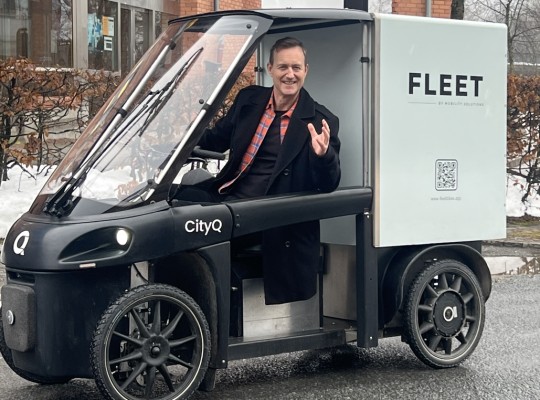
- CityQ’s unique 4-wheel e-bike has windows, wiper, doors, car like seating and turning lights. It has pedals (but no chain), a reverse gear and software-based drive train, and comes with capacity for cargo or 3 people
- When comparing total carbon footprint (from vehicle construction and emissions from a lifetime of use) CityQ e-bikes are approximately 90% more sustainable than ICE vehicles and 80% more sustainable than EVs
- For cities, these e-bikes can reduce congestion, parking issues, cut pollution and cut the need for costly car charging infrastructure
- For consumers, they deliver safe, door-to-door all-weather mobility without needing a license, insurance, or vehicle registration
- CityQ e-bikes can travel up to 110 km on a single full battery charge and have swappable batteries for last mile deliveries if needed. Max speed is by regulation, 25 km/h
- CityQ’s distinctive car-like e-bikes will be available in the UK, Germany, Benelux and Scandinavia this year
- CityQ is the first company to successfully bridge the gap between compact e-bikes and EVs and is spearheading the future of urban mobility
London : Cities across Europe looking to reduce congestion and pollution by imposing limitations to car traffic will be faced with a potential solution this year. Mobility technology startup CityQ is ramping up production of its game-changing ‘car-like e-bikes’, making both cargo and passenger models available in the UK, Germany, Benelux and Scandinavia in 2024.
Purpose-built with seating for multiple passengers, cargo capacity, weather protection and a futuristic digital powertrain, CityQ’s four wheeled e-bikes are unique because they retain true car like capabilities whilst being considerably lighter, more manoeuvrable, and more sustainable than an EV.
For cities, car like e bikes help cut pollution and congestion and for consumers, they deliver safe, door-to-door all-weather mobility without needing a license, insurance, or vehicle registration.
Charging at home without reliance on public EV infrastructure and offering unmatched stability and storage, the e-bikes provide a viable alternative to automobile ownership. Compared to EVs, CityQ e-bikes are allowed in bike lanes, take up significantly less road and can park for free together with other bikes.
With a net weight of only 120kg, they are the lightest car like vehicle available, and produce a fraction of the emissions of an EV, whilst requiring no costly car-charging infrastructure. When comparing total carbon footprint (from vehicle construction and emissions from a lifetime of use) CityQ e-bikes are approximately 90% more sustainable than ICE vehicles and 80% more sustainable than EVs.
The e-bikes have a range of 110 km using two swappable batteries and can handle moderate inclines of 20% gradients while loaded with up to 250 kg of cargo or people, with light pedalling effort. Their top speed is 25 km/h, typical for e-bikes due to regulation laws.
With Europe facing crippling pollution and congestion and underdeveloped public EV charging networks, the e bikes CityQ has produced to date have become hugely popular, with demand outstripping supply.
CityQ’s CEO Morten Rynning said:
“Cities don’t need to wait for autonomous vehicles, flying drones or new infrastructure to get less car traffic and pollution. This will come naturally by welcoming the innovation within downsized electric vehicles such as micro cars, micro mobility and CityQ. Our first revolutionary cargo e-bikes – have already been embraced by experts and global customers and thousands have reached out to test or order our family e-bike which is expected to be released this year. We will be the first company to successfully bridge the gap between cars and e-bikes – for all type of transport in inner cities.
According to the European Environment Agency, approximately 40% of EU urban dwellers are exposed to harmful levels of air pollution, primarily caused by road transportation. It is also estimated that each year, congestion costs in Europe amount to €100 billion, about 1% of the EU’s GDP. Without effective action, the problem could worsen, with congestion costs projected to increase to €200 billion by 2050. Experts like McKinsey expect that such super light, small electric vehicles can transform urban mobility, representing a $100bn global market by 2030.
CityQ’s e-bikes boast car-like seating, weather protection, safety features and a reverse gear for improved portability. Equally suited for delivery services, maintenance crews, shared platforms, families or daily commuters, the versatile e-bikes are simple and convenient to use.
So far CityQ has raised over €3 million in early-stage funding as it has developed its innovative products and built up its manufacturing capacity. Its cargo models will launch in Spring 2024, with passenger versions available in the autumn. The initial launch markets are Germany, Benelux, UK and Scandinavia and pre-orders are now open.
At this early stage, CityQ are offered at prices starting just above €11k. As production ramps up there will also be lower cost models fitting private families and attractive leasing offering for corporations offering incentive programs towards their employees.