


Bitumen is a sticky, viscous liquid. It has high viscosity and is made up of complex hydrocarbons with calcium, iron, sulfur, and oxygen present in it. It needs to be maintained at high temperatures as at normal temperature it solidifies into hard wax. It has excellent binding and water resistance properties. Therefore, bitumen prevents permeation of water and thus is used to pave roads and highways to increase their durability. It resists weathering and prevents cracks. It also avoids pothole formation, oxidation, and deformation. It enables roads to tolerate heavy traffic and thermal variations.
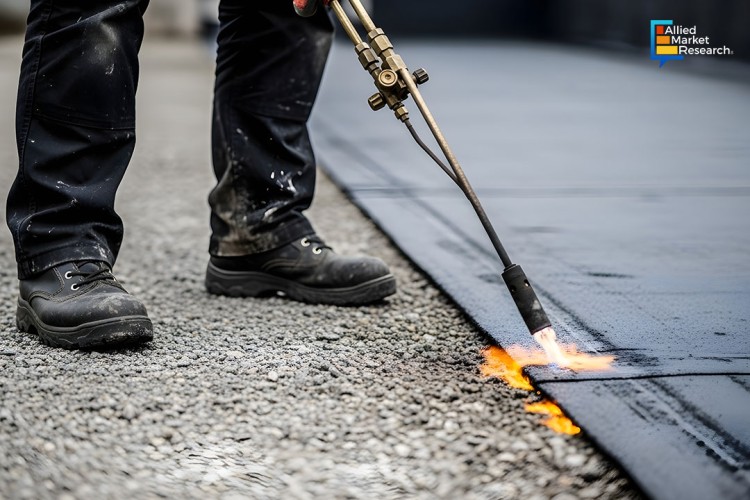
Bitumen is used as a waterproofing agent for roofing. It prevents water from seeping in. It also seals cracks and ensures that the inner surface remains dry, which protects structures from being damaged by moisture. Therefore, it is used in insulation, sealing, and soundproofing. It protects surfaces from chemical exposure, and mechanical wear. Thus, it is used in pavements, cycling tracks, runways, playgrounds, railway platforms, car parks, and bust stops.
Bitumen is modified using various polymers to enhance its performance to withstand extreme conditions. Bitumen paints offers a protective coating to surfaces and can be applied on iron, steel, concrete, wood, and many other materials. Thus, it is used in dams, boat hulls, tanks, pools, reservoirs, fire escapes, table and pipe coatings, chemical resistant linings, railings, fences, building, roof and tile waterproofing, paints, and others.
End users of Bitumen
The end users of bitumen include industries and sectors that use its unique properties. Thus, it has wide applications in construction and infrastructure development for paving as well as building and maintaining highways, streets, and airport runways. Thus, road construction companies and government agencies are the major end users of bitumen. The roofing industry applies bitumen in shingles and waterproof membranes. Construction firms apply bitumen for waterproofing foundations, basements, and bridges. In industries, it is used as a sealant. Furthermore, it is used for insulation, pipe coating, lamination, and waterproofing.
Advancements in the Bitumen Sector
Ongoing R&D in bitumen focuses on technological innovations that enhance its performance, application efficiency, and sustainability. Thus, polymer-modified bitumen (PMB) is being developed, in which the added polymers enhance the elasticity, strength, and resistance to temperature variations of bitumen. The polymer-modified bitumen further decreases cracking and rutting. This enhances road durability. Crumb rubber modified bitumen (CRMB) incorporates recycled rubber from tires. It promotes management of waste while improving its durability.
Warm mix asphalt (WMA) technology mixes and applies bitumen at lower temperatures. This decreases energy use and minimizes health risks for workers. In addition, bio-bitumen from vegetable oils, lignin, and renewable sources are being developed as an eco-friendly and sustainable alternative.
Nanotechnology adds nanosilica or nanoclay during production to enhance binding, resistance, and thermal properties of bitumen. This is expected to increase stiffness and water resistance capabilities and enhance the durability of roads and pavements. In addition, smart technologies such as IoT sensors, self-healing components, nanomaterials, and automated equipment are being used. This helps in real-time monitoring of road conditions. They repair cracks while ensuring better quality control and maintenance during and after road construction. This significantly reduces maintenance and repair costs.
Moreover, bitumen can be recycled and reused for various purposes, which makes it environment friendly. These advancements increase infrastructure durability, lower maintenance costs, and contribute to more sustainable construction practices.
Impact of AI on the Bitumen Industry
Integration of AI enhances the quality, efficiency, and sustainability of bitumen. It optimizes the mix and design while balancing strength, durability, and requirement costs. Machine learning models analyze and select the proper materials that suit different weather and traffic conditions. This enables engineers to optimize road construction and infrastructure development.
AI monitors temperature and material distribution in real time to minimize downtime using smart sensors and automation equipment. It ensures consistency and quality, while reducing human error while extending the equipment life. Predictive maintenance analyzes road conditions using AI and predicts formation of cracks, potholes, and other maintenance issues beforehand. This helps schedule frequent repairs, which saves costs and leads to longer lasting roads.
Use of AI optimizes energy use and supports sustainability during bitumen production. It enables better recycling of reclaimed asphalt materials. Road surfaces are inspected using drones and computer vision systems, which increase efficiency and improve overall safety while reducing manual labor. Thus, AI lowers production costs, enhances decision-making and real time monitoring, and promotes smarter, more sustainable use of bitumen in infrastructure development.
Conclusion
The adhesive and water-resistant properties of bitumen are sustainable for all weather conditions, which makes it a major component in construction and infrastructure development. Thus, it has extensive applications in road building, roofing, construction and infrastructure, and industrial applications. Its durability and sustainability has increased owing to developments such as polymer-modified bitumen, warm mix asphalt, and improved recycling methods. Moreover, the use of AI has increased the efficiency and reduced the duration of construction processes. They enable better-quality and longer lasting infrastructure while decreasing costs and reducing the impact on the environment. As technology continues to evolve, the bitumen industry is becoming more efficient and cost effective. Thus, bitumen is expected to play a pivotal role in building strong and sustainable infrastructure in the future.
Short Description Bitumen is a viscous, dense substance obtained by distilling crude oil. It is applied in road construction, highways, buildings, dams, industrial sectors, roofing, and sealing works. Its waterproofing properties are used in paints, pavements, binders, disinfectants, moisture resistant barriers, soundproofing, hydraulics and erosion control, along with many other applications.