


Bengaluru, Karnataka, India
- India’s lithium-ion battery demand is expected to roughly quintuple to over 115 GWh by 2030, while the country remains heavily dependent on imported battery cells and critical materials.
- As India pushes toward 500 GW of non-fossil power capacity, batteries have become one of the country’s most important manufacturing and energy-security challenges.
Lithium batteries keep catching fire. Why do they keep failing – and is there a safer alternative already on the production line? Can a country build a battery industry without depending on China for rare earths? And what would it actually take to build a battery company in India today?
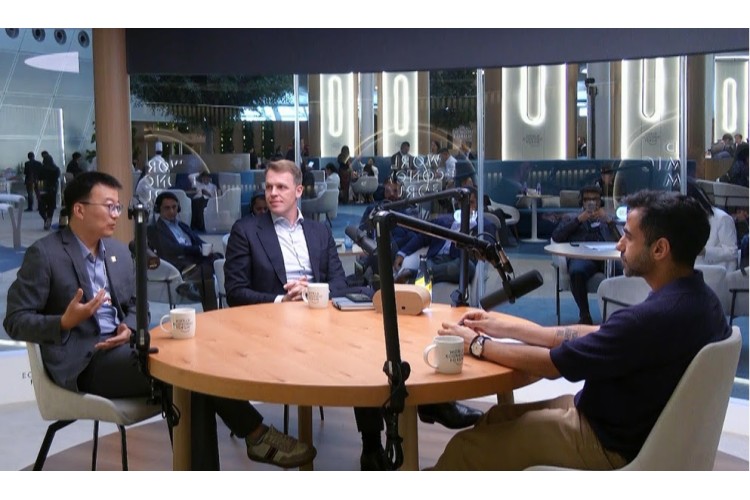
In the latest episode of People by WTF, Nikhil Kamath, who has been investing in energy-transition companies through his private-equity fund, sits down with Henning Rath, CEO of EnerVenue, and Kun Tang, Executive Chairman of HiNa Battery, to understand what the next battery industry could look like and whether India should build it. The conversation moves from battery chemistry to industrial policy, manufacturing, AI infrastructure, and the economics of building a battery company from scratch in India.
One of the episode’s sharpest moments comes when Kamath presses on lithium-iron-phosphate (LFP) batteries – the chemistry powering most electric vehicles globally, including many Teslas and BYDs. Rath explains “thermal runaway”: once a battery reaches a certain temperature, its internal reaction becomes self-accelerating and cannot be stopped. Tang then offers a number that visibly stops Kamath – the world recorded over 14,000 LFP battery fires in 2025 alone. “The higher the energy, the more safety issues,” Tang says. “The energy is like water in a pump, but the tube is thin. That’s easy to break.” Neither guest treats this as purely a chemistry problem: Tang notes that safety incidents cluster heavily among smaller, tier-two Chinese manufacturers. At the same time, leaders like CATL and BYD charge a premium precisely because of tighter production quality.
The conversation turns to what comes after lithium. Tang, whose company has already supplied what it describes as the world’s first 100-megawatt-hour sodium-ion storage project, argues sodium costs roughly a tenth of lithium, resists thermal runaway at current energy densities, and is built from materials – sodium, iron, phosphate – that almost any country can source domestically. Its trade-off is energy density, which for now limits it to grid storage and short-range vehicles like scooters and three-wheelers rather than long-range cars. Rath’s EnerVenue bets on a different route entirely: a nickel-based, water-electrolyte battery adapted from technology NASA once used, designed to sharply reduce fire risk by removing the higher-risk components that trigger thermal runaway, and rated for 30,000 charge cycles, though it currently works only for stationary storage, not vehicles. Both are skeptical that solid-state batteries, often billed as lithium’s true successor, are close to market, citing an industry readiness scale of one to nine, Tang places the technology at around level four, strong in research papers but far from commercial production.
Looking further out, Rath frames the next decade around three converging “super cycles” – electrification, manufacturing and AI – all running ahead of supply, and argues that any country serious about competing will need genuine energy independence rather than dependence on imported lithium and rare earths, a dependency he expects to grow more contested as globalisation gives way to regional blocs. He points to 2023 as the year renewable power paired with batteries quietly became cheaper than fossil fuels across much of the world, a shift he expects AI data centres to accelerate as they move away from diesel backup power toward safer battery storage.
The discussion turns directly to India, where Kamath is weighing an entry into the energy transition himself. “After my trip in China, I want to go back to India and start a business,” Kamath says, asking his guests point blank whether he should build an electric car company or a battery company. Rath’s answer is unambiguous: skip the car company. Build a battery company decoupled from lithium and rare earths altogether, pointing to India’s scooter and three-wheeler market as a natural first customer for sodium-ion technology. The two also unpack how BYD went from a phone-battery maker to a fully vertically integrated EV and battery giant within roughly a decade, backed by what Rath calls China’s “government venture capital” model: funding dozens of companies in a sector and expecting only a handful, BYD and CATL among them, to ultimately survive and dominate.
The episode closes on China’s relationship with AI, which both guests describe as defined more by curiosity than anxiety – spanning three generations in Tang’s own family, from his 90-year-old grandfather ordering drone food delivery to his six-year-old daughter. “The excitement is outpacing the anxiety,” Rath says, calling it a marked contrast to the mood he encounters in the United States.
“No single technology will solve our problem,” Tang offers as a closing thought. “We need more different chemistry to meet different demands.” It’s a fitting close to a conversation that treats the search for the next great battery less as a single breakthrough than an unglamorous, ongoing race, measured in charge cycles, safety margins and cost curves rather than headlines.