

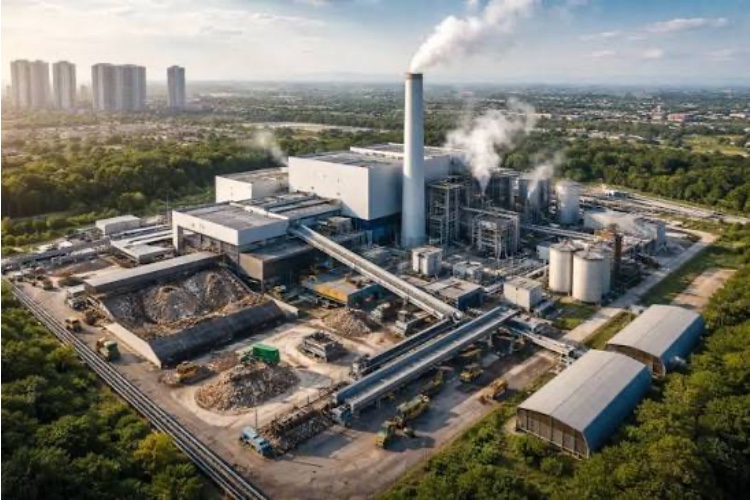
Every day, cities generate an enormous resource that is often treated as a problem: waste. From household garbage and food waste to agricultural residues, industrial by-products and sewage, the volume of discarded material continues to rise alongside urbanisation and consumption. Increasingly, however, technology is changing the way the world looks at this waste—not simply as something to collect and dispose of, but as a potential source of electricity, heat, biogas, Bio-CNG and other valuable products.
The global waste-to-energy market was valued at approximately US$41.4 billion in 2025 and is estimated to reach US$43.1 billion in 2026, with projections putting the market at around US$55.3 billion by 2033, representing a compound annual growth rate of about 3.6%. Asia-Pacific is among the fastest-growing regional markets, driven by urbanisation, increasing waste generation and investment in waste-management infrastructure.
Another recent market assessment places the global industry at US$37.29 billion in 2025, highlighting an important point: market estimates differ depending on methodology and what technologies and services are included. That study forecasts the market to reach US$51.68 billion by 2034.
The opportunity is particularly significant for India. According to the Central Pollution Control Board’s 2021–22 annual report, Indian states and Union Territories reported approximately 170,339 tonnes per day (TPD) of municipal solid waste generation, equivalent to roughly 62 million tonnes annually if maintained at that daily level. Of this, about 91,511 TPD was reported as processed or treated, while approximately 41,455 TPD was landfilled.
Beyond Disposal: The New Waste Economy
Traditional waste management has largely followed a linear model: collect, transport and dispose. Waste-to-energy introduces a different approach—recovering value before the material reaches its final destination.
The technologies involved are diverse. Organic waste can be processed through anaerobic digestion to produce biogas. That biogas can subsequently be upgraded into Bio-CNG or used to generate electricity and heat. Dry, combustible waste can be converted into refuse-derived fuel, while advanced thermal technologies such as gasification and pyrolysis can transform suitable waste streams into syngas, fuels and other products.
The Ministry of New and Renewable Energy (MNRE) has explicitly included the generation of biogas, Bio-CNG, power and producer/syngas from urban, industrial and agricultural wastes and residues within its Waste-to-Energy programme.
This diversification is important because there is no single technology capable of processing every type of waste efficiently.
Food waste behaves differently from plastic. Agricultural residue behaves differently from municipal solid waste. Industrial effluents require different treatment from household organic waste. The future of waste-to-energy is therefore likely to depend on matching the right feedstock with the right technology.
Anaerobic Digestion: Making Organic Waste Work
One of the most promising pathways is biomethanation.
In an anaerobic digestion system, microorganisms break down biodegradable organic material in the absence of oxygen. The process produces biogas, which primarily contains methane and carbon dioxide, along with a digestate that can potentially be used as a nutrient-rich soil amendment after appropriate treatment.
For cities, the technology creates an opportunity to deal with food and wet organic waste locally while simultaneously producing energy.
For industries, the same principle can be applied to wastewater, distillery effluent, food-processing waste and other organic streams.
MNRE’s programme provides financial assistance for eligible projects producing Bio-CNG, with support structured around production capacity. The programme also provides assistance for power generation from biogas and for power based on certain bio and agro-industrial waste streams.
The importance of this model goes beyond electricity. A successful biomethanation ecosystem can produce three outputs from one waste stream: energy, fuel and bio-manure.
That makes it particularly relevant to the circular economy.
The Rise of Bio-CNG
India’s transportation sector provides another potential market for waste-derived energy.
Organic municipal waste, agricultural residues and industrial waste can be converted into biogas and then upgraded into compressed biomethane. The resulting Bio-CNG can be used in applications where compressed natural gas is already utilised.
The value proposition is straightforward: instead of allowing organic waste to decompose without energy recovery, the methane generated through controlled digestion can be captured, purified and used as fuel.
MNRE’s programme identifies Bio-CNG and enriched biogas as important outputs of waste-to-energy projects, including projects using urban waste, agricultural waste, industrial waste and effluents.
The challenge, however, is not simply producing gas. Feedstock aggregation, segregation, transportation, contamination, plant utilisation and long-term offtake agreements all influence the economics of a project.
In other words, technology is only one part of the equation. The real innovation lies in building the entire ecosystem around it.
AI Enters the Waste Stream
Artificial intelligence and automation are beginning to change waste management before waste even reaches the energy-conversion stage.
Computer vision can identify different waste materials on conveyor belts. Robotic systems can assist in sorting. Sensors can monitor moisture, composition and contamination. Data analytics can help operators forecast waste volumes and optimise plant performance.
For waste-to-energy plants, better sorting can have a direct impact on efficiency.
Consider a thermal conversion plant receiving a highly inconsistent waste stream. Variations in moisture and calorific value can affect combustion conditions, energy output and emissions. Better segregation and real-time monitoring can therefore help create a more predictable feedstock.
Digital technologies can also support predictive maintenance. Sensors installed across equipment can monitor temperature, vibration, pressure and other operating parameters, helping operators identify potential failures before they result in major downtime.
The next generation of waste-to-energy facilities could therefore look less like conventional waste-processing plants and more like highly automated energy-production facilities.
Beyond Incineration: Gasification and Pyrolysis
Thermal technologies remain an important part of the waste-to-energy landscape, but innovation is expanding the technological toolkit.
Gasification converts carbon-based feedstock into a combustible gas, commonly referred to as syngas, through controlled high-temperature processes with limited oxygen. Depending on the feedstock and process configuration, syngas can be used for heat, power or further chemical conversion.
Pyrolysis heats organic material in the absence of oxygen, producing products such as gases, liquids and solid char.
These technologies are particularly relevant to the broader conversation around resource recovery because the objective is increasingly shifting from simply reducing waste volume to extracting multiple forms of value.
However, their commercial success depends heavily on feedstock quality, plant design, economics, environmental controls and the ability to operate consistently at scale.
India’s Infrastructure Gap Creates the Opportunity
India’s waste numbers show why innovation is urgently needed.
The CPCB’s 2021–22 data reported more than 170,000 TPD of municipal solid waste generation, while the reported treatment/processing level was approximately 91,500 TPD. The difference highlights the continuing infrastructure gap.
At the same time, India’s installed renewable-energy landscape remains dominated by technologies such as solar and wind. MNRE’s cumulative figures as of 31 August 2026 show around 168 GW of solar capacity and 58.5 GW of wind capacity, compared with approximately 324 MW of grid-connected waste-to-energy capacity and 554 MW of off-grid waste-to-energy capacity.
These figures underline an important distinction: waste-to-energy is not positioned to replace large-scale solar or wind. Instead, its value lies in solving two problems simultaneously—waste management and energy recovery.
It can also provide a more predictable energy output than intermittent renewable sources, depending on the technology and feedstock.
Financing Will Determine the Next Phase
Technology alone cannot build a waste-to-energy industry.
Projects require reliable feedstock, land, collection systems, segregation infrastructure, long-term contracts, power or fuel offtake and predictable regulation. Financing is equally critical because waste-to-energy facilities often require substantial upfront investment and depend on long operating periods to recover capital.
Government support can therefore play an important role in making projects commercially viable.
Under its Waste-to-Energy programme, MNRE has offered Central Financial Assistance for eligible Bio-CNG, biogas and power projects. For example, the programme specifies assistance of ₹4 crore per 4,800 kg/day of Bio-CNG production from a new biogas plant, subject to a maximum of ₹10 crore per project.
The programme also supports eligible biogas-based power projects and certain power-generation projects using bio and agro-industrial waste.
At the same time, policy design needs to recognise that different waste streams require different solutions. MNRE’s current programme specifically does not provide support for MSW/RDF-to-power projects based on thermal technologies such as incineration, gasification and pyrolysis under that particular scheme.
That distinction is important when evaluating India’s waste-to-energy opportunity: policy support exists, but the technology pathway and eligibility conditions matter.
The Road Ahead: From Waste Management to Resource Management
The most significant transformation may ultimately be conceptual rather than technological.
Waste should not be viewed as a single category. It is a collection of different materials with different economic and energy values.
Organic waste can become biogas and Bio-CNG. Agricultural residues can become energy or industrial fuel. Certain dry waste streams can become refuse-derived fuel. Recoverable materials can return to manufacturing. Residual waste can undergo controlled treatment.
This is the foundation of a circular waste economy.
The global market’s projected growth to more than US$55 billion by 2033 reflects increasing investment in technologies that can recover value from waste. For India, the opportunity is particularly connected to the country’s rapidly expanding cities, growing consumption and need for more efficient resource management.
But the next decade will not be defined simply by the number of waste-to-energy plants built. It will be defined by how effectively cities and industries integrate segregation, collection, recycling, biological treatment, thermal conversion, energy generation and material recovery into one connected system.
Conclusion: A New Life for What We Throw Away
The waste of today could become part of the energy system of tomorrow.
The combination of AI-powered sorting, advanced biomethanation, Bio-CNG production, gasification, pyrolysis, automation and digital plant management is opening new possibilities for extracting value from materials that once ended their journey in landfills.
Yet the biggest opportunity lies in treating waste-to-energy not as an isolated power-generation technology, but as part of a larger resource-recovery ecosystem.
For India, the equation is compelling: millions of tonnes of waste, expanding cities, rising energy demand and a growing need for circular economic models.
The challenge now is to build the infrastructure, policy frameworks, technology capabilities and business models capable of connecting these dots.
When that happens, the definition of waste itself could change.
What was once considered the end of a product’s useful life may increasingly become the beginning of another energy, fuel or material cycle.
The future may not be about producing more energy from more resources—it may be about recovering more energy from the resources we already have.