

Urja Daily
No Result
View All Result
  • News
  • Renewable
    • Solar
    • Rooftop
    • Floating Solar
    • Module
    • Wind
    • Hydrogen
    • Biomass
    • Tenders
    • Sustainibility
  • Storage
  • E-Mobility
  • Battery
  • Smart City
  • Power
    • Smart Grid
    • Microgrid
    • Off-Grid
  • Editor’s Pick
    • Articles
    • In Talks
    • E-MAG
    • Market Research
  • On-demand Webinars
  • More
    • Events
    • Contact Us
    • Subscribe
  • News
  • Renewable
    • Solar
    • Rooftop
    • Floating Solar
    • Module
    • Wind
    • Hydrogen
    • Biomass
    • Tenders
    • Sustainibility
  • Storage
  • E-Mobility
  • Battery
  • Smart City
  • Power
    • Smart Grid
    • Microgrid
    • Off-Grid
  • Editor’s Pick
    • Articles
    • In Talks
    • E-MAG
    • Market Research
  • On-demand Webinars
  • More
    • Events
    • Contact Us
    • Subscribe
No Result
View All Result
Urja Daily
No Result
View All Result
Home News

Toshiba’s Transparent Cu2O Tandem Solar Top Cell Achieves

Urja Daily by Urja Daily
December 22, 2021
in News
Reading Time: 3 mins read
0
Toshiba-s-transparent-Cu2O-solar-cell
Share on FacebookShare on TwitterShare on Linkedin

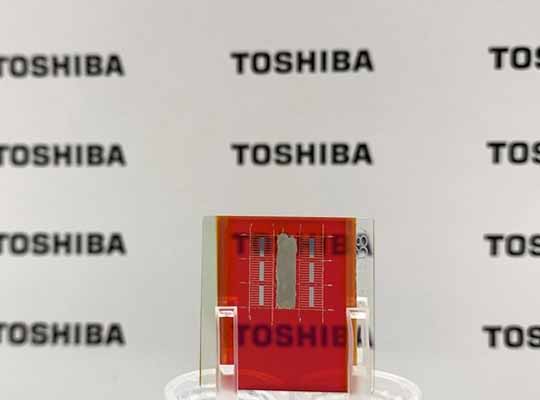
TOKYO — Toshiba Corporation announced that it has successfully raised the power conversion efficiency (PCE) of its transparent Cu2O solar cell to 8.4%, the world’s highest level for a reported Cu2O solar cell. With the cell positioned as the top cell over a 25% PCE silicon cell (Cu2O-Si tandem cell), Toshiba estimates that an overall PCE of 27.4% can be achieved, notably above the 26.7% highest PCE reported for any standard silicon cell.

Under the test criteria defined by Japan’s New Energy and Industry Technology Development Organization (NEDO), Toshiba estimates that the Cu2O-Si tandem cell will carry an EV 35km without any need of recharging. Looking ahead, Toshiba expects the new cell to boost development of EVs with no need for plug-in charging, and to advance other mobility applications, such as the High Altitude Platform Station (HAPS), the telecom platform in the stratosphere.

RELATED POSTS

VinFast India Partners with Federal Bank to Strengthen Dealer Financing Ecosystem

MC²+ Ignite Selects 30 Energy Deep-Tech Startups for Funding

The tandem solar cell offers the promise of more efficient solar modules by combining top and bottom cells that generate power at different wavelengths (Figure 3). Tandem cells that achieve an overall efficiency close to 30% have been reported, far higher than any conventional crystalline silicon cell, but they are fabricated with III-V materials, such as gallium arsenide, and their very high production costs─several hundred to several thousand times higher than for crystalline silicon solar cells─severely restrict application.

Toshiba has focused its R&D on transparent Cu2O cells. They are formed from naturally abundant materials, which lowers costs, and offer light transmittance that opens the way to excellent power generation efficiency. Toshiba developed the first transparent Cu2O solar cell in 2019, and demonstrated a Cu2O-Si tandem cell delivering 23.8% PCE in the same year, a time when the typical PCE of stand-alone silicon solar cells was 22%.

The company’s latest advance in PCE is the result of precise control of CuO and Cu impurities during the fabrication of the cell’s Cu2O layer. These impurities are generated in the current reactive sputtering deposition method due to the nature of the Cu2O, and they are the major cause of diminished PCE and transparency.

Commenting on the breakthrough, Kazushige Yamamoto, Fellow at Toshiba’s Corporate Research & Development Center, said: “X-ray diffraction analysis allows us to detect and quantify the degree of the CuO and Cu, giving us data that helps us to identify the best deposition method to control the impurities to the lowest level. Our targets are 10% PCE for the top Cu2O cell, and 80% of transmittance. This breakthrough brings us a step closer to those goals (Figure 4).”

Details on this technology were recently published in Applied Physics Letters.

With support from NEDO, Toshiba will continue research to achieve the 10% PCE target for top Cu2O cells. Toshiba is also cooperating with Toshiba Energy Systems & Solutions Corporation in the development of large-scale Cu2O solar cells that are the same size as mass-produced silicon solar cells. The two companies aim to supply samples for external evaluations by FY2023, with a roadmap to completing manufacturing technologies for commercial products by FY2025.

Tags: powersolar cellToshibatransparent Cu2O
ShareTweetShare
Urja Daily

Urja Daily

Related Posts

VinFast India

VinFast India Partners with Federal Bank to Strengthen Dealer Financing Ecosystem

by Palak
August 22, 2026
0

Gurugram, Haryana, India - VinFast India has signed a Memorandum of Understanding (MOU) with Federal Bank, one of India’s leading...

IGNITE

MC²+ Ignite Selects 30 Energy Deep-Tech Startups for Funding

by Palak
August 22, 2026
0

National : MC²+, an energy innovation platform led by the Ministry of Petroleum & Natural Gas (MoPNG) and backed by...

Palo Alto Networks

Palo Alto Networks Introduces Frontier AI Critical Defense Program

by Palak
August 20, 2026
0

Mumbai, India — Palo Alto Networks announced the Frontier AI Critical Defense Program, a first-of-its-kind initiative to protect critical infrastructure from...

FLIR

FLIR: End-to-End Reliability Partner for Data Centers

by Palak
August 19, 2026
0

For a data center operator, risk rarely comes down to a single system or department. For a data center operator,...

Kalpataru

Kalpataru Projects Wins ₹3,526 Crore Orders Across Businesses

by Palak
August 19, 2026
0

Kalpataru Projects International Limited has secured new orders worth approximately Rs 35.26 billion across multiple business segments. The orders include...

Next Post
Zypp

Zypp Electric Partnered with Flo Mobility to Expand its Footprint

GE1

Green Energy push for future Sustainability in India

Leave a Reply Cancel reply

Your email address will not be published. Required fields are marked *

RECOMMENDED

Beyond Installation: What Defines a Successful Industrial Solar Project?

August 22, 2026
Shweta Solar

Shweta Solar pushes for stronger storage and grid readiness as rooftop solar expands

August 22, 2026

MOST VIEWED

  • Solar

    When the Sun Began Paying the Electricity Bills: The Story of PM Surya Ghar Muft Bijli Yojana

    0 shares
    Share 0 Tweet 0
  • India’s Emerging Polysilicon Manufacturing Ecosystem: Opportunities and Challenges

    0 shares
    Share 0 Tweet 0
  • KP Group & PP Savani University Launches Urjanoor Scholarship

    0 shares
    Share 0 Tweet 0
  • StarlinePS Enterprises Invests ₹160 Crore in Celloraa Energy

    0 shares
    Share 0 Tweet 0
  • Business Delegation Signs 66 MoUs During Central Asia Visit to Boost Multi-Sector Collaboration

    0 shares
    Share 0 Tweet 0

Beyond Installation: What Defines a Successful Industrial Solar Project?

Shweta Solar pushes for stronger storage and grid readiness as rooftop solar expands

VinFast India Partners with Federal Bank to Strengthen Dealer Financing Ecosystem

MC²+ Ignite Selects 30 Energy Deep-Tech Startups for Funding

Servotech Renewable Launches New TVC for Solar Lithium Batteries Featuring Sonu Sood

Nuvoton Begins Production of 16-Cell Battery Monitoring ICs for AI Servers

Latest Magazine

© 2016 – 2025 TechZone Print Media | All Rights Reserved

  • About Us
  • Contact Us
No Result
View All Result
  • News
  • Renewable
    • Solar
    • Rooftop
    • Floating Solar
    • Module
    • Wind
    • Hydrogen
    • Biomass
    • Tenders
    • Sustainibility
  • Storage
  • E-Mobility
  • Battery
  • Smart City
  • Power
    • Smart Grid
    • Microgrid
    • Off-Grid
  • Editor’s Pick
    • Articles
    • In Talks
    • E-MAG
    • Market Research
  • On-demand Webinars
  • More
    • Events
    • Contact Us
    • Subscribe

© 2016 - 2025 TechZone Print Media | All Rights Reserved