

Urja Daily
No Result
View All Result
  • News
  • Renewable
    • Solar
    • Rooftop
    • Floating Solar
    • Module
    • Wind
    • Hydrogen
    • Biomass
    • Tenders
    • Sustainibility
  • Storage
  • E-Mobility
  • Battery
  • Smart City
  • Power
    • Smart Grid
    • Microgrid
    • Off-Grid
  • Editor’s Pick
    • Articles
    • In Talks
    • E-MAG
    • Market Research
  • On-demand Webinars
  • More
    • Events
    • Contact Us
    • Subscribe
  • News
  • Renewable
    • Solar
    • Rooftop
    • Floating Solar
    • Module
    • Wind
    • Hydrogen
    • Biomass
    • Tenders
    • Sustainibility
  • Storage
  • E-Mobility
  • Battery
  • Smart City
  • Power
    • Smart Grid
    • Microgrid
    • Off-Grid
  • Editor’s Pick
    • Articles
    • In Talks
    • E-MAG
    • Market Research
  • On-demand Webinars
  • More
    • Events
    • Contact Us
    • Subscribe
No Result
View All Result
Urja Daily
No Result
View All Result
Home News

Sharp Achieves Conversion Efficiency of 32.65% in Lightweight, Flexible Solar Module

Urja Daily by Urja Daily
June 7, 2022
in News, Solar
Reading Time: 3 mins read
0
Sharp
Share on FacebookShare on TwitterShare on Linkedin

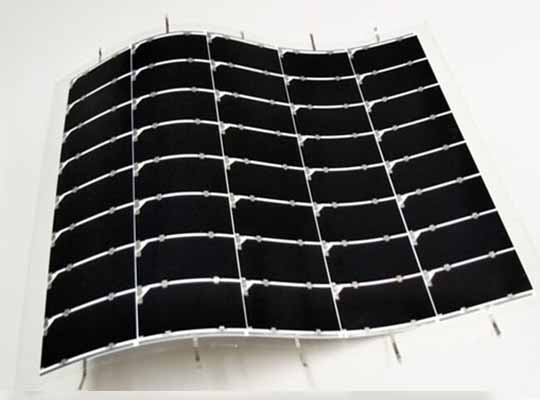
Sharp Corporation has achieved a conversion efficiency of 32.65%, the world’s highest, in a lightweight, flexible, practically sized solar module developed as part of the “Research and Development of Solar Cells for Use in Vehicles” project*3, which is administered by the New Energy and Industrial Technology Development Organization (NEDO) of Japan.

The module’s conversion efficiency bests that of a similar Sharp module developed under another NEDO project in 2016, which notched an efficiency of 31.17%, at the time a world record. The new prototype solar module, which uses a triple-junction compound design*4, is both lightweight and flexible thanks to its structure, which sandwiches the solar cell between layers of film. As a result, the module is expected to be used in a variety of vehicles, an application that demands high efficiency and lightweight construction.

RELATED POSTS

Shweta Solar pushes for stronger storage and grid readiness as rooftop solar expands

VinFast India Partners with Federal Bank to Strengthen Dealer Financing Ecosystem

Sharp will continue to conduct R&D into more efficient, lower-cost solar modules with a view to their use in applications including electric vehicles (EVs) and aerospace. The design, which embodies one path towards achieving carbon neutrality by 2050, will help reduce greenhouse gas emissions from vehicles.

*1 As of June 6, 2022, for solar modules at the research level (based on a survey by Sharp).

*2 Conversion efficiency confirmed by the National Institute of Advanced Industrial Science and Technology (AIST; one of several organizations around the world that officially certifies energy conversion efficiency measurements in solar cells) in February 2022. (Module surface approx. 965 square centimeters; maximum output 31.51 W)

*3 Project name: Development of Technologies to Promote Photovoltaic Power Generation as a Primary Power Source; Development of Technologies for Creating New Markets for Photovoltaic Power Generation; Research and Development of Solar Cells for Use in Vehicles (Development of Technologies for Super-high-efficiency Modules)
Project dates: FY2020 to FY2022 (with possible extension to FY2024)

*4 A type of solar cell that achieves high conversion efficiency by incorporating three photo-absorption layers made of compounds consisting of two or more elements, for example indium, gallium, and arsenic, such that each layer absorbs light of a different wavelength.

Development Background

Efforts to introduce electrified vehicles as a way to lower CO2 emissions and address air pollution are accelerating in the transportation industry, which relies on fossil fuels to meet most of its energy demands. The prospect of supplying power derived from renewable energy is attracting high expectations as an approach with the potential to maximize the effectiveness of those vehicles. In addition, power derived from renewable energy can be supplied directly by equipping EVs with solar cells, promising to make them more convenient for users, for example by lowering fuel costs and reducing the number of times they require charging.
Against this backdrop, Sharp has been developing high-efficiency, low-cost solar modules that can conform to the curved surfaces of vehicles for use in a broad range of vehicles, including in standard EV and aerospace applications, by 2050. This time, Sharp succeeded in developing a lightweight, flexible solar module with a conversion efficiency of 32.65%, the world’s highest.

■ Results

1.  Development of a light, flexible solar module

Whereas modules to date have sandwiched solar cells between two sheets of glass, Sharp was able to achieve a lightweight, flexible module by switching to a structure in which the cells are sandwiched between sheets of thin film. Modules measuring about 29 by 34 centimeters (for an area of 965 square centimeters), a size which is large enough to be commercially viable, weigh only about 56 grams (0.58 kilograms per square meter).

2. Achievement of the world’s highest conversion efficiency

Sharp’s triple-junction compound solar cell adopts a proprietary structure that comprises three photo-absorption layers with indium gallium arsenide as the bottom layer so that sunlight can be efficiently converted into electricity. Smaller cells using this structure (with an area of 1.047 square centimeters) achieved a conversion efficiency of 37.9% in April 2013. Then in 2016, Sharp used practically sized cells (with an area of 27.86 square centimeters) to create a composite module (with an area of 968 square centimeters) to achieve a conversion efficiency of 31.17%, at the time the world’s highest.
In this project, Sharp increased the average conversion efficiency of its triple-junction compound solar cells (with an area of 22.88 square centimeters) from the 2016 modules (from about 34.5% to about 36%) and improved the cell fill factor on each module to improve the conversion efficiency for a practically sized module (with an area of 965 square centimeters) to 32.65%.


Tags: Sharpsolar cellsolar module
ShareTweetShare
Urja Daily

Urja Daily

Related Posts

Shweta Solar

Shweta Solar pushes for stronger storage and grid readiness as rooftop solar expands

by Palak
August 22, 2026
0

New Delhi : The rooftop solar market in India has moved well beyond the early stage of convincing households to...

VinFast India

VinFast India Partners with Federal Bank to Strengthen Dealer Financing Ecosystem

by Palak
August 22, 2026
0

Gurugram, Haryana, India - VinFast India has signed a Memorandum of Understanding (MOU) with Federal Bank, one of India’s leading...

IGNITE

MC²+ Ignite Selects 30 Energy Deep-Tech Startups for Funding

by Palak
August 22, 2026
0

National : MC²+, an energy innovation platform led by the Ministry of Petroleum & Natural Gas (MoPNG) and backed by...

Servotech Renewable Power System Ltd.

Servotech Renewable Launches New TVC for Solar Lithium Batteries Featuring Sonu Sood

by Palak
August 20, 2026
0

New Delhi : Servotech Renewable Power System Ltd. has launched its latest TVC under its ongoing brand campaign featuring actor...

Palo Alto Networks

Palo Alto Networks Introduces Frontier AI Critical Defense Program

by Palak
August 20, 2026
0

Mumbai, India — Palo Alto Networks announced the Frontier AI Critical Defense Program, a first-of-its-kind initiative to protect critical infrastructure from...

Next Post
Tata Power EZ charging

Kolte-Patil, Tata Power to set up Charging Stations in Pune

Dr Abhilasha Gaur

Learn how to be Robotic Automation Lead Design Specialist

Leave a Reply Cancel reply

Your email address will not be published. Required fields are marked *

RECOMMENDED

Beyond Installation: What Defines a Successful Industrial Solar Project?

August 22, 2026
Shweta Solar

Shweta Solar pushes for stronger storage and grid readiness as rooftop solar expands

August 22, 2026

MOST VIEWED

  • Solar

    When the Sun Began Paying the Electricity Bills: The Story of PM Surya Ghar Muft Bijli Yojana

    0 shares
    Share 0 Tweet 0
  • India’s Emerging Polysilicon Manufacturing Ecosystem: Opportunities and Challenges

    0 shares
    Share 0 Tweet 0
  • KP Group & PP Savani University Launches Urjanoor Scholarship

    0 shares
    Share 0 Tweet 0
  • StarlinePS Enterprises Invests ₹160 Crore in Celloraa Energy

    0 shares
    Share 0 Tweet 0
  • Business Delegation Signs 66 MoUs During Central Asia Visit to Boost Multi-Sector Collaboration

    0 shares
    Share 0 Tweet 0

Beyond Installation: What Defines a Successful Industrial Solar Project?

Shweta Solar pushes for stronger storage and grid readiness as rooftop solar expands

VinFast India Partners with Federal Bank to Strengthen Dealer Financing Ecosystem

MC²+ Ignite Selects 30 Energy Deep-Tech Startups for Funding

Servotech Renewable Launches New TVC for Solar Lithium Batteries Featuring Sonu Sood

Nuvoton Begins Production of 16-Cell Battery Monitoring ICs for AI Servers

Latest Magazine

© 2016 – 2025 TechZone Print Media | All Rights Reserved

  • About Us
  • Contact Us
No Result
View All Result
  • News
  • Renewable
    • Solar
    • Rooftop
    • Floating Solar
    • Module
    • Wind
    • Hydrogen
    • Biomass
    • Tenders
    • Sustainibility
  • Storage
  • E-Mobility
  • Battery
  • Smart City
  • Power
    • Smart Grid
    • Microgrid
    • Off-Grid
  • Editor’s Pick
    • Articles
    • In Talks
    • E-MAG
    • Market Research
  • On-demand Webinars
  • More
    • Events
    • Contact Us
    • Subscribe

© 2016 - 2025 TechZone Print Media | All Rights Reserved