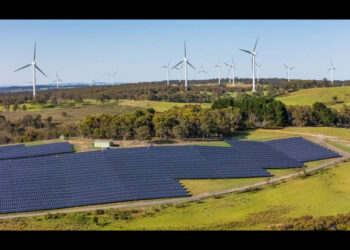




Washington DC – A review by the SUN DAY Campaign of data just released by the Federal Energy Regulatory Commission (FERC) reveals that the combination of solar and wind accounted for 91% of new U.S. electrical generating capacity added in the first half of 2025. In June, solar alone provided 82% of new capacity, making it the 22nd consecutive month in which solar has held the lead among all energy sources.
Solar was 82% of new generating capacity in June and 75% in the first half of 2025:
In its latest monthly “Energy Infrastructure Update” report (with data through June 30, 2025), FERC says 63 “units” of solar totaling 2,439 megawatts (MW) were placed into service in June, accounting for over 81.5% of all new generating capacity added during the month.
The new facilities include six solar farms with capacities of 199-MW or more: the 417.7-MW Ash Creek Solar Project and the 206.1-MW Mercury Solar & Storage Project both in Hill County, TX; the 300-MW Box Canyon Solar Project in Pinal County, AZ; the 250-MW Morris Solar Project in Adair County, MO; the 200.0-MW Big Star Solar & Storage Project in Bastrop County, TX; and the 199.0-MW Speedway Solar Project in Shelby County, IN.
The 14,567-MW of utility-scale (i.e., >1-MW) solar added during the first six months of 2025 was almost three-quarters (74.9%) of the total new capacity placed into service by all sources.
Solar has now been the largest source of new generating capacity added each month for twenty-two consecutive months: September 2023 – June 2025. During that period, total utility-scale solar capacity grew from 91.82 gigawatts (GW) to 151.73-GW. No other energy source added anything close to that amount of new capacity. Wind, for example, expanded by 10.53-GW while natural gas increased by just 2.73-GW.
Solar, wind and biomass were over 91% of new capacity added in the first half of 2025:
Between January and June, new wind has provided 3,139-MW of capacity additions – almost double the new capacity provided by natural gas (1,727-MW). Wind thus accounted for 16.1% of all new capacity added during the first six months of 2025. In June alone, the 144.0-MW Crossover Wind Project in Cross County, AR came on-line along with the 58.8-MW Moscow Wind Power Project in Somerset County, ME.
For the first half of 2025, the combination of solar and wind (plus 3-MW of biomass) was 91.04% of new capacity while natural gas provided just 8.88%; the balance came from oil (14-MW).
Solar + wind are almost a quarter of U.S. utility-scale generating capacity; all renewables combined are nearly a third:
Utility-scale solar’s share of total installed capacity of (11.34%) is now almost equal to that of wind (11.83%). Taken together, they constitute nearly one-fourth (23.17%) of the U.S.’s total available installed utility-scale generating capacity.
Moreover, at least 25-30% of U.S. solar capacity is in the form of small-scale (e.g., rooftop) systems that are not reflected in FERC’s data. [1] Including that additional solar capacity would bring the share provided by solar + wind to more than a quarter of the nation’s total.
With the inclusion of hydropower (7.62%), biomass (1.07%) and geothermal (0.31%), renewables currently claim a 32.17% share of total U.S. utility-scale generating capacity. If small-scale solar capacity is included, renewables are now about one-third of total U.S. generating capacity.
Solar remains on track to become the second largest source of U.S. generating capacity:
FERC reports that net “high probability” additions of solar between July 2025 and June 2028 total 92,660-MW – an amount more than four times the forecast net “high probability” additions for wind (23,136-MW), the second fastest growing resource. Notably, FERC’s most recent three-year forecasts for growth by both solar and wind are the highest they have been thus far in 2025.
FERC also foresees net growth for hydropower (583-MW) and geothermal (92-MW) but a decrease of 131-MW in biomass capacity.
Taken together, the net new “high probability” capacity additions by all renewable energy sources over the next three years – i.e., the bulk of the Trump Administration’s remaining time in office – would total 116,340-MW.
On the other hand, there is no new nuclear capacity in FERC’s three-year forecast while coal and oil are projected to contract by 25,017-MW and 1,572-MW respectively. Natural gas capacity would expand by 8,748-MW.
Adjusting for the different capacity factors of gas (59.7%), wind (34.3%), and utility-scale solar (23.4%), electricity generated by the projected new solar capacity to be added in the coming three years would be more than four times greater than that produced by the new natural gas capacity while the electrical output by the new wind capacity would be 52% more than that by gas. [2]
If FERC’s current “high probability” additions materialize, by July 1, 2028, solar will account for over one-sixth (17.1%) of the nation’s installed utility-scale generating capacity. Wind would provide an additional one-eighth (12.6%) of the total. Thus, each would be greater than coal (12.1%) and substantially more than either nuclear power or hydropower (7.3% and 7.1% respectively).
Assuming current growth rates continue, the installed capacity of utility-scale solar is likely to surpass that of wind capacity this year and exceed that of coal by the end of next year. Installed solar capacity is already almost 50% greater than that of nuclear power. Thus, within two years, solar should be in second place for installed generating capacity – behind only natural gas.
The combined capacities of all renewables, including small-scale solar, could overtake natural gas within three years:
The mix of all utility-scale renewables is now adding about two percentage points each year to its share of generating capacity. At that pace, by July 1, 2028, renewables would account for over three-eighths (38.1%) of total available installed utility-scale generating capacity – rapidly closing the gap with natural gas (40.0%). Solar and wind would constitute more than three-quarters of the installed capacity of renewable sources. If those trendlines continue, utility-scale renewable energy capacity should surpass that of natural gas in 2029 or sooner.
However, as noted, FERC’s data do not account for the capacity of small-scale solar systems. If that is factored in, within three years, total U.S. solar capacity (i.e., small-scale plus utility-scale) could approach 350-GW. In turn, the mix of all renewables would then be about 40% of total installed capacity – or more – while natural gas’ share would drop to about 38%.
Moreover, FERC reports that there may actually be as much as 230,770-MW of net new solar additions in the current three-year pipeline in addition to 68,627-MW of new wind, 7,923-MW of new hydropower, 202-MW of new geothermal, and 27-MW of new biomass. By contrast, net new natural gas capacity potentially in the three-year pipeline totals just 30,251-MW. Consequently, renewables’ share could be even greater by early summer 2028.
Evidence of the energy transition grows stronger as renewables’ share of generating capacity continues to increase while that of fossil fuels and nuclear power shrinks:
A year ago, the mix of all renewables accounted for 29.95% of total generating capacity. Solar alone was 8.99% while wind was 11.75%. Over the course of twelve months – i.e., by the end of June 2025 – renewables’ share had risen to 32.17% with solar at 11.34% and wind at 11.83%.
On the other hand, natural gas’ share had slipped from 43.32% to 42.34% as coal fell from 15.76% to 14.82% and oil dropped from 2.77% to 2.71%. Similarly, nuclear power’s share of generating capacity decreased from 8.04% to 7.80%.
“Notwithstanding the hostility towards solar and wind shown by the Trump Administration and its Republican supporters in Congress, both technologies are moving full-speed ahead,” noted the SUN DAY Campaign’s executive director Ken Bossong. “In fact, FERC’s latest data suggest growth by renewables may actually be accelerating.”