


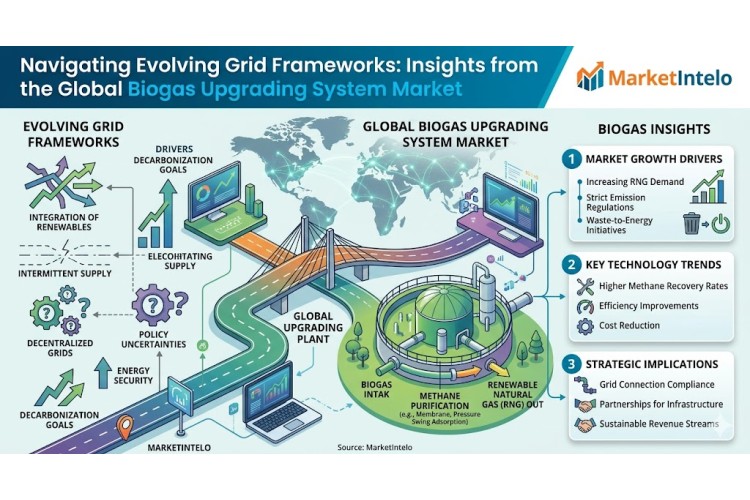
The global biogas upgrading system market is entering a more mature and strategic phase. What was once seen mainly as a waste-to-energy segment is now becoming an important part of the wider renewable gas economy. As countries push harder for decarbonization, energy security, and circular economy solutions, biomethane is gaining attention as a flexible fuel that can be injected into gas grids, used in transport, or applied in industrial settings.
However, the market is not growing evenly everywhere. One of the most important factors shaping its development is the evolving grid framework. In simple terms, the technical and regulatory rules for injecting upgraded biogas into gas networks are changing, and those changes are influencing investment decisions, plant design, and long-term project viability. For developers, utilities, and policymakers, understanding grid injection rules is becoming just as important as understanding upgrading technology itself.
According to Market Intelo, the Global Biogas Upgrading System market size was valued at $1.52 billion in 2024, and is forecasted to hit $4.31 billion by 2033, growing at a robust CAGR of 12.5% during the forecast period.
The Role of Biogas Upgrading
Raw biogas is produced from organic materials such as agricultural waste, sewage sludge, food waste, and landfill gas. Although useful as a renewable energy source, raw biogas contains carbon dioxide, water vapour, hydrogen sulphide, and other impurities that make it unsuitable for direct grid injection. Biogas upgrading systems remove these unwanted components and increase methane concentration, producing biomethane that can match natural gas quality standards.
This upgrading process is the bridge between local waste management and large-scale energy distribution. Once biomethane is cleaned and compressed to meet quality requirements, it can be fed into natural gas infrastructure. This ability makes it valuable in countries looking to reduce fossil fuel use without rebuilding their entire energy systems. In many ways, upgrading systems are no longer just treatment units; they are enabling technologies for the renewable gas market.
Why Grid Injection Rules Matter
Grid injection rules define what gas quality standards must be met before biomethane can enter a pipeline network. These rules usually cover methane content, oxygen levels, calorific value, pressure, sulphur content, moisture, and trace contaminants. While these standards exist to protect infrastructure and maintain gas safety, they also create a major challenge: they are often inconsistent across regions.
This inconsistency affects the market in several ways. First, it increases engineering complexity because upgrading systems must be designed around local requirements. Second, it raises project costs because extra purification, monitoring, and compression equipment may be needed. Third, it slows adoption where procedures are unclear or approval timelines are long. In short, a technically viable biomethane project may still fail commercially if the grid connection process is too difficult.
Changing Regulatory Landscape
Around the world, gas network rules are gradually evolving to accommodate renewable gas. In Europe, where biomethane deployment is relatively advanced, many countries are moving toward more structured frameworks for grid access. Some markets have detailed quality standards, while others are still refining connection procedures, tariff rules, and responsibility for gas balancing.
This regulatory evolution is significant because it shifts biomethane from being a niche environmental project to a mainstream energy asset. Governments are beginning to see that biomethane can help solve multiple problems at once: waste treatment, emissions reduction, local energy production, and grid diversification. As a result, policy support is increasingly focused not just on production incentives, but on making injection into the grid simpler and more predictable.
At the same time, regulators must balance innovation with safety. Gas networks are critical infrastructure, and operators cannot allow variable-quality gas without strict controls. That is why grid codes continue to evolve carefully. The trend is not toward weaker standards, but toward smarter, more transparent, and more harmonized standards that still protect network integrity.
Market Impact on Equipment Design
The impact of evolving grid frameworks is visible in the design of upgrading systems. Earlier projects often focused mainly on methane recovery efficiency. Today, system buyers also want reliable compliance, stable output quality, and real-time monitoring capabilities. This has increased demand for advanced sensors, automatic control systems, and polishing units that can ensure gas quality remains within tight limits.
Different upgrading technologies respond differently to these demands. Water scrubbing, membrane separation, pressure swing adsorption, and chemical absorption all have strengths, but the ideal choice depends on the feed gas composition and the local injection standard. For example, a market with stricter oxygen or nitrogen limits may require a more sophisticated configuration than one with more flexible standards. This means suppliers must offer not only equipment, but also regulatory awareness and project-specific engineering support.
The market is also seeing greater interest in modular and scalable systems. Smaller plants serving farms, municipalities, or food processing clusters often need compact solutions that can adapt to future rule changes. Larger systems, especially those tied to industrial or regional gas networks, may require more complex quality assurance systems. In both cases, flexibility is becoming a competitive advantage.
Key Challenges for Developers
Project developers face several challenges when working in this environment. One of the biggest is uncertainty. A project may be designed around current grid rules, only for those rules to change before commissioning. This creates risk for capital investment, permits, and long-term operations. Another challenge is administrative complexity, since grid connection can involve multiple stakeholders, including gas network operators, regulators, environmental agencies, and local authorities.
Data and monitoring requirements are also increasing. Grid operators often want continuous proof that injected biomethane meets standard conditions. That means projects need reliable metering, gas analysis, leak detection, and reporting systems. For smaller developers, these requirements can feel burdensome, but they are becoming part of the normal cost of market entry.
Feedstock quality also matters. Since biogas composition depends on the source material, facilities using agricultural waste may face different upgrading needs than plants using municipal waste or landfill gas. This makes early-stage site assessment critical. A strong project is not just about building a plant; it is about aligning feedstock, upgrading technology, and grid expectations from the beginning.
Opportunities in a Growing Market
Despite the challenges, the outlook for the biogas upgrading sector remains strong. Governments are under pressure to lower emissions, reduce dependence on imported fuels, and support domestic renewable energy industries. Biomethane fits all three goals. It can be produced locally, used in existing infrastructure, and scaled in a way that complements electrification.
There are also strong opportunities in sectors that are hard to electrify. Heavy transport, industrial heat, and certain chemical processes can benefit from renewable gas where direct electrification is difficult or expensive. This expands the addressable market for upgrading systems beyond pure grid injection and makes biomethane a more versatile asset.
Another opportunity lies in standardization. As countries align technical rules and simplify connection processes, project risk may decline and investment could accelerate. A more predictable regulatory environment would likely encourage more developers, financiers, and utilities to participate. Over time, this could create a more integrated global market for biogas upgrading systems.
Future Outlook
The future of the market will depend on how quickly grid frameworks adapt to renewable gas growth. If regulations become clearer and more harmonized, the sector could move from selective deployment to broader adoption. If standards remain fragmented, growth may continue but at a slower and more uneven pace.
Technology will continue to improve, but regulation will remain the main gatekeeper. The next phase of market development will likely reward companies that can combine strong engineering with compliance expertise. Those that understand local grid codes, design for quality assurance, and offer flexible systems will be better positioned to win contracts.
In the long run, biomethane could become a major component of low-carbon energy strategies. Its success, however, will not depend on upgrading systems alone. It will depend on whether grid frameworks evolve fast enough to turn renewable gas from an alternative option into a routine part of energy infrastructure.
ConclusionThe global biogas upgrading system market is being shaped by a simple but powerful reality: technology can only scale when regulation allows it to flow into the grid. Evolving grid frameworks are redefining how biomethane projects are planned, financed, and operated. For the industry, the future belongs to solutions that are not only efficient, but also compliant, adaptable, and ready for a more demanding regulatory environment.