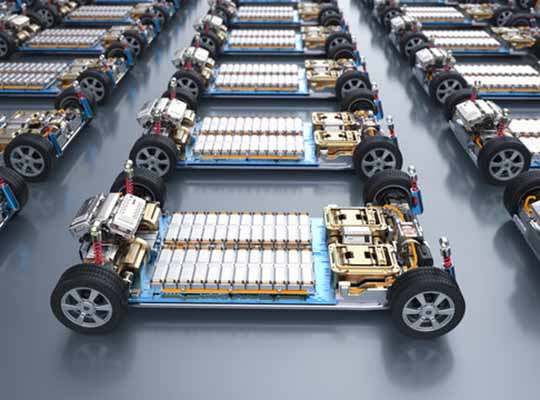



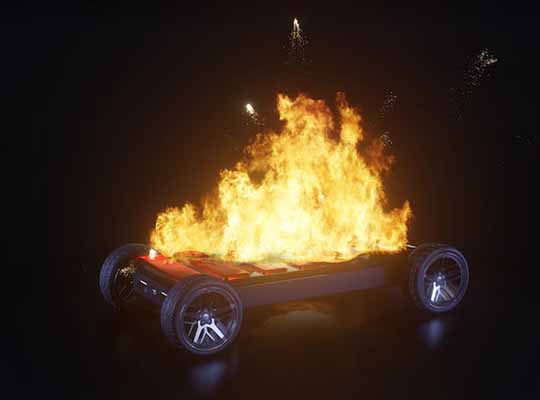
Thermal runaway and the associated battery fires have proven to be a critical concern for customers, battery designers, and electric vehicle manufacturers. Many vehicles have experienced battery fires and hundreds of thousands have been recalled. While these events are rare, they can be very severe, and it is important to provide as much safety for people in and around these vehicles. A common question is whether the upcoming solid-state battery technology will be safer and will this eliminate the need for thermal management and fire protection materials?
IDTechEx‘s report “Solid-State and Polymer Batteries 2023-2033: Technology, Forecasts, Players” looks at the technologies, players, safety, and adoption of solid-state batteries. While its report “Fire Protection Materials for Electric Vehicle Batteries 2023-2033” considers the materials used to prevent or delay the propagation of thermal runaway in EV battery packs.
Are Solid-State Batteries Safer?
At first glance, solid-state batteries present various safety benefits. They eliminate the flammable liquid electrolyte and can replace it with a non-flammable solid-state electrolyte. They also generally have a wider operating temperature window, potentially making the occurrence of thermal runaway through cell overheating less likely. The heat generated through external heating failure is also typically reduced.
However, this does not tell the entire story. The term solid-state battery actually refers to a host of battery technologies. In some cases, the battery will still use a liquid component for ion exchange (semi-solid-state), meaning a volatile component is still present. Some polymer solid-state electrolytes will not be completely inflammable, and any electrolyte can melt if the system gets hot enough.
In 2022, the public transport operator in Paris temporarily withdrew 149 electric buses after two separate bus fires. The cells used here were stated to use batteries with an LFP cathode, Li metal anode, and solid-state polymer electrolyte. The supplier describes its batteries as “completely solid, with no liquid components, no nickel, and no cobalt”.
Another example comes from a simulation-based research study from Sandia National Laboratories in 2022 (Hewson et. al., Joule, Vol.6, Issue 4, 742-755) that compared safety for an all-solid-state battery, a solid-state battery with liquid electrolyte added in the cathode, and a conventional liquid-based Li-ion battery. The study found that for external heating failure, a solid-state battery with a small amount of liquid electrolyte generates less heat than a typical Li-ion battery but more than an all solid-state battery. For short circuit failure, the heat released was only dependent on cell capacity. Given that solid-state batteries may have a higher energy density, more heat could be generated. The typical thermal runaway temperatures talked about for regular Li-ion batteries is around 1000-1200°C; in some scenarios in this research, the temperature rise of the solid-state batteries reached nearly 1800°C.
Solid-state battery development is still in progress, but the takeaway is that solid-state batteries may well be safer in most cases. Still, no battery system will be 100% safe. Hence, thermal management and fire protection materials will always be required to provide that final layer to delay fire propagation outside the pack.
Fire Protection Material Solutions
The sorts of fire protection material used for solid-state will largely be similar to those used for traditional Li-ion batteries, the form factor of the cells (cylindrical, prismatic, pouch), and the overall design of the pack will have a greater impact on the choice of material. Today, commonly used materials for passive fire protection are mica sheets, ceramic blankets, encapsulating foams, and fire retardant coatings, among others. Aerogels are gaining traction in the market and options like intumescent coatings and phase change materials are receiving increased interest.
Many of these materials would struggle to deal with temperatures above 1500°C. Still, the end goal is not necessarily to completely halt propagation but to delay it for as long as possible. In addition to high-temperature performance, these materials increasingly have to deal with other functions, such as conformability with cells, compression performance, and cost. The rapidly growing EV market, with an increased focus on fire safety, will present a variety of opportunities for fire protection materials and they will not be eliminated by alternative battery technologies like solid-state.
IDTechEx’s report “Solid-State and Polymer Batteries 2023-2033: Technology, Forecasts, Players”, offers technology benchmarking and analysis, market estimation and forecast, player activity tracking and evaluation, and supply chain establishment and security. Their report, “Fire Protection Materials for Electric Vehicle Batteries 2023-2033” provides material benchmarking, player adoption, pricing, and forecasts for several fire protection material categories.
To find out more about these reports, including downloadable sample pages, please visit www.IDTechEx.com/Research/ES.