

Urja Daily
No Result
View All Result
  • News
  • Renewable
    • Solar
    • Rooftop
    • Floating Solar
    • Module
    • Wind
    • Hydrogen
    • Biomass
    • Tenders
    • Sustainibility
  • Storage
  • E-Mobility
  • Battery
  • Smart City
  • Power
    • Smart Grid
    • Microgrid
    • Off-Grid
  • Editor’s Pick
    • Articles
    • In Talks
    • E-MAG
    • Market Research
  • On-demand Webinars
  • More
    • Events
    • Contact Us
    • Subscribe
  • News
  • Renewable
    • Solar
    • Rooftop
    • Floating Solar
    • Module
    • Wind
    • Hydrogen
    • Biomass
    • Tenders
    • Sustainibility
  • Storage
  • E-Mobility
  • Battery
  • Smart City
  • Power
    • Smart Grid
    • Microgrid
    • Off-Grid
  • Editor’s Pick
    • Articles
    • In Talks
    • E-MAG
    • Market Research
  • On-demand Webinars
  • More
    • Events
    • Contact Us
    • Subscribe
No Result
View All Result
Urja Daily
No Result
View All Result
Home EV Batteries

IDTechEx Assesses the Current Status of 800V for EVs

Palak by Palak
December 16, 2025
in EV Batteries
Reading Time: 4 mins read
0
IDTechEx
Share on FacebookShare on TwitterShare on Linkedin

The transition to 800V EVs is one which affects the whole powertrain, including the power electronics. In IDTechEx’s report, Power Electronics for Electric Vehicles 2026-2036: Technologies, Markets, and Forecasts, these trends are analysed and used to forecast the adoption of wide bandgap semiconductors SiC and GaN, as well as the entire power electronics market for electric vehicles (EV).

800V is Mature and Proven

RELATED POSTS

Integrals Power Validates Sustainably Produced Iron Phosphate Precursor and LFP Cathode Material in Cell Level at University of St Andrews

Sodium-Ion and Zinc-Air Batteries: The Future of Sustainable Energy Storage

The automotive industry is converging on 800V platforms for battery electric vehicles (BEVs), when earlier generations of vehicle were 400V. While 400V will certainly have a part to play in the next decade, the advantages of 800V platforms are undeniable, and in most cases worth the re-engineering of the powertrain to accommodate this.

Firstly, the higher voltage means that the battery can charge at greater power while using less current. For consumers that want charging to be as quick as refueling an internal combustion engine (ICE) vehicle, 800V vehicles can deliver greater average and peak rates of power. While this is generally the case, other parameters in the vehicle and also in the charger will determine the actual charging speed.

Secondly, since the voltage is much higher, significantly less current is required to deliver the same amount of power to the traction inverter and the motor. The end result is fewer losses and greater efficiency, allowing for either a small increase in range, or a reduction in battery size (and therefore weight and cost). Either case is advantageous, and SiC MOSFETs are much more efficient than Si IGBTs at 800V due to its material and device properties, such that the transition to 800V EVs and SiC MOSFETs go hand in hand.

Finally, since less current runs through the wiring harnesses in the vehicle, the diameter of the wiring harness can be significantly reduced. Copper is heavy and expensive, so a theoretical halving of the wiring harness diameter (excluding insulation and cooling requirements) delivers a compounded cost and weight saving. Even though BEVs are much more efficient than ICE vehicles, squeezing out extra efficiency at lower cost is beneficial to the consumer, but also to the OEM, many of which have struggled with the profitability of their BEVs.

There Are Different Ways to Achieve 400V to 800V Compatibility

There is one glaring issue with building an 800V platform EV: the majority of DC chargers in the world are 400V, meaning that there needs to be an onboard system to convert the 400V DC from the charger to 800V DC to charge the high voltage battery. Without such a system, the majority of DC chargers cannot be used. Mercedes controversially did not include an 800V booster in its announcement for the Mercedes CLA EV earlier in 2025, although this has since been reversed.

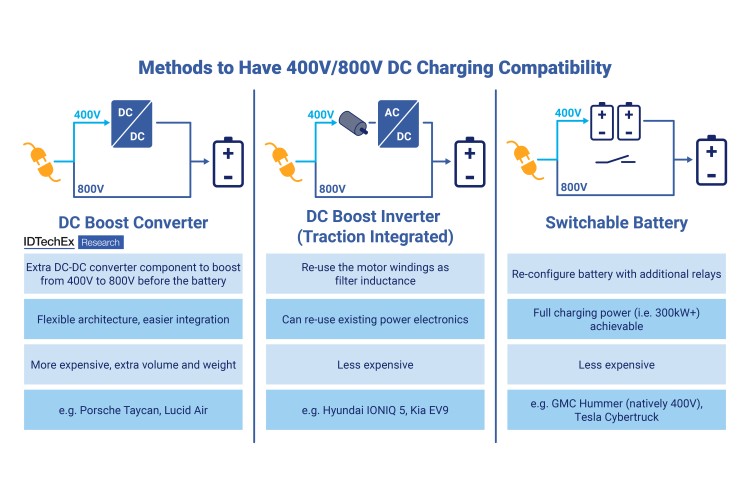
IDTechEx has identified three key ways to achieve 400V to 800V charging compatibility, each with its own advantages and disadvantages. While each system is complex, IDTechEx has found that battery switching, DC boost converters, and traction integrated onboard chargers are the three main approaches from OEMs and tier-one suppliers to achieve 800V compatibility.

Boost converters are the simplest method, whereby an extra DC-DC converter is installed onto the vehicle to boost the voltage from 400V to 800V before feeding into the high voltage battery. While this is simple, it is also costly to add this extra unit, especially when space in a vehicle is limited to begin with. This is the method used in the Porsche Taycan.

By switching the configuration of cells in charging, the battery pack can be charged as a mix of series and parallel connections to match the incoming voltage from the DC charger. The GMC Hummer and Tesla Cybertruck run variants of this technique to ensure charging compatibility.

Finally, traction integrated onboard chargers are a unique way to boost the voltage without the need for a separate DC-DC converter. The windings in the electric motor act as filter inductance, and are used to boost the voltage of the incoming DC from the charger without requiring a separate DC-DC converter unit. This is the approach used by Hyundai and Kia, and multiple tier-one suppliers have similar methods to boost voltage.

IDTechEx compares the three different ways to have charging compatibility between 400V and 800V. Source: IDTechEx.

IDTechEx analyzes different power electronics innovations alongside semiconductor technologies to forecast what the market will look like in ten years. Further information can be found in IDTechEx’s report, Power Electronics for Electric Vehicles 2026-2036: Technologies, Markets, and Forecasts.

For more information on this report, including downloadable sample pages, please visit www.IDTechEx.com/PowerElec, or for the full portfolio of EV research available from IDTechEx, see www.IDTechEx.com/Research/EV. 

Tags: BEVelectric vehicleEV ResearchEVsICEIDTechExpowerTechnology
ShareTweetShare
Palak

Palak

Related Posts

Integrals Power

Integrals Power Validates Sustainably Produced Iron Phosphate Precursor and LFP Cathode Material in Cell Level at University of St Andrews

by Urja Daily
June 22, 2026
0

MILTON KEYNES, UK: Integrals Power, the UK-based battery cathode innovators, today announces that its scientists are working alongside  the team at...

Sodium-Ion and Zinc-Air Batteries: The Future of Sustainable Energy Storage

by Urja Daily
June 19, 2026
0

Introduction As the world moves toward renewable energy and electric transportation, the demand for efficient, affordable, and environmentally friendly batteries...

AVILOO

AVILOO turns battery anxiety into battery confidence with industry-first warranty for used EVs

by Palak
June 16, 2026
0

AVILOO launches the UK’s first financially backed battery warranty for used electric vehicles, grounded in independent diagnostic data, not manufacturer...

91Wheels, Mahindra Electric

91Wheels, Mahindra Electric Complete India–Bhutan EV Journey

by Palak
June 12, 2026
0

New Delhi, Delhi, India - 91Wheels.com, in collaboration with Mahindra Electric Automobile Limited (MEAL), has successfully completed a landmark cross-border...

EV Charging

CIYES System Targets Growth in India’s EV Charging Market

by Palak
June 10, 2026
0

Bangalore, India : As India accelerates towards electric mobility, CIYES Systems is inviting entrepreneurs, property owners, fleet operators, institutions, and commercial...

Next Post
Vena Energy

Vena Energy Secures Funding for 300 MWp Solar Project in the Philippines

INTEC

INTEC secures USD 117 million EPC contract for 288 MWp Shafag solar project in Azerbaijan

Leave a Reply Cancel reply

Your email address will not be published. Required fields are marked *

RECOMMENDED

FPT TUVSUDV

FPT Enters The Top Three of Europe’s Certified High-Voltage Battery Producers With TÜV SÜD Recognition 

June 23, 2026
FPT

FPT And Green Power Systems Help Boost Algeria’s Powdered Milk Production

June 23, 2026

MOST VIEWED

  • Solar

    When the Sun Began Paying the Electricity Bills: The Story of PM Surya Ghar Muft Bijli Yojana

    0 shares
    Share 0 Tweet 0
  • India’s Emerging Polysilicon Manufacturing Ecosystem: Opportunities and Challenges

    0 shares
    Share 0 Tweet 0
  • KP Group & PP Savani University Launches Urjanoor Scholarship

    0 shares
    Share 0 Tweet 0
  • Xpeng Selects u‑blox F9 Centimeter-level Multi-Band GNSS Technology for P7 Smart EV

    0 shares
    Share 0 Tweet 0
  • How proper refurbishment can extend life of pre-owned bikes in India?

    0 shares
    Share 0 Tweet 0

FPT Enters The Top Three of Europe’s Certified High-Voltage Battery Producers With TÜV SÜD Recognition 

FPT And Green Power Systems Help Boost Algeria’s Powdered Milk Production

Gruner’s CBG Plant Sets Asia Record with 23.5 TPD Output, Achieves 120% of Design Capacity at Satna

Integrals Power Validates Sustainably Produced Iron Phosphate Precursor and LFP Cathode Material in Cell Level at University of St Andrews

Power Transmission is the Foundation of Economic Growth

VinFast India, Tata Capital Join Hands for Dealer Financing

Latest Magazine

© 2016 – 2025 TechZone Print Media | All Rights Reserved

  • About Us
  • Contact Us
No Result
View All Result
  • News
  • Renewable
    • Solar
    • Rooftop
    • Floating Solar
    • Module
    • Wind
    • Hydrogen
    • Biomass
    • Tenders
    • Sustainibility
  • Storage
  • E-Mobility
  • Battery
  • Smart City
  • Power
    • Smart Grid
    • Microgrid
    • Off-Grid
  • Editor’s Pick
    • Articles
    • In Talks
    • E-MAG
    • Market Research
  • On-demand Webinars
  • More
    • Events
    • Contact Us
    • Subscribe

© 2016 - 2025 TechZone Print Media | All Rights Reserved