


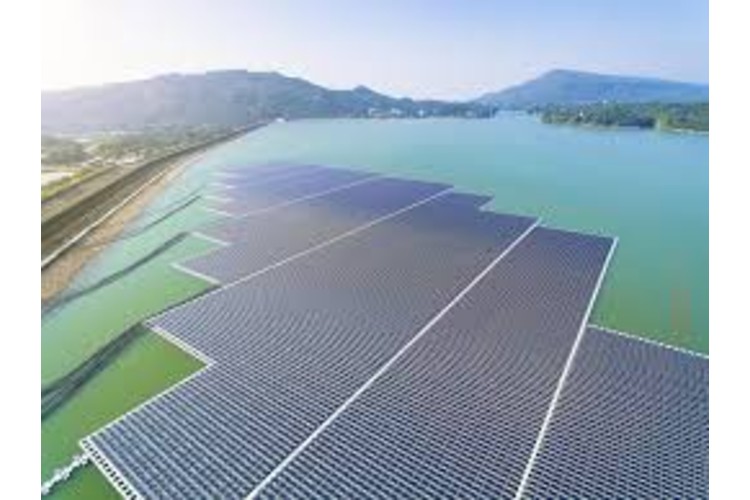
Floating solar power is rapidly transitioning from an experimental clean-energy concept to a mainstream infrastructure asset class. As governments confront land scarcity, rising electricity demand, and climate commitments, floating photovoltaic (FPV) systems are emerging as a high-efficiency, land-neutral solution capable of transforming underutilized water bodies into productive renewable energy hubs. From India’s reservoir-based megaprojects to Germany’s technological breakthroughs and Southeast Asia’s aggressive auction programs, floating solar is redefining how solar energy integrates into national grids and investment portfolios.
India’s western state of Gujarat has recently reinforced this transition by proposing a ₹150 crore floating solar power project at Kadana Dam in its FY 2026–27 budget. The initiative, announced by State Finance Minister Kanu Desai, aims to harness reservoir surfaces for renewable generation without consuming valuable land resources. This project is strategically aligned with India’s broader energy transition agenda, especially as water bodies such as dams and canals represent vast untapped solar potential. By situating panels on water, Gujarat is not only expanding capacity but also optimizing multi-use infrastructure combining hydropower assets with solar generation in a complementary model.
The international outlook reinforces this momentum. The Philippines Department of Energy has committed to auctioning an additional 25 GW of renewable capacity by 2035 under its Green Energy Auction program. Notably, in the GEA-4 round, 2.2 GW of floating solar capacity was awarded, signaling that FPV is no longer peripheral but central to future renewable procurement strategies. Such large-scale commitments demonstrate that floating solar is gaining institutional legitimacy across emerging and developed economies alike.
Technologically, floating solar systems operate on the same photovoltaic principles as land-based installations but benefit from unique aquatic advantages. Advanced PV cells capture solar radiation and convert it into direct current (DC), which is transformed into alternating current (AC) via integrated inverters for grid compatibility. However, unlike rooftop or ground-mounted systems, floating installations experience natural thermoregulation from surrounding water bodies. This cooling effect can improve efficiency by up to 15%, reducing performance losses associated with high panel temperatures. Additionally, the albedo effect sunlight reflected from the water surface further enhances energy yield, especially during peak sunlight hours.
India’s portfolio of floating solar plants illustrates both scale and geographic diversification. The 100 MW floating solar project at NTPC’s Ramagundam plant in Telangana exemplifies engineering optimization, with floating ferrocement platforms anchored to concrete blocks to ensure stability and maximize evaporation control. Similarly, the 92 MW Kayamkulam project in Kerala demonstrates commercial viability, with power purchased by the Kerala State Electricity Board at competitive tariffs. Uttar Pradesh’s 150 MW Rihand Floating Solar Plant reflects long-term revenue assurance through a 25-year power purchase agreement, reinforcing bankability.
Perhaps the most ambitious project is the 600 MW Omkareshwar Floating Solar Plant in Madhya Pradesh, expected to become the world’s largest upon completion and capable of preventing approximately 1.2 million metric tons of CO₂ emissions annually. Other notable projects include the 100 MW Getalsud Dam project in Jharkhand, the 25 MW Simhadri plant in Andhra Pradesh, and the 5 MW Sagardighi project in West Bengal. Collectively, these installations demonstrate that floating solar is not geographically constrained but adaptable across diverse climatic and hydrological contexts.
Beyond India, innovation continues to reshape floating solar’s technical landscape. In Bavaria, Germany, SINN Power commissioned what is described as the world’s first vertical floating photovoltaic system at the Jais gravel pit. With an installed capacity of 1.87 MW and expected annual output of 2 GWh, the project introduces a patented vertical east–west orientation that enhances morning and evening generation periods when conventional systems typically underperform. Importantly, the system covers only 4.65% of the lake surface, well below regulatory limits, while environmental monitoring indicates no negative ecological impacts. In fact, early data suggests improved water quality and new aquatic habitats, reinforcing FPV’s compatibility with environmental conservation frameworks.
Investment dynamics further validate floating solar’s evolution into a credible infrastructure segment. Global installed floating solar capacity is projected to surpass 10 GW by 2030, up from approximately 3 GW today. Market forecasts suggest revenue growth at a CAGR exceeding 23% between 2025 and 2033, underscoring long-term investor confidence. Asia-Pacific dominates the sector, controlling nearly 71.8% of global floating solar panel market share in 2024, driven by aggressive deployments in China, India, South Korea, and Southeast Asia.
Institutional investors are particularly drawn to floating solar’s alignment with ESG mandates, predictable long-term power purchase agreements, and hybrid integration opportunities with hydropower assets. High-level dialogues in India, including renewable investment discussions hosted by NSEFI, GGGI, GRIDCO, and supported by policy leaders and financial institutions, indicate strong public-private coordination. Additionally, Odisha’s clearance of 20 renewable projects worth ₹4,353 crore, including floating solar components, highlights state-level facilitation of capital inflows. At global forums such as the World Economic Forum Annual Meeting 2026 in Davos, renewable infrastructure including FPV is expected to feature prominently in investment discussions.
From a technology segmentation perspective, the market is also evolving. According to Fairfield Market Research on the Floating Solar Panels Market, stationary floating solar panels account for over 70% of revenue share in 2025 due to their cost-effectiveness and suitability for reservoirs and dams. However, tracking floating solar panels are projected to grow at a CAGR above 25%, offering up to 20% higher energy yields by dynamically adjusting panel orientation throughout the day. This shift suggests a gradual transition toward performance-optimized systems as economies of scale reduce costs.
Floating solar also delivers measurable environmental co-benefits. Panel coverage reduces water evaporation, which is particularly valuable in water-stressed regions. Shading limits excessive algae growth, improving water quality. The absence of land acquisition mitigates social displacement and ecological disruption. Installation costs can be competitive due to proximity to existing transmission infrastructure at dam sites. Importantly, system designs increasingly incorporate ecological buffers to protect aquatic life.
According to the Neha Patil “floating solar is transitioning from an experimental renewable application to a structured infrastructure investment category supported by policy clarity, technological refinement, and institutional capital participation”. This insight encapsulates the sector’s current trajectory: scale, sophistication, and systemic integration.
As renewable energy systems mature globally, floating solar stands at the intersection of engineering innovation, environmental sustainability, and financial scalability. The convergence of supportive government policies, expanding project pipelines, improving technology efficiency, and climate-aligned investment capital is accelerating its mainstream adoption. What was once a niche adaptation for land-constrained regions is now a globally recognized solution capable of reshaping reservoir landscapes into power-generating assets.
Floating solar power is no longer merely an alternative it is emerging as a strategic pillar of renewable infrastructure, poised to play a decisive role in the next phase of the global energy transition.