



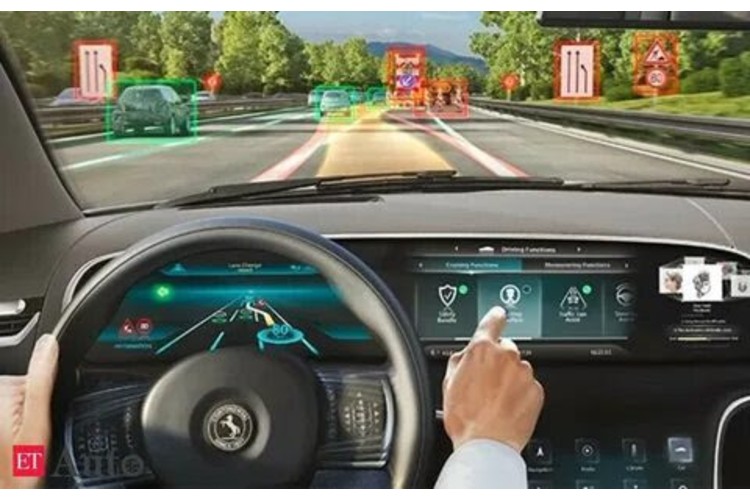
In today’s rapidly evolving automotive landscape, the integration of Artificial Intelligence (AI) and Machine Learning (ML) into safety and mobility solutions is revolutionizing how we drive. Among the most impacted segments is the Advanced Driver Assistance Systems Market, where AI and ML are enhancing not just automation but also decision-making, safety, and the overall driving experience.
This blog explores how these intelligent technologies are shaping the future of ADAS and pushing us closer to fully autonomous vehicles.
What Are Advanced Driver Assistance Systems (ADAS)?
Advanced Driver Assistance Systems, commonly known as ADAS, are electronic technologies that support drivers in various functions, including driving, parking, and safety. These systems include features such as adaptive cruise control, lane departure warnings, automatic emergency braking, and blind spot monitoring. The Advanced Driver Assistance Systems Market is rapidly growing, fueled by rising concerns over road safety, stringent government regulations, and consumer demand for smart driving technologies.
ADAS relies on multiple sensors—like cameras, radar, ultrasonic, and LiDAR—combined with software to interpret data and assist in real-time decision-making. Traditional systems operated on rule-based algorithms. However, with the inclusion of AI and ML, these systems now learn from experience and continuously improve performance, making driving safer and smarter.
How AI Enhances ADAS Capabilities
Artificial Intelligence enables ADAS to go beyond basic automation by enabling context-aware decision-making. Unlike traditional software, AI algorithms can analyze vast amounts of sensor data in real-time to detect road signs, recognize objects, understand traffic patterns, and predict possible hazards.
For example, AI-powered adaptive cruise control doesn’t just maintain a preset distance from the car ahead—it adjusts dynamically based on speed patterns and anticipated road conditions. Similarly, AI-driven lane-keeping systems analyze road curvature, lane markings, and vehicle drift to keep the car centered more effectively.
Companies in the Advanced Driver Assistance Systems Market are actively investing in deep learning, neural networks, and real-time analytics to build ADAS platforms that closely mimic human driving intelligence. This is particularly important for navigating complex urban traffic, where decision-making has to be rapid, accurate, and adaptive.
Key Applications of Machine Learning in ADAS
Machine Learning brings the element of continuous improvement to ADAS by learning from large datasets of real-world driving scenarios. Once trained, these models enable predictive analytics, anomaly detection, and behavior-based adjustments in system performance.
Some critical applications of ML in ADAS include:
- Object Detection and Classification: ML models process visual and radar data to distinguish between pedestrians, vehicles, road signs, and other obstacles.
- Driver Monitoring Systems: Machine learning detects signs of drowsiness, distraction, or fatigue and triggers alerts.
- Predictive Collision Avoidance: By analyzing traffic behavior, the system can predict potential collisions and initiate braking or evasive maneuvers before a human would react.
- Traffic Sign Recognition: Trained models enable the vehicle to interpret traffic signs from different regions, including damaged or poorly visible signs.
According toFairfield Market Research,the combination of machine learning and ADAS is expected to drastically reduce accident rates and increase the effectiveness of safety features, particularly in emerging economies with rapidly urbanizing traffic patterns.
Top ADAS Features Powered by AI and ML
The integration of AI and ML is enabling a new generation of advanced features within ADAS, making them more intuitive, responsive, and accurate. Here are some of the most innovative features currently powered by these technologies:
- Autonomous Emergency Braking (AEB): AI identifies an imminent collision and activates brakes faster than human response time.
- Lane Keeping Assistance (LKA): Machine learning algorithms recognize road markings even when they are faded or obstructed.
- Intelligent Parking Assist: Vehicles learn to park themselves using data from previous parking maneuvers.
- Adaptive Lighting Systems: AI adjusts headlight intensity based on traffic and weather conditions.
- Blind Spot Detection: AI continuously monitors vehicle surroundings, providing real-time alerts when another vehicle enters a blind spot.
These smart features are not only making vehicles safer but also more appealing to consumers, boosting the overall growth of the Advanced Driver Assistance Systems Market.
Future Outlook: AI and the Road to Full Autonomy
As the industry advances, AI and machine learning will continue to be at the forefront of ADAS development. The future of the Advanced Driver Assistance Systems Market lies in fully autonomous vehicles that require no human intervention. While we’re not there yet, AI is steadily closing the gap.
In the coming years, we can expect:
- Integration with 5G and V2X Technologies: Vehicles will communicate with infrastructure, other cars, and the cloud in real-time, improving response accuracy.
- AI-Based Personalization: ADAS will adapt to individual driving styles, enhancing user experience and comfort.
- Scalable AI Platforms: OEMs will deploy software-defined vehicles that receive over-the-air updates to continuously evolve system capabilities.
- Simulation and Virtual Testing: AI will power advanced simulation tools to train and test ADAS features under millions of virtual scenarios, reducing time to market.
Governments across Europe, Asia, and North America are mandating the inclusion of safety features that rely on these technologies. As a result, automakers are forging partnerships with AI and software companies to ensure compliance and gain competitive advantage.
The convergence of AI and machine learning is transforming ADAS from assistive technologies into intelligent co-pilots. These advancements are not just elevating safety but are also ushering in a new era of personalized, data-driven, and semi-autonomous driving.
Backed by insights from Fairfield Market Research, it is evident that the Advanced Driver Assistance Systems Market is set to experience exponential growth, driven by the expanding role of AI in modern transportation. As automakers, tech firms, and regulatory bodies align their efforts, the journey toward fully autonomous vehicles becomes not just a possibility, but an inevitability.