


Bengaluru : As EV adoption accelerates across passenger vehicles, commercial fleets, two-wheelers and public mobility, India’s EV industry is entering its most employment-intensive phase, evolving from a vehicle manufacturing opportunity into a fully integrated industrial ecosystem. The sector is projected to generate 30 – 40 million jobs, 10-15% direct and 85-90% indirect jobs by 2030. Hiring is expected to grow by 15%-20% Y-o-Y, with the next decade defined less by assembly-line jobs and more by specialised engineering, energy systems and battery technologies across the value chain.
According to Deepesh Gupta, Director and Head of General Staffing, Adecco India, “India currently contributes 4% to the global EV industry in the passenger car segment and holds 17% market share in 2 wheeler segment, but its long-term opportunity lies in capturing a far greater share of the global value chain. With states now operationalising execution-stage EV policies, including Delhi’s ₹7,000-crore EV Policy 2026 and subsidy portal, India’s EV story is shifting from incentive-driven adoption to industrial-scale hiring, making workforce planning, marking a critical inflection point for India’s talent pipeline. Catalysing the vision of ‘Atmanirbhar Bharat and Sustainable Growth’, India’s competitiveness in the global EV economy will be determined as much by the quality of its talent pipeline as by its manufacturing capacity”
“This growth supported by the ‘Make in India initiative’ will reduce India’s crude oil import dependence, enhance energy security, and support the Net-Zero emissions target by 2070, while creating opportunities across Tier-2 and Tier-3 regions”, he added.
The EV ecosystem is expected to contribute 60% of India’s projected green jobs by 2030, with specialised EV talent attracting salary premiums of up to 45% over traditional ICE roles.
Manufacturing continues to remain the largest employment engine, with 50%-55% of the total demand concentrated across established automotive hubs including Tamil Nadu (15.24%), Karnataka (6.3%), Maharashtra (13%), Gujarat (13%), Telangana (5%) and NCR (6%). However, the next phase of growth is increasingly being driven beyond these traditional clusters. Investments are rapidly expanding into Tier-II and Tier-III industrial corridors including Hosur, Sanand and Dholera, where gigafactories, component parks, battery recycling facilities and supplier ecosystems are creating entirely new employment corridors and formalising workforce participation. Nearly 70% of all new hiring mandates are expected to originate outside conventional automotive and manufacturing hubs. 40%-50% of this hiring wave will begin as contractual and flexi-staffing engagements before converting to permanent roles, a pattern typical of high-growth manufacturing ramp-ups.
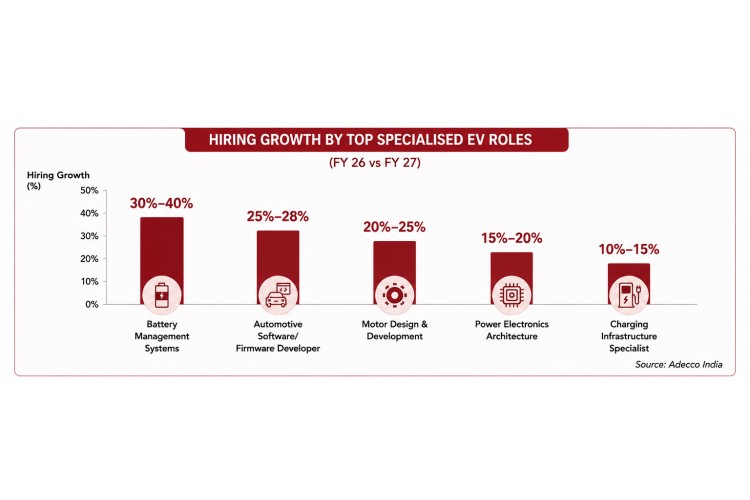
The Products & Parts segment will account for 40% – 45% of hiring, with demand extending well beyond OEMs and Tier-I suppliers into a wider ecosystem of Tier-II and Tier-III EV-focused MSMEs and startups, as the segment localises battery cells, motors, controllers, semiconductors and power electronics across the domestic supply chain. Entry-level demand is strongest across manufacturing engineering, testing, validation and quality functions (45%), while product differentiation around battery performance is driving mid-level hiring for Battery Management System (BMS) Engineers, Embedded Software Engineers, Power Electronics Engineers and Thermal Engineers (35%-40%). At the senior level, demand is centred on Battery R&D Scientists, Cell Chemistry Specialists, Functional Safety Leaders and Advanced Manufacturing Heads (10%-15%).
India’s EV adoption rate has climbed to ~8.5% of total automotive sale. Following this, the battery waste is projected to reach 1.5 to 2 million tonnes annually by 2030. With the battery recycling market having grown at a CAGR of 55% between FY2022 and FY2026, EV Recycling and Circular Manufacturing has emerged as one of the fastest job creation and investment attraction spaces within the sector. Government support is beginning to accelerate the ecosystem, with a ₹1,500-crore incentive scheme for domestic recyclers and a ₹169-crore India-EU collaboration advancing recycling technology and infrastructure. With India currently recycling only ~1% of end-of-life lithium-ion batteries, the sector is expected to expand into a ₹31,150-crore industry by 2030. This positions the segment as critical not just for mineral recovery, import substitution and supply chain resilience, but as a standalone growth vertical in its own right. Demand is shifting towards Chemical Process Engineers and Battery Diagnostics Specialists at mid-level, and Hydrometallurgy Experts and EPR Compliance Leaders at senior level. Hiring here is projected to grow by 25%–30%, with premiums of 30%-40% reflecting one of the industry’s most acute skill shortages with an 45% skill deficit.
“Despite strong hiring momentum, specialised talent availability continues to lag industry demand by 20%-25% across battery sciences, electrochemistry, embedded software, power electronics, grid technologies and recycling engineering. 35% of India’s existing ICE-trained shopfloor workforce, skilled in engine and transmission systems, is not directly transferable to battery, software and grid-focused EV roles without structured reskilling. Addressing this gap will require large-scale transition of India’s informal workforce into formal, skilled roles, accelerated reskilling of the conventional automotive workforce, stronger industry-academia collaboration, and deeper investment in specialised technical education”, Deepesh added.
EV Infrastructure accounts for 15%-20% of total hiring as India rapidly expands charging networks, battery-swapping stations, fleet hubs, grid systems, energy corridors and gigafactories. With only around 29,000 public charging stations today against an estimated 1.3 million required by 2030, alongside a projected 35% increase in gigafactory capacity, demand for talent across infrastructure planning, deployment and operations is expected to grow by 45% over the next 10 years. Hiring is strongest for Electrical Engineers, Site Engineers, Charging Infrastructure Engineers, Grid Integration Specialists, SCADA/IoT Experts and Energy Network Architects (35%-40%), while professionals with cross-functional expertise in power systems, digital energy management and renewable integration are expected to command salary premiums of up to 15%-20%.
Looking ahead, organisations that successfully build multidisciplinary talent pipelines will lead India’s EV ecosystem in the global market. With deep expertise in engineering, manufacturing and specialised workforce solutions, Adecco India is well positioned to support companies in building this future-ready talent base.