



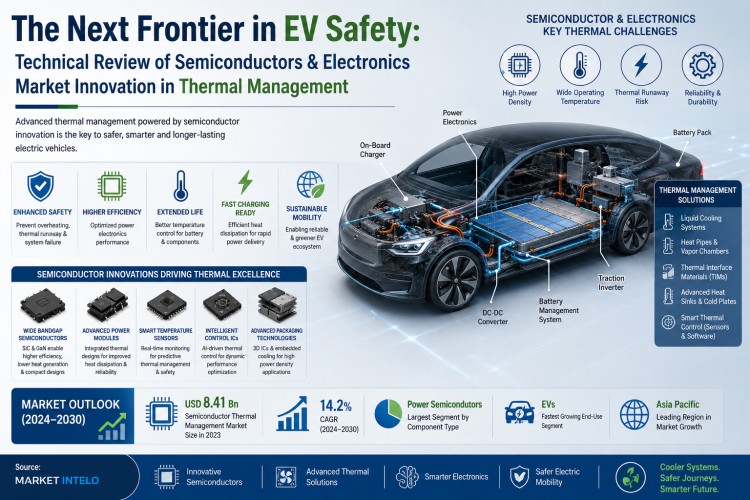
Electric vehicles are transforming global transportation, but their complex power electronics demand unprecedented thermal management solutions. As EV adoption accelerates toward 2033 targets, semiconductor innovations in heat dissipation, power efficiency, and battery safety represent the critical safety frontier. This technical review examines cutting-edge developments in thermal management for advanced semiconductor packaging and their implications for automotive reliability, drawing insights from industry leaders and emerging standards.
Semiconductor Thermal Challenges in EVs
EV powertrains generate extreme heat concentrations—up to 200°C in SiC/GaN modules—necessitating semiconductors that maintain performance under thermal cycling. Traditional silicon IGBTs struggle with switching losses above 150 kW, while wide-bandgap materials like Silicon Carbide (SiC) and Gallium Nitride (GaN) enable 30% higher efficiency but require sophisticated cooling architectures.
The power semiconductor module market now prioritizes thermal interface materials (TIMs) with >10 W/mK conductivity, double the previous generation. Phase-change materials and graphene-enhanced TIMs address hotspot formation in 800V architectures, where junction temperatures must stay below 175°C during 3C fast charging.
Advanced Cooling Technologies
- Liquid Cooling Integration: Direct coolant impingement on IGBT bases achieves 5x better heat transfer than air cooling. Tesla’s 4680 cells use integrated cold plates with 0.2mm microchannels, maintaining <45°C gradients across 100kWh packs. Industry shifts toward single-phase dielectric fluids (3M Novec) eliminate pump complexity while matching water-glycol performance.
- Embedded Microchannel Heatsinks: 3D-printed copper microchannels within DBC substrates reduce thermal resistance by 40%. Infineon’s HybridPACK Drive Gen4 integrates 50μm channels directly into power modules, enabling 650kW continuous output in compact footprints.
- Two-Phase Immersion Cooling: Fluorinated fluids with 2000 W/m²K heat transfer coefficients surround power electronics, eliminating air gaps. Delta Electronics’ immersion-cooled inverters achieve 99% uptime in fleet testing, critical for autonomous trucking.
Battery Management System (BMS) Thermal Intelligence
Modern BMS semiconductors monitor cell-level temperatures with 0.1°C resolution across 1000+ cells. Texas Instruments’ ISO 26262 ASIL-D chips integrate Kalman filtering with machine learning anomaly detection, predicting thermal runaway 30 seconds in advance. Rohm’s SiC MOSFET gate drivers incorporate real-time junction temperature estimation, dynamically adjusting PWM frequencies to maintain 98% efficiency envelopes.
- Active Thermal Balancing: Algorithms redistribute charge current based on microclimate variations, preventing 5-8% capacity loss from uneven aging. CATL’s Shenxing BMS uses 12-bit ADCs sampling at 10kHz, achieving 99.9% state-of-charge accuracy across -20°C to 60°C.
- Materials Science Breakthroughs
- Diamond Thermal Substrates: CVD diamond substrates with 2000 W/mK conductivity replace traditional ceramics, shrinking inverter footprints 25%. Wolfspeed’s diamond-interposer modules handle 1.2kV/1000A without derating.
- Aerogel Insulation: Silica aerogels provide κ=0.015 W/mK insulation around high-voltage busbars, preventing arcing under thermal expansion. Used in Lucid Air’s 900V system, they enable 40% thinner insulation layers.
- PCM-Enhanced Gap Fillers: Phase-change composites absorb 200 J/g during peak loads, maintaining <5°C overshoot. Parker LORD’s CHT-SG125S achieves 8.5 W/mK while flowing into 0.05mm gaps.
SiC and GaN Power Electronics Revolution
SiC MOSFET Advantages:
- 3x lower switching losses vs. silicon
- 900V operation enables 800V architectures
- Junction temperature up to 200°C
- 50% reduction in heatsink mass
GaN HEMT Applications:
- On-board chargers: 98% peak efficiency
- DC-DC converters: 500kHz switching
- Traction inverters: Zero-voltage switching
STMicroelectronics’ Gen 3 SiC achieves RDS(on) of 15 mΩ at 1200V, enabling 50kW/L power density. Combined with aerosol-sintered silver sintering (void-free bonds), module lifetimes exceed 2 million km.
Safety Standards Evolution
ISO 26262 ASIL-D certification now mandates thermal runaway propagation prevention. AEC-Q101 Grade 1 (-40°C to 150°C) qualification ensures reliability across automotive thermal profiles. JEDEC JESD22-A104 stress testing validates 1000 cycles between -40°C and 175°C.
Functional Safety Features:
- Redundant temperature sensors (PT1000 + thermistor)
- Limp-home mode at 125°C Tjmax
- Over-temperature coefficient for gate drivers
- Integrated DESAT protection
Market Growth Projections
According to Market Intelo, the EV thermal management system market grows at 15.2% CAGR through 2033, reaching $18.7 billion. Power semiconductors claim 45% share, driven by SiC adoption in premium platforms. Asia-Pacific dominates with 58% revenue, led by China’s CATL-BYD ecosystem and India’s emerging SiC fabrication.
| Technology | 2026 Market ($B) | 2033 Market ($B) | CAGR |
| SiC Modules | 4.2 | 18.5 | 28% |
| GaN Systems | 1.8 | 7.2 | 22% |
| Advanced TIMs | 2.1 | 6.8 | 18% |
| Liquid Cooling | 3.5 | 11.4 | 19% |
Future Directions
- Chiplet-Based Power Modules: Modular SiC dies enable scalable 100-1500kW platforms. Thermal TSVs (through-silicon vias) with diamond fillers achieve 1.5x heat flux capacity.
- AI-Optimized Cooling: Reinforcement learning predicts thermal profiles 10x faster than CFD, adjusting fan/pump speeds proactively. NVIDIA’s Drive Thor integrates thermal-aware workload scheduling.
- Solid-State Cooling: Electrocaloric materials promise 15°C delta-T without refrigerants, targeting cabin and electronics cooling by 2030.
Implementation Roadmap
- 2026-2028: SiC mainstreaming, 800V universal adoption
- 2028-2030: Diamond substrates, immersion cooling scale
- 2030-2033: GaN traction inverters, AI thermal management
EV manufacturers prioritizing semiconductor thermal innovation gain 15% range advantage and 25% cost reduction over five years. The next safety frontier isn’t structural—it’s thermal mastery at the chip level.