

Urja Daily
No Result
View All Result
  • News
  • Renewable
    • Solar
    • Rooftop
    • Floating Solar
    • Module
    • Wind
    • Hydrogen
    • Biomass
    • Tenders
    • Sustainibility
  • Storage
  • E-Mobility
  • Battery
  • Smart City
  • Power
    • Smart Grid
    • Microgrid
    • Off-Grid
  • Editor’s Pick
    • Articles
    • In Talks
    • E-MAG
    • Market Research
  • On-demand Webinars
  • More
    • Events
    • Contact Us
    • Subscribe
  • News
  • Renewable
    • Solar
    • Rooftop
    • Floating Solar
    • Module
    • Wind
    • Hydrogen
    • Biomass
    • Tenders
    • Sustainibility
  • Storage
  • E-Mobility
  • Battery
  • Smart City
  • Power
    • Smart Grid
    • Microgrid
    • Off-Grid
  • Editor’s Pick
    • Articles
    • In Talks
    • E-MAG
    • Market Research
  • On-demand Webinars
  • More
    • Events
    • Contact Us
    • Subscribe
No Result
View All Result
Urja Daily
No Result
View All Result
Home Editor's Pick Market Research

Thermal Management in The Silicon Carbide Revolution

Urja Daily by Urja Daily
October 14, 2021
in Market Research
Reading Time: 3 mins read
0
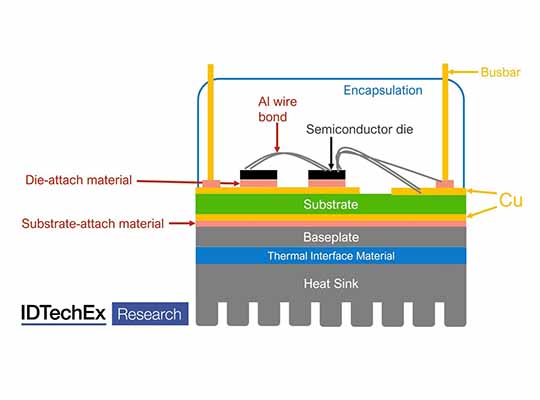
Traditional power electronics package with thermal failure points (red). Source: IDTechEx – “Thermal Management for Electric Vehicles 2021-2031”
Share on FacebookShare on TwitterShare on Linkedin

BOSTON – For electric vehicles (EVs), efficiency is the name of the game. There are many avenues to improving efficiency, especially within the drivetrain with one of the key areas being power electronics. Of these components, the main inverter is the highest power and gives the best opportunity for efficiency improvements. The main inverter is responsible for converting the DC output of the battery into an AC input for the electric motor. In the past few years, we have started to see wide bandgap semiconductors such as silicon carbide (SiC) adopted in EV inverters to replace the typical silicon insulated-gate bipolar transistors (Si IGBTs). The use of SiC enables higher density power modules that can operate at higher temperatures, leading to new thermal management and material opportunities for EV power electronics.

The SiC Transition

RELATED POSTS

Hydropower Digitalization Market To Reach USD 21.5 billion by 2034

Evaluating Circular Economy Potential: A Global Bio-CNG Market Research Report 2033 Analysis

Despite the increased cost of SiC metal-oxide-semiconductor field-effect transistors (MOSFETs), their penetration into the EV market has been substantial. According to IDTechEx research, in 2020, SiC MOSFET inverters made up nearly 30% of the EV market globally. Tesla started the trend in 2018, with others like BYD have vehicles on the road. Giants like Stellantis and Hyundai are including SiC power electronics in incoming models to help enable their high voltage (800 V) platforms. IDTechEx’s new report on “Power Electronics for Electric Vehicles 2022-2032” considers the transition to SiC in addition to deep analysis of power electronics for the EV market with examples from EV models, the supply chain, and package materials and innovations.

Thermal Management Challenges

Power electronics in EVs present interesting thermal management challenges and the adoption of SiC changes several aspects of the module and package design along with material selection. In a traditional power electronics package, several potential failure points occur with thermal cycling. As the package heats up and cools down, the mismatch in thermal expansion between materials causes degradation of various connections, these include the wire bonds, die-attach, and substrate-attach. In SiC packages, power density and operating temperature can be increased significantly, meaning that certain traditional options are no longer suitable.

Today, aluminum wire bonds are the dominant interconnect technology, however, these are a common failure point. This has led to more use of wire bonding with aluminum alloys, copper, or even direct lead bonding. Die-attach materials are also critical. This would typically be done with a traditional solder, but with higher operating temperatures (especially for SiC), normal SAC (tin-silver-copper) solder can be unreliable leading to the emergence of alternatives like silver sintering to provide much better thermal cycling performance. Tesla’s package from STMicroelectronics utilizes a combination of copper ribbon bonds and aluminum wire bonds with silver sintering for its die-attach. Very much embracing these emerging alternative technologies. As we continue, we are sure to see further adoption of these options in inverter packages to enable higher reliability in smaller form factors with higher efficiency.

At a larger scale, much like many EV batteries, EV power electronics tend to be liquid-cooled. Typically, the coolant is passed through the fins of the heat sink under the module. Whilst this section of the power electronics thermal management may not be as innovative as emerging materials within the package, it still presents interesting opportunities for integration across the vehicle. Many vehicles use the same coolant path through the power electronics and electric motor. For example, in certain models, waste heat can be scavenged from the drivetrain for use in heating the cabin, helping to reduce losses and improve overall vehicle range, especially in cold conditions.

The evolution of power electronics, especially towards wide bandgap semiconductors is transforming the thermal management and hence material landscape within EV power electronics. IDTechEx‘s “Thermal Management for Electric Vehicles 2021-2031” report covers several use-cases within EV power electronics packages as well as investigating the trends around options for wire bonds, die-attach, and substrate materials. In addition to power electronics, the report takes a deep dive into the thermal management strategies across the batteries, motors, and power electronics including market forecasts through to 2031.

Tags: electric vehicleelectronicsEVinverterpower
ShareTweetShare
Urja Daily

Urja Daily

Related Posts

Hydropower Digitalization Market To Reach USD 21.5 billion by 2034

by Palak
July 2, 2026
0

According to our Growth Market Report, the global Hydropower Digitalization market size reached USD 7.5 billion in 2025, reflecting robust digital integration across the hydropower...

Evaluating Circular Economy Potential A Global Bio-CNG Market Research

Evaluating Circular Economy Potential: A Global Bio-CNG Market Research Report 2033 Analysis

by Palak
June 26, 2026
0

The global Bio-CNG market is emerging as one of the most promising renewable fuel segments in the transition toward a...

Microneedling Devices Market

Why Is the Microneedling Devices Market Experiencing Rapid Growth Worldwide?

by Palak
June 12, 2026
0

The beauty and aesthetics industry has undergone a remarkable transformation over the last decade, with consumers increasingly seeking procedures that...

Hydrogen

Hydrogen Energy Storage Market To Reach USD 34.2 billion by 2033

by Palak
June 4, 2026
0

According to our Growth Market Report, the global hydrogen energy storage market size reached USD 16.2 billion in 2024, reflecting a robust expansion driven...

Data Center Switch Market

Data Center Switch Market: How Next-Generation Networking Is Powering the Digital Economy

by Palak
June 2, 2026
0

The rapid expansion of cloud computing, artificial intelligence workloads, streaming services, and enterprise digital transformation has significantly increased the need...

Next Post
Bechtel South Field Energy Center

Bechtel Completes Low-Carbon Energy Plant To Power

sunpower

SunPower and The New Home Company Create Sustainable, Energy Independent Community

Leave a Reply Cancel reply

Your email address will not be published. Required fields are marked *

RECOMMENDED

Automation Expo 2026 Invite

WIKA India to Showcase Intelligent Instrumentation and IIoT Solutions at Automation Expo 2026 Mumbai, Maharashtra

July 14, 2026
POWERGRID

POWERGRID secures LoI for ISTS augmentation project under TBCB

July 14, 2026

MOST VIEWED

  • Solar

    When the Sun Began Paying the Electricity Bills: The Story of PM Surya Ghar Muft Bijli Yojana

    0 shares
    Share 0 Tweet 0
  • India’s Emerging Polysilicon Manufacturing Ecosystem: Opportunities and Challenges

    0 shares
    Share 0 Tweet 0
  • KP Group & PP Savani University Launches Urjanoor Scholarship

    0 shares
    Share 0 Tweet 0
  • StarlinePS Enterprises Invests ₹160 Crore in Celloraa Energy

    0 shares
    Share 0 Tweet 0
  • Xpeng Selects u‑blox F9 Centimeter-level Multi-Band GNSS Technology for P7 Smart EV

    0 shares
    Share 0 Tweet 0

WIKA India to Showcase Intelligent Instrumentation and IIoT Solutions at Automation Expo 2026 Mumbai, Maharashtra

POWERGRID secures LoI for ISTS augmentation project under TBCB

JSW Energy arm bags Rs 4.4 billion BESS order from Bondada Engineering

KP Green Engineering Limited Secures ₹2.39 Billion Orders Across Multiple Business Segments

SAEL bags solar module supply order from NTPC REL

Thailand Approves $1.99 Billion Investment in AI, Data Centres and Clean Energy

Latest Magazine

© 2016 – 2025 TechZone Print Media | All Rights Reserved

  • About Us
  • Contact Us
No Result
View All Result
  • News
  • Renewable
    • Solar
    • Rooftop
    • Floating Solar
    • Module
    • Wind
    • Hydrogen
    • Biomass
    • Tenders
    • Sustainibility
  • Storage
  • E-Mobility
  • Battery
  • Smart City
  • Power
    • Smart Grid
    • Microgrid
    • Off-Grid
  • Editor’s Pick
    • Articles
    • In Talks
    • E-MAG
    • Market Research
  • On-demand Webinars
  • More
    • Events
    • Contact Us
    • Subscribe

© 2016 - 2025 TechZone Print Media | All Rights Reserved