

Urja Daily
No Result
View All Result
  • News
  • Renewable
    • Solar
    • Rooftop
    • Floating Solar
    • Module
    • Wind
    • Hydrogen
    • Biomass
    • Tenders
    • Sustainibility
  • Storage
  • E-Mobility
  • Battery
  • Smart City
  • Power
    • Smart Grid
    • Microgrid
    • Off-Grid
  • Editor’s Pick
    • Articles
    • In Talks
    • E-MAG
    • Market Research
  • On-demand Webinars
  • More
    • Events
    • Contact Us
    • Subscribe
  • News
  • Renewable
    • Solar
    • Rooftop
    • Floating Solar
    • Module
    • Wind
    • Hydrogen
    • Biomass
    • Tenders
    • Sustainibility
  • Storage
  • E-Mobility
  • Battery
  • Smart City
  • Power
    • Smart Grid
    • Microgrid
    • Off-Grid
  • Editor’s Pick
    • Articles
    • In Talks
    • E-MAG
    • Market Research
  • On-demand Webinars
  • More
    • Events
    • Contact Us
    • Subscribe
No Result
View All Result
Urja Daily
No Result
View All Result
Home Editor's Pick Articles

Massless Energy Storage Batteries

Urja Daily by Urja Daily
November 23, 2021
in Articles
Reading Time: 3 mins read
0
Massless-Energy-Storage
Share on FacebookShare on TwitterShare on Linkedin

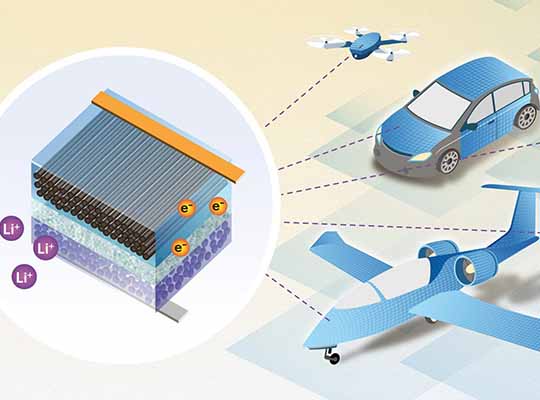
Storage of energy is the need and is always stored in a system having mass. Batteries, the wheels of present day, technology are the example of energy storage for its (energy) use in required form, desired time, place and amount/rate. Batteries are a mass energy storage systems, coming with various limitations like, weight, size, cost, and life span. Efforts are always directed to develop batteries with characters like light weight, cost effective, small in size, durable, with more capacity. Now, efforts are also being directed towards massless energy storage and when it will be practical, it could revolutionize the battery or energy dependent applications like electric vehicle and aircrafts. Recently, scientists have made a massless structural battery 10 times better than before. The battery cell performs well in structural and energy tests, with planned further improvements. Structural batteries reduce weight and could revolutionize electric cars and planes.

A structural battery refers to an energy storage device that can also bear weight as part of a structure-like if the studs in home were all batteries, or if an electric fence also held up a wall. The structural battery uses carbon fiber as a negative electrode, and a lithium iron phosphate-coated aluminum foil as the positive electrode. The carbon fiber acts as a host for the lithium and thus stores the energy. Since the carbon fiber also conducts electrons, the need for copper and silver conductors is also avoided – reducing the weight even further. Both the carbon fiber and the aluminum foil contribute to the mechanical properties of the structural battery. The two electrode materials are kept separated by a fiberglass fabric in a structural electrolyte matrix. The task of the electrolyte is to transport the lithium ions between the two electrodes of the battery, but also to transfer mechanical loads between carbon fibers and other parts.

RELATED POSTS

Sustainable Solar Infrastructure: Designing for Longevity and Circularity

Overcoming Transmission Bottlenecks: The Role of the Dynamic Line Rating IoT Market in Wind Energy Grid Integration

Researchers from Chalmers University of Technology and KTH Royal Institute of Technology in Sweden reveal how their “massless” structural battery works. To make the new structural battery, the scientists layered a buffer glass “fabric” between a positive and negative electrode, then packed it with a space-age polymer electrolyte and cured it in the oven which results in a tough, flat battery cell that conducts well and holds up to tensile tests in all directions. The cell consists of a carbon fiber electrode and a lithium iron phosphate electrode separated by a fiberglass fabric, all impregnated with a structural battery electrolyte for combined mechanical and electrical function. Three structural batteries have been connected in series and laminated as part of a larger composite laminate. Each structural battery cell has a nominal voltage of 2.8 V. The laminate has a total voltage of 8.4 V and a stiffness in the plane of just over 28 GPa.

The main use case is for electric cars, where a literally massive amount of batteries take up a ton of room and don’t contribute to the actual structure of the car. In fact, these cars must be specially designed to carry the mass of the batteries. But what if the frame of the car could hold energy? The new battery has a negative electrode made of carbon fiber, and a positive electrode made of a lithium iron phosphate-coated aluminum foil. They are separated by a fiberglass fabric, in an electrolyte matrix. Due to their multifunctionality, structural battery composites are often referred to as ‘massless energy storage’ and have the potential to revolutionize the future design of electric vehicles and devices. It is called ‘massless’ energy storage because rather than add extra weight to the vehicle, it becomes part of the load-bearing structure – the battery’s weight essentially vanishes. For EVs to be more efficient, better energy storage is required, but the overall weight needs to be maintained or reduced.

The batteries in today’s electric cars constitute a large part of the vehicles’ weight, without fulfilling any load-bearing function. The first attempt to make a structural battery was made as early as 2007, but it has so far proven difficult to manufacture batteries with both good electrical and mechanical properties. A structural battery, on the other hand, is one that works as both a power source and as part of the structure – for example, in a car body. This is termed ‘massless’ energy storage, because in essence the battery’s weight vanishes when it becomes part of the load-bearing structure. Calculations show that this type of multifunctional battery could greatly reduce the weight of an electric vehicle. Structural battery composites cannot store as much energy as lithium-ion batteries, but have several characteristics that make them highly attractive for use in vehicles and other applications. When the battery becomes part of the load bearing structure, the mass of the battery essentially disappears. Thus, super light electric bikes and consumer electronics could soon be a reality.


Tags: batteriesEnergyEnergy StorageTechnology
ShareTweetShare
Urja Daily

Urja Daily

Related Posts

GOLDBECK SOLAR

Sustainable Solar Infrastructure: Designing for Longevity and Circularity

by Palak
June 17, 2026
0

As of March 2026, India's installed solar capacity stands at over 150 GW — a number that places this country...

Overcoming Transmission Bottlenecks The Role of the Dynamic Line Rating IoT Market in Wind Energy Grid Integration

Overcoming Transmission Bottlenecks: The Role of the Dynamic Line Rating IoT Market in Wind Energy Grid Integration

by Palak
June 15, 2026
0

As India and other markets accelerate wind capacity additions, transmission bottlenecks increasingly limit how much renewable energy reaches demand centres....

EV Charging

Accelerating India’s E-Mobility Infrastructure through the Solar Powered EV Charger Market Evolution

by Palak
June 15, 2026
0

IntroductionIndia’s emobility transition depends as much on charging infrastructure as on vehicle adoption. Solarpowered EV chargers—combining photovoltaic (PV) generation, battery...

biogas upgrading system market

Navigating Evolving Grid Frameworks: Insights from the Global Biogas Upgrading System Market

by Palak
June 15, 2026
0

The global biogas upgrading system market is entering a more mature and strategic phase. What was once seen mainly as...

Graphite Sheet

Innovations in the Graphite Sheet for EV Battery Thermal Management Market to Enhance Cell Safety

by Palak
June 15, 2026
0

Digital twins—high fidelity virtual replicas of physical assets and processes—are reshaping energy operations by enabling realtime simulation, predictive control and...

Next Post
Harper

Greta Electric Scooters Set to Change the Electric Mobility Landscape

airport solar power market

Airport Solar Power Market - Global Industry Analysis and Forecast 2017 - 2025

Leave a Reply Cancel reply

Your email address will not be published. Required fields are marked *

RECOMMENDED

FPT TUVSUDV

FPT Enters The Top Three of Europe’s Certified High-Voltage Battery Producers With TÜV SÜD Recognition 

June 23, 2026
FPT

FPT And Green Power Systems Help Boost Algeria’s Powdered Milk Production

June 23, 2026

MOST VIEWED

  • Solar

    When the Sun Began Paying the Electricity Bills: The Story of PM Surya Ghar Muft Bijli Yojana

    0 shares
    Share 0 Tweet 0
  • India’s Emerging Polysilicon Manufacturing Ecosystem: Opportunities and Challenges

    0 shares
    Share 0 Tweet 0
  • KP Group & PP Savani University Launches Urjanoor Scholarship

    0 shares
    Share 0 Tweet 0
  • Xpeng Selects u‑blox F9 Centimeter-level Multi-Band GNSS Technology for P7 Smart EV

    0 shares
    Share 0 Tweet 0
  • How proper refurbishment can extend life of pre-owned bikes in India?

    0 shares
    Share 0 Tweet 0

FPT Enters The Top Three of Europe’s Certified High-Voltage Battery Producers With TÜV SÜD Recognition 

FPT And Green Power Systems Help Boost Algeria’s Powdered Milk Production

Gruner’s CBG Plant Sets Asia Record with 23.5 TPD Output, Achieves 120% of Design Capacity at Satna

Integrals Power Validates Sustainably Produced Iron Phosphate Precursor and LFP Cathode Material in Cell Level at University of St Andrews

Power Transmission is the Foundation of Economic Growth

VinFast India, Tata Capital Join Hands for Dealer Financing

Latest Magazine

© 2016 – 2025 TechZone Print Media | All Rights Reserved

  • About Us
  • Contact Us
No Result
View All Result
  • News
  • Renewable
    • Solar
    • Rooftop
    • Floating Solar
    • Module
    • Wind
    • Hydrogen
    • Biomass
    • Tenders
    • Sustainibility
  • Storage
  • E-Mobility
  • Battery
  • Smart City
  • Power
    • Smart Grid
    • Microgrid
    • Off-Grid
  • Editor’s Pick
    • Articles
    • In Talks
    • E-MAG
    • Market Research
  • On-demand Webinars
  • More
    • Events
    • Contact Us
    • Subscribe

© 2016 - 2025 TechZone Print Media | All Rights Reserved