

As vehicles become software-defined, the ability to process data in real time is becoming as important as the ability to generate it. Edge computing is emerging as a critical layer between automotive sensors, AI and the cloud—helping vehicles respond faster, operate more intelligently and build the foundation for safer connected mobility.
A modern automobile is no longer simply a machine powered by an engine or battery. It is increasingly a high-performance computing platform on wheels. Cameras, radar, LiDAR, ultrasonic sensors, microphones, GPS systems and dozens of electronic control units continuously generate information about the vehicle and its surroundings.
The challenge is no longer just collecting this data. It is processing the right information at the right place and at the right time.
This is where edge computing is becoming increasingly important.
The Data Explosion Inside the Vehicle
Autonomous and highly automated vehicles can generate enormous quantities of sensor data. One McKinsey estimate suggests that a highly autonomous vehicle could generate around 4 terabytes of data every hour.
That is equivalent to roughly 1.1 GB of data every second.
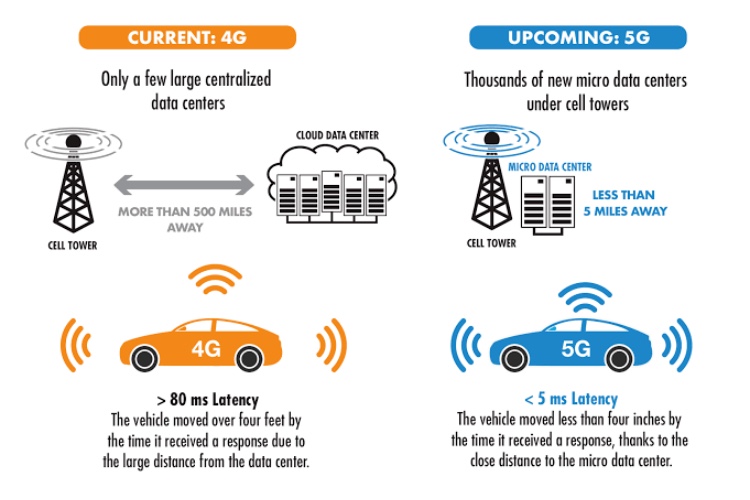
Trying to send all of this information to a remote cloud data centre for processing would create enormous demands on bandwidth, connectivity and storage. More importantly, safety-critical decisions cannot always wait for data to travel to the cloud and return.
Edge computing addresses this challenge by bringing processing closer to the source of the data.
The cloud remains important for long-term analytics, AI model training, fleet management and software updates, but the vehicle can handle time-sensitive decisions locally.
Why Milliseconds Matter
In automotive safety, latency is more than a technology specification—it can directly influence how quickly a vehicle responds to its environment.
Consider an autonomous vehicle travelling at 100 km/h. It covers approximately 27.8 metres every second, or about 27.8 centimetres in just 10 milliseconds.
That means even seemingly small processing and communication delays can translate into meaningful physical distance.
Edge AI can reduce this delay by processing information within the vehicle rather than depending entirely on remote servers.
McKinsey’s 2025 analysis of automotive edge AI found that, for voice-assistance tasks, cloud-based approaches delivered latency of around 1,000–2,200 milliseconds, compared with approximately 300–700 milliseconds for edge deployments in the scenarios studied.
The exact latency advantage varies significantly depending on the application, network and hardware architecture, but the principle remains important: local processing removes network transmission from the critical path.
Edge AI: The Brain Closer to the Sensor
The rise of edge computing is closely connected with the growth of Edge AI.
AI algorithms running directly inside vehicles can analyse sensor information without continuously sending raw data to the cloud.
A camera, for instance, can identify:
- Pedestrians
- Vehicles
- Traffic signs
- Road markings
- Cyclists
- Obstacles
- Driver behaviour
The resulting information can then be used by ADAS or automated-driving systems.
This is creating demand for increasingly sophisticated automotive semiconductor platforms incorporating CPUs, GPUs, DSPs and neural processing units (NPUs).
According to McKinsey, demand for NPUs and modular SoC architectures is growing as automotive AI moves increasingly toward onboard execution.
For semiconductor manufacturers, this represents a major shift: the automotive chip is no longer simply controlling an individual function. It is increasingly becoming a computational platform capable of running AI workloads in real time.
A $519 Billion Automotive Software and Electronics Opportunity
The transformation is also visible at the market level.
McKinsey’s January 2026 analysis estimates that the global automotive software and electronics market could reach $519 billion by 2035, growing at approximately 4.5% CAGR from 2025 to 2035.
The software component alone could increase from approximately $294 billion in 2025 to $469 billion by 2035, according to the same analysis.
This expansion is being driven by several interconnected trends:
Autonomous driving + AI + electrification + connectivity + software-defined vehicles
Together, these trends are increasing the amount of computation required inside vehicles.
Sensors Are Becoming Intelligent
The growth of edge computing is also changing the role of sensors.
Historically, sensors primarily captured physical information and transmitted it to an ECU. Increasingly, sensors themselves are becoming capable of pre-processing and analysing information.
This can involve filtering noise, extracting useful features and reducing the amount of raw data that must travel through the vehicle’s network.
This is important because transmitting every raw sensor signal consumes bandwidth and processing resources.
McKinsey estimates that the automotive sensor market could grow from $23 billion in 2019 to $46 billion by 2030, driven particularly by increasing demand for cameras, radar and LiDAR associated with ADAS and autonomous driving.
The implication for electronics manufacturers is significant: future automotive sensors will increasingly need to be designed as intelligent edge devices, rather than simply data-collection components.
From ECUs to Central and Zonal Computing
Another major transformation is taking place in vehicle electronic/electrical architecture.
Traditional vehicles can contain a large number of individual ECUs, each responsible for specific functions. Software-defined vehicles are increasingly moving towards centralised and zonal architectures.
Instead of having computing distributed across numerous independent control units, high-performance computers can manage multiple vehicle functions.
Zonal architectures divide the vehicle into physical zones and connect sensors and actuators to local controllers, while central computing provides higher-level processing.
This architecture can reduce wiring complexity while creating a more scalable platform for software and AI.
McKinsey’s 2026 research identifies the shift towards zonal and central computing architectures as one of the key trends shaping automotive software and electronics through 2035.
Edge + Cloud: Not Edge vs Cloud
It would be misleading to suggest that edge computing will replace the cloud.
The future automotive architecture is more likely to be a three-layer ecosystem:
1. Vehicle Edge
Handles safety-critical and latency-sensitive tasks such as ADAS perception, emergency braking, sensor fusion and real-time vehicle control.
2. Network Edge
Processes information closer to vehicles, potentially supporting traffic management, V2X applications and other distributed services.
3. Cloud
Handles large-scale analytics, AI model training, fleet data, digital twins, mapping, software development and long-term data storage.
This hybrid model allows each workload to be processed where it makes the most technical and economic sense.
McKinsey estimates that the value created by connected-car use cases could increase from about $65 billion in 2020 to $450–500 billion by 2030, while the share of this value enabled by 5G and edge technologies could rise from approximately 5% to 30%.
5G Adds Another Layer of Intelligence
Edge computing becomes even more powerful when combined with high-speed connectivity.
5G networks are designed to offer high bandwidth, greater device density and potentially very low latency. McKinsey notes that 5G’s theoretical latency can reach approximately 1 millisecond, although real-world performance varies considerably by network and application.
For automotive applications, this opens possibilities around:
- Vehicle-to-vehicle communication
- Vehicle-to-infrastructure communication
- Smart traffic systems
- Remote assistance
- Connected intersections
- Cooperative driving
- Real-time traffic information
However, for safety-critical decisions, the vehicle should not assume that a network connection will always be available. Local computing remains essential.
Safety First: Where Edge Computing Makes the Difference
The strongest argument for automotive edge computing is safety.
Consider an emergency braking scenario.
A forward-facing camera identifies an object. The AI processor analyses the image, combines it with radar information, determines whether the object represents a collision risk and communicates with the braking system.
If every stage depended on cloud connectivity, network availability could become a critical dependency.
With edge processing, the perception and initial decision-making can happen locally.
This architecture supports applications such as:
ADAS: Collision avoidance, lane keeping and pedestrian detection.
Driver Monitoring: Detecting distraction, drowsiness and other changes in driver behaviour.
Battery Management: Monitoring temperature, voltage, current and battery health in EVs.
Predictive Maintenance: Identifying abnormal patterns before they result in component failures.
Automated Parking: Processing camera and sensor information in real time.
Vehicle Control: Supporting rapid responses to changing road and vehicle conditions.
The Semiconductor Challenge: More Compute, Less Power
There is, however, a major engineering challenge.
More AI processing means more computational power—and more computation generally means more power consumption and heat.
This becomes particularly important in electric vehicles, where every watt consumed by electronics ultimately contributes to the vehicle’s overall energy budget.
McKinsey’s 2025 research found that 35% of interviewed automotive stakeholders identified energy consumption from computationally intensive AI workloads as a concern, while 46% cited resource constraints in vehicle SoCs.
This is why automotive semiconductor innovation is increasingly focused not simply on making processors faster, but on making them more efficient.
The next generation of automotive chips will need to balance:
Performance + Power Efficiency + Thermal Management + Functional Safety + Cybersecurity + Cost
Edge AI Could Also Reduce Data Transmission
There is another less visible benefit of edge computing: data reduction.
A vehicle does not necessarily need to transmit an entire camera feed continuously to the cloud.
Instead, an edge AI system can identify relevant events and transmit only the information required for further analysis.
Security Moves Closer to the Hardware
As vehicles become connected computers, cybersecurity becomes inseparable from automotive electronics.
Edge processing can reduce the amount of raw information that needs to leave the vehicle, but it also means that powerful computing systems are physically located inside the vehicle and must be protected.
Automotive platforms therefore increasingly require:
- Secure boot
- Hardware security modules
- Encryption
- Authentication
- Secure OTA updates
- Software isolation
- Real-time monitoring
Security is becoming a hardware-and-software challenge rather than simply a network-security issue.
The Road Ahead
The evolution of automotive electronics is moving from distributed control to distributed intelligence.
Vehicles are becoming capable of sensing their environment, processing information locally, communicating with infrastructure and continuously improving through software updates.
As software-defined vehicles become mainstream, edge computing could become one of the most important technologies determining how quickly, safely and efficiently vehicles can respond to the world around them.
The race is no longer simply to build cars with more sensors. It is to build vehicles capable of turning sensor data into intelligent decisions in milliseconds.
And in the world of automotive electronics, those milliseconds could make all the difference.