


Batteries can be deployed under different frameworks, provided market design evolves alongside system needs, to provide batteries with the ability to stack various revenue streams together.
India’s severe heatwaves in April and May, followed by a delayed southwest monsoon, have highlighted the growing challenge of balancing one of the world’s fastest-growing renewable power systems. As solar capacity continues to expand and grid constraints become more apparent, India’s battery energy storage sector is at a pivotal stage.
Low battery prices in the first three quarters of 2025 led to record low tariffs in standalone battery tenders in the range of INR 1.6-1.9 lakh/MW/month. However, increasing battery prices in recent months driven by tightening supply of raw materials and policy changes in China, still the world’s dominant battery manufacturer, have pushed standalone battery tender tariffs to around INR 2.1 lakh/MW/month, leaving some of the previously-tendered capacity at risk of delays or non-delivery.
Despite this volatility, there is broad consensus that batteries will play a critical role in India’s power sector.
This year’s delayed monsoon and heatwaves in April and May increased electricity demand, leading to consistent periods of power prices clearing at the INR 10/kWh price cap in the Day Ahead Market during the evening and overnight. On the other hand, extended periods of hot, dry weather across parts of India created favourable conditions for stronger solar generation, leading to low power prices around midday. The higher renewable output increases the risk of curtailment where transmission infrastructure and grid flexibility cannot keep pace.
The challenge is not new. In 2025, delays in the commissioning of transmission lines, record solar capacity additions of more than 38 GW and subdued power demand during an extended monsoon season resulted in more than 5 TWh of renewable generation being subject to T-GNA curtailment. Retrofitting batteries at solar sites can provide a hedge against such curtailment, allowing excess generation to be stored, while also creating opportunities to sell power in the evening when prices are higher.
The Central Electricity Authority of India (CEA)’s Generation Adequacy Plan of 2026-2036, estimates 147 GWh of battery storage to be required by 2031-32 and 321 GWh by 2035-36, to maintain reliability as renewable energy grows. Given the Indian power sector’s solar-heavy nature, batteries are uniquely positioned to charge up excess solar generation during the midday hours and discharge in the evening hours to meet demand when solar output falls.
This balancing role becomes important as coal capacity additions struggle to keep pace with the growth in peak demand. Unlike large thermal projects, batteries have short commissioning timelines and can be deployed quickly. Over time, as technology improves and costs fall further, India is likely to see a shift towards longer-duration storage, allowing batteries to cover extended periods of evening and night-time demand. Grid-forming batteries have also picked up globally in recent years, providing better voltage and frequency regulation in addition to load shifting capabilities.
Most battery storage projects in India have been contracted through tenders conducted by the Renewable Energy Implementing Agencies (REIAs) or Distribution Companies (DISCOMs). These range from relatively simple capacity-based tolling contracts to complex Firm and Dispatchable Renewable Energy (FDRE) tenders which require optimisation across renewables, storage, and market procurement to meet the power delivery requirements. These tenders have provided the revenue-certainty required to kick-start the market, with batteries forming a crucial component of FDRE project portfolios due to the strict non-delivery penalties.
The interest in batteries is also growing beyond the government tenders route. The Commercial and Industrial (C&I) sector has also seen an increase in interest in contracting battery capacity in recent months, driven by tightening electricity banking regulations in some states and mandatory storage capacity requirements. Maharashtra’s recent Renewable Energy and Energy Storage Policy mandated at least 2 hours of energy storage equivalent to 50% of project capacity for new projects.
Regulatory changes are also strengthening the case for battery storage. The tightening of deviation bands under the Deviation Settlement Mechanism from 1st April 2026 has increased the penalty risk for standalone solar and wind projects, leading to developers exploring the addition of battery storage on plants facing high penalties, or at a pooling substation to collectively manage deviations at a substation-level rather than at plant-level.
The merchant market for batteries in India remains nascent but offers an advantage compared to fully contracted models. Rising price volatility, driven by excess midday solar generation and strong evening demand, has widened arbitrage opportunities, with average one-hour price spreads increasing to INR 7.42/kWh in 2025 from INR 6.95/kWh in 2024. Events such as this year’s delayed southwest monsoon and severe heatwaves in April and May further demonstrate how weather-related shifts in supply and demand can create additional value for flexible storage.
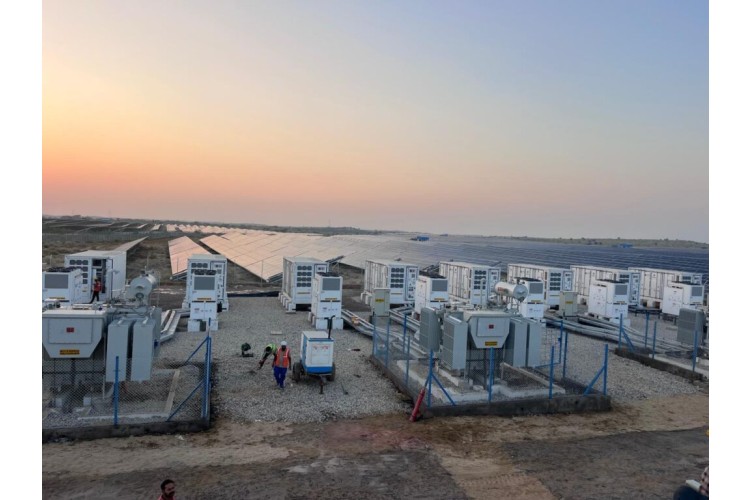
This is already translating into real activity, with developers commissioning merchant battery projects and trading power on exchanges, such as Juniper Green’s 100MWh system. An important next step for the sector is the development of domestic battery manufacturing. India’s Production-Linked Incentive scheme has allocated 40 GWh of manufacturing capacity across two auctions but progress on the ground has been slower than hoped. Most battery projects being deployed in India today are using batteries imported from China, which has most of the global battery manufacturing capacity. Scaling up domestic manufacturing, first in cell-to-pack assembly and eventually in manufacturing cells, will be key to reducing costs, improving security of supply, and supporting long-term growth.
Globally, there is no single model for deploying battery storage. Some markets like the UK support batteries through capacity markets, others like Australia’s NEM rely on highly volatile energy and ancillary service markets, and still others, like India, are building systems based on long-term contracts which provide revenue certainty. What is clear is that batteries can be deployed under different frameworks, provided market design evolves alongside system needs, to provide batteries with the ability to stack various revenue streams together.
For India, this evolution is underway, but further reforms will strengthen the business case for battery storage. Despite high volatility in power exchange prices, the INR 10/kWh price cap in the Day-Ahead Market and Real Time Market limits revenue potential for batteries and constrains the growth of merchant models. Revising this cap would improve project economics and unlock greater private investment.
Batteries are also well suited to provide ancillary services such as frequency control due to their bidirectional and dispatchable nature, and quick response times. While Primary, Secondary, and Tertiary Reserve Ancillary Services exist in India, only the Tertiary Reserve is currently procured through the power exchanges. Expanding procurement across these services would create additional revenue streams and accelerate deployment.
Ultimately, the opportunity for battery storage in India is clear, but the pace of scale-up will depend on how quickly these market constraints are addressed.