


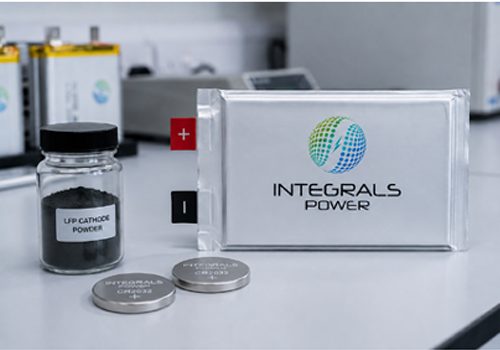
MILTON KEYNES, UK: Integrals Power, the UK-based battery cathode innovators, today announces that its scientists are working alongside the team at the University of St Andrews and are conducting external cell testing of its Lithium Iron Phosphate (LFP) cathode active material. The programme is designed to validate the reliability and electrochemical performance of Integrals Power’s sustainably produced Iron Phosphate precursor in LFP material, demonstrating that a Western-manufactured alternative can match the performance of Chinese-produced equivalents that currently dominate approximately 90% of global production without necessarily resulting in the increase of cost
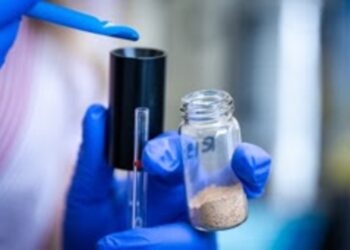
The collaboration represents a direct bridge between academic rigour and industrial manufacturing. The state-of-the-art facilities in the University of St Andrews allows to assemble the early stagebattery cell prototypes using Integrals Power’s low-cost LFP cathode material alongside standard commercial anodes and liquid electrolyte. The cells are being put through 100s of cycles, with testing focused on capacity retention, rate capability, and long-term cycling stability. Results to date show over 153mAh/gr specific capacity, placing Integrals Power’s material on a direct performance par with leading Chinese LFP cathode materials at very cost competitive price.
Integrals Power’s LMFP material is produced at its UK pilot plant in Milton Keynes using raw materials sourced exclusively from European and North American suppliers.
The importance of the St Andrews collaboration extends beyond the test data. As Western governments and automotive OEMs seek to reduce dependency on Chinese battery supply chains, rigorous independent validation of domestically produced materials is a prerequisite for commercial adoption. Early stage cell testing provides the foundational electrochemical dataset that underpins subsequent scale-up to large and multi-layer pouch or prismatic cell formats, and the academic environment at St Andrews ensures the results carry the weight of impartial scientific scrutiny.
For Integrals Power, the programme forms part of a broader strategy to build an evidence base that satisfies both technical and commercial due diligence requirements across the global battery supply chain. The company has invested in a UK-based manufacturing process that provides full supply chain transparency, mitigates geopolitical risk, and supports the country’s net-zero ambitions, including the UK’s 2030 target for phasing out the sale of new combustion engine vehicles.
Founder and CEO of Integrals Power said: “The battery industry has long been told that matching Chinese LFP performance from a Western supply chain is an ambition rather than a reality. This collaboration with the University of St Andrews is about converting that ambition into independently verified evidence within one of the most credible testing environments available. Cell testing is the foundation on which commercial confidence is built. By working with a world-class academic institution and using its advanced facilities to rigorously evaluate our materials, we can provide customers and partners with the impartial, technically robust data they need to make procurement and qualification decisions with confidence.