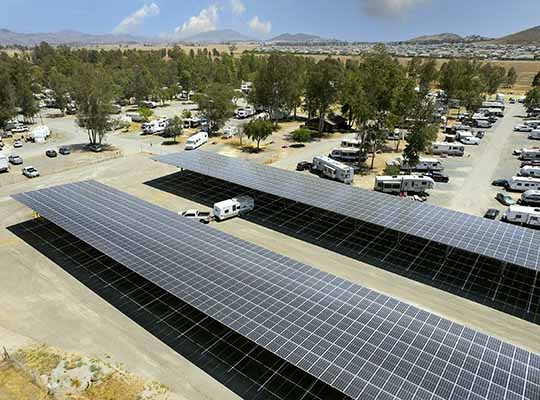




Washington DC – A review by the SUN DAY Campaign of data just released by the Federal Energy Regulatory Commission (FERC) reveals that the combination of solar and wind accounted for more than 98% of new U.S. electrical generating capacity added in January. Solar alone accounted for over two-thirds of the new capacity. Moreover, January was the seventeenth month in a row in which solar was the largest source of new capacity.
Renewables were 98.4% of new generating capacity in January:
In its latest monthly “Energy Infrastructure Update” report (with data through January 31, 2025), FERC says 63 “units” of solar totaling 2,945 megawatts (MW) were placed into service in January along with five units of wind (1,301-MW). Combined they accounted for 98.4% of all new generating capacity added during the month. The balance was provided by natural gas (60-MW) and oil (11-MW).
Solar was more than two-thirds of new capacity added in January:
Solar accounted for 68.2% of all new generating capacity placed into service in January – more than double the solar capacity added a year earlier (1,176-MW).
Contributing to solar’s recent additions were twelve projects – each 74.5-MW – sponsored by Florida Power & Light as well as the 435.0-MW Dunns Bridge Solar Project in Indiana. Other major additions were the 245.8-MW Porter, the 240.6-MW 7V, and 195.4-MW Angelo solar projects – all in Texas as well as the 190.0-MW Atlanta Farms solar project in Ohio.
Solar has now been the largest source of new generating capacity added each month for seventeen consecutive months: September 2023 – January 2025.
Solar plus wind is now almost a quarter of U.S. utility-scale generating capacity; all renewables combined are nearly a third:
New wind accounted for most of the balance (30.1%) of capacity additions. In fact, more new wind capacity was added in January 2025 than was reported as being added during any month in 2024.
Much of the new wind capacity is attributable to the 390.4-MW Cedar Springs Wind IV and 330.0-MW Boswell Wind Farm projects, both in Wyoming, as well as the 300.0-MW Prosperity Wind Farm in Illinois and the 201.0-MW Golden Hills Wind Farm Expansion in Oregon.
The installed capacities of solar (10.5%) and wind (11.8%) are now each more than a tenth of the nation’s total. Taken together, they constitute almost one-fourth (22.3%) of the U.S.’s total available installed utility-scale generating capacity.
Moreover, approximately 30% of U.S. solar capacity is in the form of small-scale (e.g., rooftop) systems that is not reflected in FERC’s data. [1] Including that additional solar capacity would bring the share provided by solar + wind to more than a quarter of the nation’s total.
With the inclusion of hydropower (7.6%), biomass (1.1%) and geothermal (0.3%), renewables currently claim a 31.3% share of total U.S. utility-scale generating capacity. If small-scale solar capacity is included, renewables are now about one-third of total U.S. generating capacity.
Solar will soon be the second largest source of U.S. generating capacity:
FERC reports that net “high probability” additions of solar between February 2025 and January 2028 total 89,033-MW – an amount almost four times the forecast net “high probability” additions for wind (22,312-MW), the second fastest growing resource. FERC also foresees net growth for hydropower (1,319-MW) and geothermal (92-MW) but a decrease of 130-MW in biomass capacity.
Taken together, the net new “high probability” capacity additions by all renewable energy sources would total 112,626-MW with solar comprising over 79% and wind providing another 20%.
On the other hand, there is no new nuclear capacity in FERC’s three-year forecast while coal and oil are projected to contract by 24,940-MW and 2,237-MW respectively. Natural gas capacity would expand by only 455-MW.
If FERC’s current “high probability” additions materialize, by February 1, 2028, solar will account for nearly one-sixth (16.2%) of the nation’s installed utility-scale generating capacity. Wind would provide an additional one-eighth (12.6%) of the total. Thus, each would be greater than coal (12.4%) and substantially more than either nuclear power or hydropower (both 7.3%). [2]
In fact, assuming current growth rates continue, the installed capacity of utility-scale solar is likely to surpass coal and wind within the next two years, placing solar in second place for installed generating capacity – behind only natural gas.
Meanwhile, the mix of all renewables is now adding about two percentage points each year to its share of generating capacity. Thus, by February 1, 2028, renewables would account for 37.4% of total available installed utility-scale generating capacity – rapidly approaching that of natural gas (40.2%) – with solar and wind constituting more than three-quarters of the installed renewable energy capacity.
The combined capacities of all renewables, including small-scale solar, are on track to exceed natural gas within three years:
As noted, FERC’s data do not account for the capacity of small-scale solar systems. If that is factored in, within three years, total U.S. solar capacity (i.e., small-scale plus utility-scale) could surpass 325-GW. In turn, the mix of all renewables would then exceed 40% of total installed capacity while natural gas’ share would drop to about 37%.
Moreover, FERC reports that there may actually be as much as 220,767-MW of net new solar additions in the current three-year pipeline in addition to 68,409-MW of new wind, 9,833-MW of new hydropower, 201-MW of new geothermal, and 39-MW of new biomass. By contrast, net new natural gas capacity potentially in the three-year pipeline totals just 18,363-MW. Thus, renewables’ share could be even greater by early 2028.
“The Biden era closed out with record-setting solar additions and a rebound in new wind capacity,” noted the SUN DAY Campaign’s executive director Ken Bossong. “Whether solar, wind, and other renewables can continue that growth under the policies of the Trump Administration remains to be seen.”