


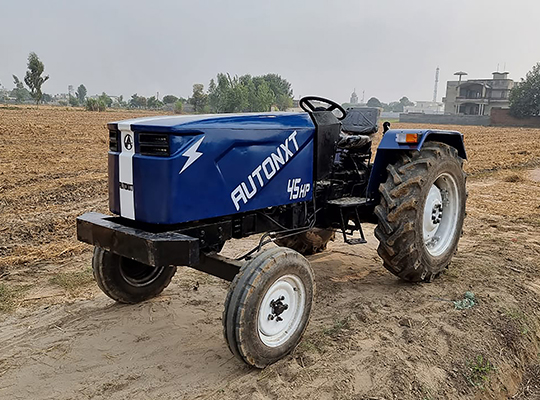
The world is facing an ever-increasing population and a growing demand for food. This demand has put immense pressure on the agriculture industry, which has had to find ways to increase efficiency, reduce costs, and produce more food. One solution that is gaining traction is automation, which has the potential to transform the farming industry. Based on our experience in building Electric Autonomous Tractors, here are a few reasons why we believe automation is the future of the farming industry and the benefits it offers.
Automation has been transforming various industries across the world and the farming industry is no exception. In India, the agriculture sector is the backbone of the economy, employing more than 50% of the country’s workforce. With the introduction of self-driving tractors and other automation technologies, the future of the farming industry in India looks promising.
Self-driving tractors are a form of automation technology that is increasingly gaining popularity in the agriculture industry across the world. These tractors are equipped with various sensors, cameras, and GPS technology that allows them to operate autonomously. They can perform tasks such as ploughing, sowing, and harvesting with precision and accuracy, without the need for human intervention. The introduction of self-driving tractors and other autonomous solutions in India could have a significant impact on the agriculture sector, improving efficiency and productivity.
One of the main benefits of automation is increased efficiency. The tractors can work during the day as well as at night-time, without the need for human supervision. This means that tasks such as ploughing and planting can be completed faster, leading to higher productivity and increased crop yields. Moreover, self-driving tractors can also operate in difficult terrain or weather conditions that may be challenging for human operators.
Another advantage of self-driving tractors and other autonomous solutions is the ability to reduce labour costs. The agriculture sector in India heavily relies on manual labour, which can be expensive and cheaper labour options are not reliable. With the introduction of self-driving tractors, farmers can reduce their reliance on manual labour, making their operations more profitable and sustainable. Moreover, self-driving tractors can also help to address the issue of labour shortages, which are becoming increasingly common in India, especially in rural areas.
Self-driving tractors can also improve the accuracy and precision of farming operations. These tractors are equipped with sensors and GPS technology that allows them to navigate fields and perform tasks with precision. They can apply fertilizers and pesticides more accurately, reducing the amount of chemicals that are needed. This can help to reduce pollution and protect the environment, which is becoming increasingly important in today’s society.
Another benefit of self-driving tractors is their ability to collect and analyse data. These tractors will eventually be equipped with various sensors that can collect data on soil moisture levels, nutrient levels, and other factors that affect crop growth. This data can then be analysed using machine learning algorithms to optimize
irrigation and fertilization schedules, ensuring that crops receive the right amount of water and nutrients. This can lead to higher yields, better quality crops, and reduced environmental impact.
Despite the numerous benefits that self-driving tractors offer, there are also some challenges and concerns associated with their use in India. One challenge is the high cost of implementing this technology. The initial investment in equipment and software can be high, particularly for small-scale farmers or those operating in developing countries.
Another concern is the need for training and education. Self-driving tractors require some skills to operate and maintain. Farmers in India may require training and support to effectively utilize this technology, which could be initially a barrier to adoption. In the same way people perceived computers and mobile phones automation will go through a similar cycle of adoption. The automation will create smarter jobs in the rural area as well along with improving the productivity of the nation.
In conclusion, automation, particularly the use of self-driving tractors, is the future of the farming industry in India. The benefits of self-driving tractors, such as increased efficiency, reduced labour costs, improved accuracy and precision, and the ability to collect and analyse data, make it an attractive solution for farmers looking to improve their operations. Similar to how people perceived Computers, automation in different fields will face similar challenges in adoption initially but eventually people will realize how easy their lives can become after introducing automation. The minor challenges and concerns associated with the adoption of this technology are likely to be overcome as the technology becomes more widespread and accessible.
The agriculture sector in India has the potential to transform with the introduction of automation, leading to increased productivity, sustainability, and profitability. For this to be successful, the entire ecosystem must work together and look at automation as a long-term sustainable solution, this will make sure that the food supply is maintained equally as per the growing demand across the world. The government also will play a major role by making schemes that help the farmers afford some of the latest available automation technologies in the market. Automation will first come in Agriculture and the off-highway sector before it comes on the road as it makes complete all-around sense.
About The Author :

Kaustubh Dhonde
The author is the Founder & CEO of AutoNxt Automation (www.autonxt.in ), India’s First electric tractor venture and an automation technology startup.