

Urja Daily
No Result
View All Result
  • News
  • Renewable
    • Solar
    • Rooftop
    • Floating Solar
    • Module
    • Wind
    • Hydrogen
    • Biomass
    • Tenders
    • Sustainibility
  • Storage
  • E-Mobility
  • Battery
  • Smart City
  • Power
    • Smart Grid
    • Microgrid
    • Off-Grid
  • Editor’s Pick
    • Articles
    • In Talks
    • E-MAG
    • Market Research
  • On-demand Webinars
  • More
    • Events
    • Contact Us
    • Subscribe
  • News
  • Renewable
    • Solar
    • Rooftop
    • Floating Solar
    • Module
    • Wind
    • Hydrogen
    • Biomass
    • Tenders
    • Sustainibility
  • Storage
  • E-Mobility
  • Battery
  • Smart City
  • Power
    • Smart Grid
    • Microgrid
    • Off-Grid
  • Editor’s Pick
    • Articles
    • In Talks
    • E-MAG
    • Market Research
  • On-demand Webinars
  • More
    • Events
    • Contact Us
    • Subscribe
No Result
View All Result
Urja Daily
No Result
View All Result
Home Editor's Pick Articles

Converting CO2 into Butanol Using Phosphorous-Rich Copper Cathodes

Urja Daily by Urja Daily
July 8, 2021
in Articles
Reading Time: 3 mins read
0
Converting CO2 into Butanol Using Phosphorous-Rich Copper Cathodes
Share on FacebookShare on TwitterShare on Linkedin

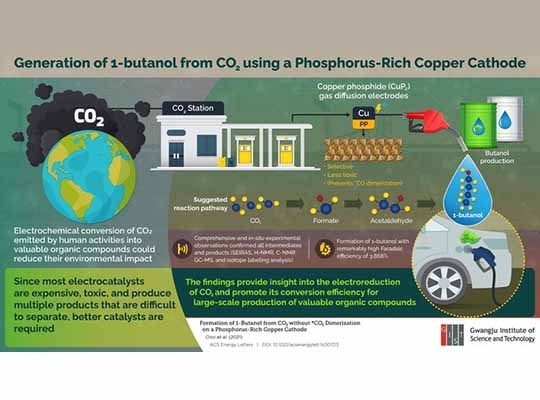
Converting CO2, which is rapidly accumulating in the atmosphere, into other valuable organic products. Now, scientists from the Gwangju Institute of Science and Technology in South Korea have proposed a reaction for the highly selective production of 1-butanol, a valuable alternative fuel, by electrochemical reduction using copper phosphide electrodes. Their findings offer a new insight on the use of Cu-based electrocatalysts for the electroreduction of CO2.

Human activities like the burning of coal and fossil fuels have caused CO2 to accumulate in the atmosphere, which has significantly affected the Earth’s climate. As a result, several scientists are looking for ways to convert CO2 into other valuable organic products, such as 1-butanol, which has shown promise as an alternative fuel for vehicles. This could help reduce our dependence on fossil fuels.

RELATED POSTS

Machine Learning in Renewable Energy Forecasting: Powering a Smarter, Greener Grid

Solar Plus Storage Hybrid Systems: Powering India’s Next Energy Revolution

One method of obtaining useful compounds is by the electrochemical reduction reaction (CO2RR). Researchers have developed metal-based catalysts that can fulfill this task. However, there is a caveat: most of these catalysts are expensive and produce a variety of products during the reaction, which can be difficult to separate.

To solve this problem, a team of researchers led by Prof. Dr. Jaeyoung Lee and comprising Mr. Minjun Choi, Dr. Jin Won Kim, and Prof. Sungyool Bong from the Gwangju Institute of Science and Technology (GIST) in South Korea came up with a procedure that directly generates 1-butanol with the help of copper phosphide (CuP2) without first undergoing CO dimerization. “We are trying to develop a Cu-based electrode for electrochemical conversion of CO2 that avoids *CO dimerization and can help usincrease the selectivity of the product so that additional power consumption from separation processes can be avoided,” explains Mr. Minjun Choi, a Ph.D. student at the university and the paper’s first author. Their research has recently been published in volume 6 (issue 6) of the journal ACS Energy Letters on 11 June 2021 and has been available online since 11 May 2021.

Even though numerous copper-based electrocatalysts exist today, this is among the first instances in which CuP2 has been used to develop an electrocatalyst that is highly product-selective. It induces a C-C coupling reaction and circumvents the formation of CO, which is known to be a critical intermediate for Cu-based systems. The researchers confirmed this by using surface-enhanced infrared absorption spectroscopy to show that their CuP2 electrocatalyst yielded the desired product, 1-butanol, with a remarkably high Faradaic efficiency of >3%.

The team is excited about the implications of their findings. “Our goal is to design new electrodes that are stackable, that can increase production rates, and that can promote conversion efficiency so that we can make our goal of converting and using CO2 as a fuel in reality,” concludes Prof. Lee.

Tags: CO2electrochemicalGISTphosphide electrodes
ShareTweetShare
Urja Daily

Urja Daily

Related Posts

AI and Machine Learning

Machine Learning in Renewable Energy Forecasting: Powering a Smarter, Greener Grid

by Palak
May 22, 2026
0

As the global energy landscape undergoes a rapid transformation, renewable energy sources such as solar and wind are taking center...

Solar Plus Storage Hybrid Systems

Solar Plus Storage Hybrid Systems: Powering India’s Next Energy Revolution

by Palak
May 22, 2026
0

India’s renewable energy ambitions are among the most aggressive in the world. The country has already crossed 100 GW of...

Sharad Gupta

TOPCon vs PERC: The Solar Technology Battle Defining 2026

by Palak
May 22, 2026
0

For nearly a decade, Passivated Emitter and Rear Cell (PERC) technology has served as the foundation of global solar deployment....

The Next Frontier in EV Safety

The Next Frontier in EV Safety: Technical Review of Semiconductors & Electronics Market Innovation in Thermal Management

by Palak
May 22, 2026
0

Electric vehicles are transforming global transportation, but their complex power electronics demand unprecedented thermal management solutions. As EV adoption accelerates...

The Circular Economy Rise Bio-CNG and Compressed Biogas Chemicals & Materials Market Intelligence 2026

The Circular Economy Rise: Bio-CNG and Compressed Biogas Chemicals & Materials Market Intelligence 2026

by Palak
May 22, 2026
0

India's waste mountains are becoming fuel factories. What was once destined for landfills now feeds a network of biogas plant market facilities...

Next Post
Valmet deliver turnkey biopower plant to produce green electricity and heat

Valmet deliver turnkey biopower plant to produce green electricity and heat

Energy Fuel

Energy Fuels and Neo Performance Materials Announce Contract Signing

Leave a Reply Cancel reply

Your email address will not be published. Required fields are marked *

RECOMMENDED

Joint solar

Joint Solar sharpens focus on TOPCon and higher-efficiency solar modules

June 3, 2026
Shri V. Packirisamy

V. Packirisamy Appointed Director (Commercial) at Power Finance Corporation Limited

June 3, 2026

MOST VIEWED

  • Solar

    When the Sun Began Paying the Electricity Bills: The Story of PM Surya Ghar Muft Bijli Yojana

    0 shares
    Share 0 Tweet 0
  • India’s Emerging Polysilicon Manufacturing Ecosystem: Opportunities and Challenges

    0 shares
    Share 0 Tweet 0
  • KP Group & PP Savani University Launches Urjanoor Scholarship

    0 shares
    Share 0 Tweet 0
  • How proper refurbishment can extend life of pre-owned bikes in India?

    0 shares
    Share 0 Tweet 0
  • ACWA Power Signs Landmark $10 Billion Clean Energy Agreements

    0 shares
    Share 0 Tweet 0

Joint Solar sharpens focus on TOPCon and higher-efficiency solar modules

V. Packirisamy Appointed Director (Commercial) at Power Finance Corporation Limited

Sharika Enterprises Limited Enters SCADA-ADMS Market with Uttarakhand Grid Modernization Project

Cargill Launches Two-Year Livestock Development Initiative to Strengthen Maharashtra’s Dairy Sector

Flip Chip Technology Market Witnesses Rising Demand from Consumer Electronics Sector

Servotech Signs ₹400 Crore MoU for Haryana Manufacturing Expansion

Latest Magazine

© 2016 – 2025 TechZone Print Media | All Rights Reserved

  • About Us
  • Contact Us
No Result
View All Result
  • News
  • Renewable
    • Solar
    • Rooftop
    • Floating Solar
    • Module
    • Wind
    • Hydrogen
    • Biomass
    • Tenders
    • Sustainibility
  • Storage
  • E-Mobility
  • Battery
  • Smart City
  • Power
    • Smart Grid
    • Microgrid
    • Off-Grid
  • Editor’s Pick
    • Articles
    • In Talks
    • E-MAG
    • Market Research
  • On-demand Webinars
  • More
    • Events
    • Contact Us
    • Subscribe

© 2016 - 2025 TechZone Print Media | All Rights Reserved