

Urja Daily
No Result
View All Result
  • News
  • Renewable
    • Solar
    • Rooftop
    • Floating Solar
    • Module
    • Wind
    • Hydrogen
    • Biomass
    • Tenders
    • Sustainibility
  • Storage
  • E-Mobility
  • Battery
  • Smart City
  • Power
    • Smart Grid
    • Microgrid
    • Off-Grid
  • Editor’s Pick
    • Articles
    • In Talks
    • E-MAG
    • Market Research
  • On-demand Webinars
  • More
    • Events
    • Contact Us
    • Subscribe
  • News
  • Renewable
    • Solar
    • Rooftop
    • Floating Solar
    • Module
    • Wind
    • Hydrogen
    • Biomass
    • Tenders
    • Sustainibility
  • Storage
  • E-Mobility
  • Battery
  • Smart City
  • Power
    • Smart Grid
    • Microgrid
    • Off-Grid
  • Editor’s Pick
    • Articles
    • In Talks
    • E-MAG
    • Market Research
  • On-demand Webinars
  • More
    • Events
    • Contact Us
    • Subscribe
No Result
View All Result
Urja Daily
No Result
View All Result
Home News

Producing Green Hydrogen Through the Exposure of Nanomaterials

Urja Daily by Urja Daily
January 22, 2021
in News
Reading Time: 3 mins read
0
Producing Green Hydrogen Through the Exposure of Nanomaterials
Share on FacebookShare on TwitterShare on Linkedin

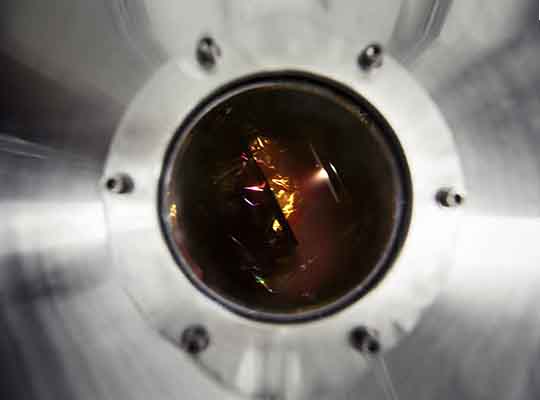
A research team from the Institute National Recherch scientifi(INRS) has joined forces with French researchers from the Institute of Chemistry and Processes for Energy, Environment and Health (ICPEES), a CNRS-University of Strasbourg joint research lab, to pave the way towards the production of green hydrogen. This international team has developed new sunlight-photosensitive nanomaterials electrodes. The results of their research were published in the November 2020 issue of the journal of Solar Energy Materials and Solar Cells.

An Energy Transition Vector

RELATED POSTS

Building a Knowledge Hub for China-ASEAN Energy Cooperation

Water-Based Coating System Delayed Air Supply Unit Replacement 10 Years, Saving Estimated Millions

Hydrogen is being considered by several countries of the Organisation for Economic Co-operation and Development (OECD) as a key player in the transition towards decarbonized industries and sectors. According to the INRS Professor My Ali El Khakani, Quebec could strategically position itself in this energy sector of the future. “Thanks to high-performance nanomaterials, we can improve the efficiency of water dissociation to produce hydrogen. This “clean” fuel is becoming increasingly important for the decarbonisation of the heavy-duty trucking and public transportation. For example, buses using hydrogen as a fuel are already in operation in several European countries and in China. These buses emit water instead of greenhouse gases,” added the physicist and nanomaterials specialist.

Splitting water molecules into oxygen and hydrogen has long been done by electrolysis. However, industrial electrolyzers are very energy-intensive and require large investments. The INRS and ICPEES researchers were rather inspired by a natural mechanism: photosynthesis. Indeed, they have developed specially engineered and structured electrodes that split water molecules under the sun’s light. This is a process known as photocatalysis.

Challenges in the Design and Fabrication of the Nanostructured Electrodes

For maximum use of solar energy, the research teams have selected a very abundant and chemically stable material: titanium dioxide (TiO2). TiO2 is a semiconductor known for being photosensitive to UV-light, which accounts only for 5% of the solar irradiance. Researchers have used their expertise in the field to first change the atomic composition of TiO2 and extend its photosensitivity to visible light. They were able to produce electrodes that can absorb up to 50% of the light emitted by the sun. A significant gain right from the start! 

The researchers have then proceeded with the nanomaterials of the electrode to form a network of TiO2 nanotubes that resembles a beehive-like structure. This method multiplied the effective surface area of the electrode by a factor of 100,000 or more. “Nanostructuring maximizes the ratio between surface and volume of a material. For example, TiO2 nanostructures can offer a surface area of up to 50 m2 per gram. That’s the surface area of a mid-size flat!”, Professor El Khakani enthusiastically pointed out.

The final step of the electrode elaboration is their “nanodecoration”. This process consists of depositing catalyst nanoparticles on the otherwise infinite network of TiO2 nanotubes to increase their efficiency of hydrogen production. To achieve this nanodecoration step, the researchers used the laser ablation deposition technique, a field where Professor El Khakani has developed a unique expertise over the last 25 years. The challenge was not only to control the size, dispersion and anchorage of catalyst nanoparticles on the TiO2 nanotube matrix, but also to find alternatives to the costly iridium and platinum classical catalysts.

This research identified cobalt oxide (CoO), a material that is quite available in Quebec’s underground, as effective co-catalysts for splitting water molecules. A comparison of the two materials showed that CoO nanoparticles enabled a tenfold increase the photocatalytic efficiency of these new nanodecorated electrodes under visible light compared to bare nanotubes.


Tags: ICPEESINRSNanomaterials
ShareTweetShare
Urja Daily

Urja Daily

Related Posts

ASEAN Energy Cooperation

Building a Knowledge Hub for China-ASEAN Energy Cooperation

by Urja Daily
September 22, 2026
0

NANNING, CHINA – During the 23rd China-ASEAN Expo and the China-ASEAN Business and Investment Summit, China Southern Power Grid showcased...

Water coating

Water-Based Coating System Delayed Air Supply Unit Replacement 10 Years, Saving Estimated Millions

by Urja Daily
September 22, 2026
0

 With new industrial air handling units now costing upwards of $100,000, manufacturing plants are looking for ways to delay major...

Comau

Comau Delivers Flexible Cell Formation and Testing System to NIC Ljubljana

by Urja Daily
September 22, 2026
0

Comau has developed a flexible, industrialized cell formation and testing solution for NIC, bridging the gap between academic research and...

Narendra Modi

Prime Minister Narendra Modi Met Delta Electronics’ Leadership to Chart India’s Next Decade of Energy Transition, AI Infrastructure, and Smart Manufacturing Growth

by Urja Daily
September 21, 2026
0

National — Delta Electronics Chairman & CEO Mr. Ping Cheng and Delta Electronics India President Mr. Benjamin Lin met with Prime...

ESSCI

ESSCI, NIELIT ink MoU to boost semiconductor, AI, IoT and drone skilling

by Urja Daily
September 21, 2026
0

New Delhi: In a move aimed at creating a job-ready talent pool for India’s fast-growing electronics and emerging technology sectors, the...

Next Post
GE Power Conversion signs MoU with BLP Industry AI

GE Researchers Tapping Healthcare Experience to Scale Up Offshore Wind Power

Tata Power Solar

Tata Power Solar Received the EPC Order for INR 1200 Cr

Leave a Reply Cancel reply

Your email address will not be published. Required fields are marked *

RECOMMENDED

ASEAN Energy Cooperation

Building a Knowledge Hub for China-ASEAN Energy Cooperation

September 22, 2026
Water coating

Water-Based Coating System Delayed Air Supply Unit Replacement 10 Years, Saving Estimated Millions

September 22, 2026

MOST VIEWED

  • Solar

    When the Sun Began Paying the Electricity Bills: The Story of PM Surya Ghar Muft Bijli Yojana

    0 shares
    Share 0 Tweet 0
  • India’s Emerging Polysilicon Manufacturing Ecosystem: Opportunities and Challenges

    0 shares
    Share 0 Tweet 0
  • KP Group’s Listed Renewable Businesses Post Strong Multi-Year Growth as Portfolio Expands Beyond 9.2 GW

    0 shares
    Share 0 Tweet 0
  • KP Group & PP Savani University Launches Urjanoor Scholarship

    0 shares
    Share 0 Tweet 0
  • StarlinePS Enterprises Invests ₹160 Crore in Celloraa Energy

    0 shares
    Share 0 Tweet 0

Building a Knowledge Hub for China-ASEAN Energy Cooperation

Water-Based Coating System Delayed Air Supply Unit Replacement 10 Years, Saving Estimated Millions

Comau Delivers Flexible Cell Formation and Testing System to NIC Ljubljana

Ceigall India’s Maharashtra Solar Project Reaches 10 MW capacity with Commissioning of Another 5 MW

Prime Minister Narendra Modi Met Delta Electronics’ Leadership to Chart India’s Next Decade of Energy Transition, AI Infrastructure, and Smart Manufacturing Growth

ESSCI, NIELIT ink MoU to boost semiconductor, AI, IoT and drone skilling

Latest Magazine

© 2016 – 2025 TechZone Print Media | All Rights Reserved

  • About Us
  • Contact Us
No Result
View All Result
  • News
  • Renewable
    • Solar
    • Rooftop
    • Floating Solar
    • Module
    • Wind
    • Hydrogen
    • Biomass
    • Tenders
    • Sustainibility
  • Storage
  • E-Mobility
  • Battery
  • Smart City
  • Power
    • Smart Grid
    • Microgrid
    • Off-Grid
  • Editor’s Pick
    • Articles
    • In Talks
    • E-MAG
    • Market Research
  • On-demand Webinars
  • More
    • Events
    • Contact Us
    • Subscribe

© 2016 - 2025 TechZone Print Media | All Rights Reserved