


India stands at the cusp of a transportation revolution, with its E-Mobility Roadmap to 2033 charting a bold path toward sustainable automotive dominance. This visionary blueprint, building on earlier frameworks like FAME and PM E-DRIVE, targets 30% electric vehicle penetration in new sales by 2030, scaling further by 2033 to align with net-zero ambitions by 2070. As of mid-2026, electric vehicle sales have skyrocketed, with two-wheelers leading the charge amid falling battery prices and expanding charging networks. The automotive sector, already a powerhouse contributing 7% to GDP, eyes a Rs. 20 lakh crore EV market by decade’s end, fueled by infrastructure investments and policy momentum. This analysis delves into market dynamics, growth drivers, infrastructure strategies, and hurdles, offering readers actionable insights into India’s electrified future.
Government Vision and Strategic Targets
The government’s multi-pronged approach prioritizes self-reliance, affordability, and scalability. Central to the roadmap is the PM E-DRIVE scheme, injecting Rs. 10,900 crore to deploy 72,000 fast chargers and subsidize one lakh electric buses, 3.7 lakh three-wheelers, and millions of two-wheelers. Unlike subsidy-heavy FAME phases, the new focus shifts to mandates: all new public buses in top cities must be electric by 2030, with freight corridors following suit. Research and development gets a Rs. 2,000 crore boost for indigenous batteries, aiming to cut import dependence from 80% to under 20% through gigafactories in Gujarat and Tamil Nadu.
By 2033, the plan envisions EVs comprising 40-50% of private vehicles, supported by energy independence goals for 2047. States play a pivotal role—Delhi mandates 25% e-rickshaws, while Maharashtra offers land subsidies for charging hubs. Unified digital platforms will enable seamless booking, payments, and real-time station availability, much like UPI revolutionized finance. These measures not only slash oil imports—saving $20 billion annually—but also create five crore jobs in manufacturing, recycling, and services, transforming tier-2 cities into EV hubs.
Explosive Market Growth and Segment Trends
India’s EV market has surged from niche to mainstream. In FY25, registrations hit 1.97 million units, a 63% compound annual growth rate over six years, with two-wheelers at 1.15 million and four-wheelers breaching 100,000. FY26 projections show two-wheelers growing 22%, three-wheelers doubling, and four-wheelers up 18%, propelled by affordable models under Rs. 1 lakh and EMI options from banks. Ola Electric and TVS dominate two-wheelers with 40% share, while Tata Motors leads four-wheelers via Nexon EV.
According Market Intelo, the broader autonomous logistics vehicle market, valued at USD 8.7 billion in 2024, is poised to reach USD 54.2 billion by 2033 at 22.8% CAGR, per industry forecasts. Commercial segments lag but accelerate: electric trucks on Mumbai-Pune highways cut logistics costs 30%, and e-buses in Bengaluru reduce emissions 50%. Last-mile delivery fleets from Flipkart and Amazon are 60% electrified in metros, driven by B2B leasing models. Exports beckon too—India’s low-cost EVs target Africa and Southeast Asia, with $60 billion in auto parts projected by 2033.
| Segment | FY26 Growth | Key Drivers | 2033 Share Projection |
| Electric Two-Wheelers | 22% YoY | Sub-Rs.1L models, financing | 60% of sales |
| Electric Three-Wheelers | 100% YoY | Rickshaw mandates, exports | 80% in urban areas |
| Electric Four-Wheelers | 18% YoY | Mid-size SUVs, battery swaps | 30% private vehicles |
| E-Buses & Trucks | Emerging | Corridor pilots, toll waivers | 50% public fleet |
This table highlights balanced growth, with two-wheelers anchoring volume and heavies driving value.
Infrastructure Expansion: From Gaps to Grid
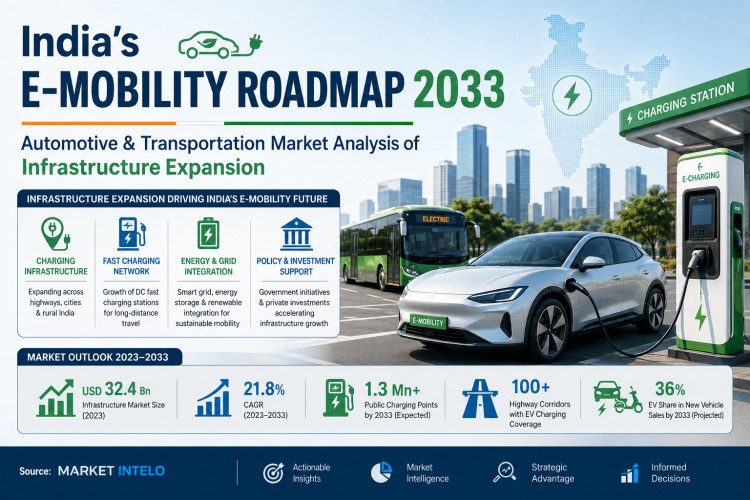
Charging infrastructure has multiplied from 5,000 stations in 2022 to over 26,000 by early 2026, yet ratios stand at one per 235 EVs—far below China’s 1:10. The roadmap counters this with “hotspot hubs” every 25 km on 20 national highways, public-private partnerships funding 1 lakh slow chargers in residential areas, and mega-stations at airports with 10% EV parking mandates. Time-of-day pricing incentivizes off-peak use, while battery-as-a-service models from Gogoro and Sun Mobility eliminate upfront costs.
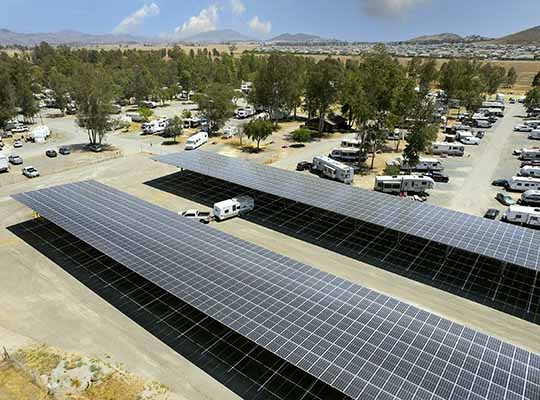
Highways like Delhi-Mumbai will pioneer wireless charging lanes by 2028, tested in Gujarat pilots. Urban focus includes retrofitting malls and colonies, with Tamil Nadu’s guidelines mandating stations in new buildings. Grid upgrades via smart meters and renewable integration—solar canopies over 50% stations—ensure reliability. By 2033, a nationwide network of 10 lakh points, powered 40% by renewables, will erase range anxiety, enabling 500 km inter-city trips.
Key Challenges and Innovative Solutions
Despite momentum, barriers persist. Upfront costs deter small operators, but battery leasing drops effective prices 40%, and Rs. 500 crore blended finance funds de-risk investments. Supply chain woes, especially lithium, spur domestic mining in Jammu & Kashmir and recycling mandates recovering 90% materials. Grid strain in EVs peak hours prompts vehicle-to-grid tech, turning cars into power banks.
Range anxiety fades with 300 km batteries standard, but interoperability standards unify plugs. Skill gaps address via 1,000 training centers, producing technicians. Consumer awareness campaigns, leveraging influencers and apps, boost adoption 25%. Public transport saturation in five pilot cities—Delhi, Mumbai, Bengaluru, Hyderabad, Chennai—will create demonstration effects.
Future Outlook to 2033
By 2033, e-mobility integrates multimodal systems: e-bikes feed into e-buses on Bharatmala corridors, slashing transport CO2 34%. A $145 billion auto industry emerges, with India exporting components to Europe amid global tariffs. Battery passports track lifecycle, enabling circular economy. Urban air quality improves dramatically—Delhi’s AQI drops 20%—while rural electrification via shared e-mobility empowers farmers.
Success demands coordination: NITI Aayog oversees data dashboards, states customize incentives, and startups innovate. For investors, opportunities abound in charging (20% ROI), batteries (gigafactory boom), and software. For consumers, cheaper ownership—EVs cost 70% less to run—ushers green mobility. India’s roadmap isn’t just policy; it’s a blueprint for global leadership, blending ambition with execution to redefine transportation.